
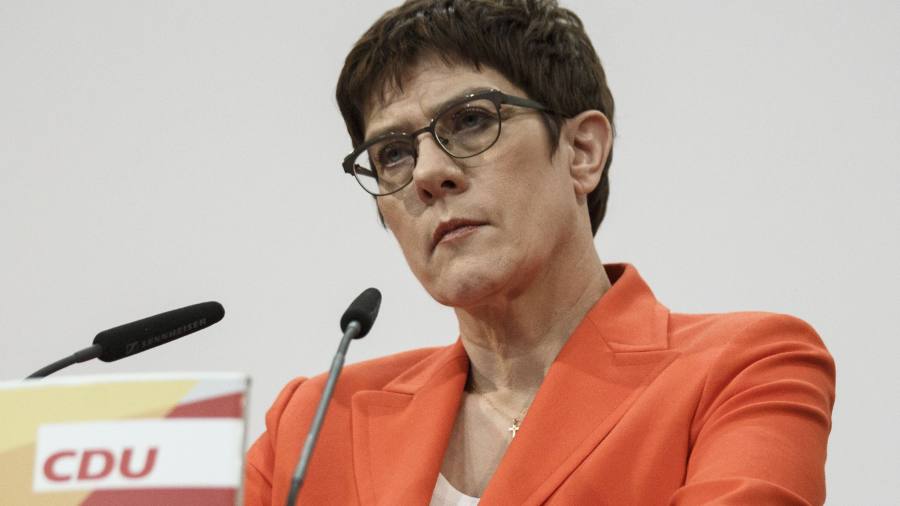

It took a mere 14 months for Annegret Kramp-Karrenbauer to tumble from the top of German politics and lose her chance to replace Angela Merkel as chancellor. But the downfall of Ms Kramp-Karrenbauer is symptomatic of more profound ailments in the German party political system.
The proximate cause of her resignation on Monday as leader of the ruling Christian Democrats was her inability to exert control over local CDU politicians in the small eastern state of Thuringia. They colluded last week with the rightwing nationalist Alternative for Germany party in electing Thuringia’s premier, thereby breaking a taboo on co-operating with the radical right which had held since the formation of the democratic West German state in 1949.
The public backlash against the Thuringian CDU’s action was immediate and intense. Far from representing a genuine breakthrough for the AfD, the unsavoury episode actually demonstrated that a majority of German society — at least, in the west — wants the taboo on collaboration with the extreme right to be applied resolutely and unconditionally.
In this sense, Germany remains a long way from travelling down the road of neighbouring Austria, where the far-right Freedom party was brought into a coalition government at national level after elections in 2017. It shared power for 18 months before its disreputable behaviour forced the party out of office.
There were other factors behind Ms Kramp-Karrenbauer’s fall from grace. She committed public relations and policy blunders that damaged her standing with German voters, stimulated internal dissent in the CDU and made it increasingly doubtful that she would be selected as the party’s candidate for chancellor in the next Bundestag elections, due by September 2021.
Even Ms Merkel’s decision in July to promote Ms Kramp-Karrenbauer to defence minister could not stop the CDU sharks from circling around their new leader. Running the defence ministry is at the best of times a thankless task for German politicians, but the chief gripe of her critics was that she was jeopardising the CDU’s chances of remaining the dominant party after the next elections.
This illustrates that the fundamental cause of the collapse of her authority lies in the reshaping and fragmentation of Germany’s party landscape in the Merkel era. In the 2017 Bundestag elections, the CDU and the Social Democrats, their coalition partners, each scored their lowest national vote since the end of Nazism.
What used to be a three-party system, involving the CDU, SPD and liberal Free Democrats, evolved after the 1980s into a four-party system with the rise of the Greens. Then it became a five-party system with the emergence of Die Linke, a leftist party with roots in former East Germany’s communist dictatorship.
Finally, after the AfD’s birth in 2013 and entry into the Bundestag in 2017, the system has six parties — or seven, if one counts the Christian Social Union, the CDU’s Bavarian sister party, separately. This splintering has made the formation of stable coalition governments an ever more awkward task, one rendered no easier by the four mainstream parties’ refusal to consider governing at national level with either Die Linke or the AfD.
The Thuringia debacle will add to these complications by intensifying suspicions of the Free Democrats, who were as guilty as the CDU, if not more so, in effectively lifting the taboo on the AfD. No less important, the prospect of a CDU-Green partnership will be clouded by the Greens’ doubts about whether the CDU can be trusted to maintain the ironclad isolation of the radical right in regional German politics.
The effect of these ructions is not to undermine the integrity of German democracy, but rather to raise questions about the effectiveness of Germany’s role in Europe and the wider global arena. As the old international order erodes, Germany is being shaken by short-term political convulsions and longer-term structural changes that hold it back just when its leadership is most needed.