


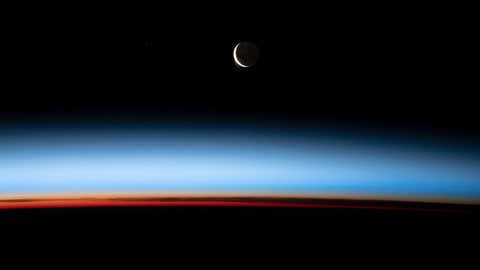
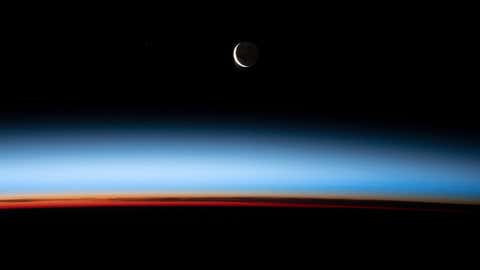
A waxing crescent Moon pictured from the ISS during an orbital sunset as it flew above the Pacific Ocean.
(Astronaut photograph ISS066-E-86969 / NASA)
There are very few things in the universe that can mirror the beauty of our natural satellite, the Moon, as visible to a human eye. The eternally mesmerising charm of the Moon has been captured in many forms throughout human history—from drawings to poems to stories to lenses!
In recent months, a slew of captivating photographs from astronauts and astrophotographers went viral on social media. A select few of such stunning images are listed below and we bet the story behind them will make you feel part of this beautiful journey with our Moon.
Astronauts capture crescent Moon from ISS
The mesmerising crescent may be the Moon’s most fascinating phase. While it’s always a source of wonder to figure out why the crescent Moon appears the way it does, the answer most of us would prefer is that it’s smiling at us.
A photo (at the top of this article) of the crescent moon rising over Earth started trending, and this was no ordinary photo but was taken by an astronaut on the International Space Station (ISS). The photo was taken with a digital camera while the International Space Station sailed over the Pacific Ocean east of New Zealand.
The beautiful photograph illustrates how the last rays of the setting sun penetrate through the atmosphere’s numerous layers. The pictures show a multicoloured orbital sunset that gradually fades from orange near Earth’s surface to turquoise at the edge of space. The Rayleigh scattering principle, named after the 19th-century British physicist Lord Rayleigh, explains these unique colours.
As per the theory, we observe such lights when electromagnetic radiation with shorter wavelengths, such as visible light, is scattered by particles with shorter wavelengths, such as air molecules. According to NASA, the different shades symbolise the first four layers of the atmosphere: troposphere, stratosphere, mesosphere, and thermosphere. The scattered light in each layer of the atmosphere is different because the density of gas particles in each layer varies.
The image was taken on December 6, 2021, by an anonymous member of the Expedition 66 crew that consisted of a group of seven astronauts from NASA, the European Space Agency, the Japan Aerospace Exploration Agency, and Russia’s State Space Corporation, Roscosmos.
After sharing the image with the world, NASA’s Earth Observatory on December 31, 2021, in a statement, said, “This image offers a symbolic finish to the year 2021 and a glimpse toward NASA’s next ambition for human-crewed exploration.”
Full Snow Moon from the ISS
The symbolic use of the Moon to depict love and romance is time immemorial. This year, Valentine’s Day happened to fall very close to the Full Snow Moon, and fortunately, the astronomers onboard the ISS were ready to capture the union. NASA astronaut Mark Vande Hei caught the glorious Moon peeking over the Earth against the dark canvas of the vast space.
Mark Vande Hei is on course to mark the longest spaceflight in human history with 355 days in low-Earth orbit. “Shockingly bright as I opened our shades, the Moon lingered, strutting by,” he said, sharing the snap on Twitter.
“Our astronauts are incredible explorers helping expand our knowledge of how humans can live and work in space for longer periods of time. Mark’s record-setting mission and his contributions to science are paving the way for more people to travel to space on longer-duration missions as the agency pushes the boundaries of exploration to the Moon and Mars. Thank you for your service, Mark, and congratulations,” said NASA Administrator Bill Nelson in a recent media release.
The astronaut witnessed the Full Moon a day after Valentine’s Day when the ISS station was orbiting at an altitude of 420 kilometres above the Pacific Ocean.
Amateur astronomer captures ISS crossing the Moon in great detail
Being an astrophotographer is tough! You need to find isolated places devoid of any light pollution (usually hundreds of kilometres away from the cities), carry large equipment, and wait for the opportune moment when something remarkable happens in the skies and (hopefully) you click the right frame at the right time.
It happened with the French amateur astronomer Thierry Legault who had to ride 250 km from home amid the thick fog to capture an event that lasted 1/2 second as the ISS crossed the Moon at 27000 km/h. And he was successful! The result is a stunning image with such incredible details that one could make out the faint grid pattern on the solar panel arrays of the ISS.
The image, taken on January 18, is claimed to be the most detailed photograph of the ISS passing the Moon.
**
For weather, science, space, and COVID-19 updates on the go, download The Weather Channel App (on Android and iOS store). It’s free!

Follow Canada News Media
Get the day's top Canadian stories and our two daily 60-second news videos wherever you scroll.
X Threads Facebook Instagram LinkedIn TikTok YouTube Pinterest Reddit Substack Flipboard Newsletter RSS