

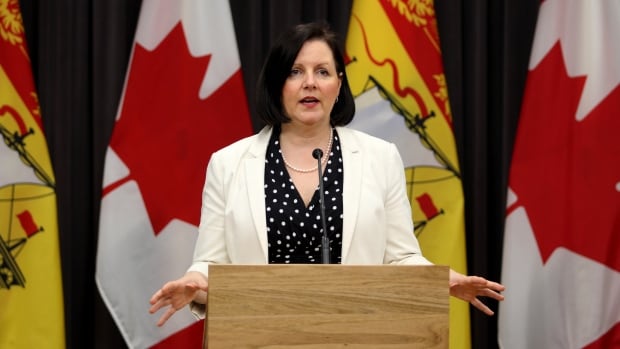

New Brunswick Public Health is reporting one new case of COVID-19 in the Moncton region, bringing the total number of active cases to 25.
The new case is travel-related and involves an individual between 20 and 29.
“After three months, it can be easy to forget to keep doing the simple things like distancing, washing your hands frequently, and covering coughs or sneezes, but these are the most important tools we have in preventing the spread of COVID-19,” said Dr. Jennifer Russell, New Brunswick’s chief medical officer of health.
147 cases of COVID-19 in New Brunswick
There have been 147 cases of COVID-19 in New Brunswick. Since the virus first broke out in March, 121 people have recovered, including one related to the outbreak in the Campbellton region, where there has been a cluster of COVID-19 cases.
There has been one death related to the respiratory virus this past month.
Five patients are hospitalized with one in an intensive care unit.
As of today, 34,814 tests have been conducted, according to public health.
Campbellton residents should only travel for essentials
People in the Campbellton region should only travel to other parts of the province for essential services, New Brunswick’s chief medical officer of health says.
The Campbellton region, also known as Zone 5, has seen a cluster of COVID-19 cases over the past few weeks, after a doctor travelled to Quebec for personal reasons and did not self-isolate after returning home to the area.
“It is not ideal for people travelling for non-essential reasons,” said Dr. Jennifer Russell during an interview with Information Morning Fredericton.
Russell said government isn’t restricting people’s movement within the province.
Instead, they’re relying on an honour system. New Brunswick borders are being patrolled and many travellers receive a follow-up visit or phone call.
“We can’t police everything,” she said.
Over the weekend, Dooly’s in Fredericton announced it was closing after a customer came into the pub who wasn’t self-isolating after visiting Quebec.
“We’re really relying on the good will and the good judgment of the people of New Brunswick.
Farmers call on Ottawa to help with rotting potatoes
New Brunswick farmers want Ottawa to speed up a program that would relieve farmers from some of the impact from the COVID-19 outbreak.
Last month, Ottawa announced a $50-million Surplus Food Purchase Program. But farmers say there hasn’t been any real follow up since and “millions of pounds of potatoes are sitting in storage and starting to rot.”
“We need to finally settle with the province and federal government so that we can dispose of these potatoes now,” said Matt Hemphill, executive director of Potatoes New Brunswick in a news release last week.
“That could mean turning them to cattle feed or creating more freezer capacity to get them processed into french fries or donating to food banks. But the reality is we need help and support to do that, and the government has yet to make any tangible move in the right direction.”
The produce-driven organization also said the closure of restaurants and bars across the country has meant a drastic drop in the number of people ordering plates of french fries. For potato farmers, this resulted in the equivalent of 700 transport truckloads of potatoes in surplus in New Brunswick alone.
Richard Strang, CEO of Strang’s Produce in Malden, almost 20 kilometres northeast of Port-Elgin, said government needs to remember farmers are working with perishable food items.
“The longer they delay, the greater the risk of spoilage and the increased chance we have to deal with potato blight in addition to the surplus.
Strang said this could have a severe impact on farm jobs, processing plants, grocery stores and the restaurant industry.
What to do if you have symptoms
People concerned they might have COVID-19 can take a self-assessment on the government website at gnb.ca.
Public Health says symptoms shown by people with COVID-19 have included: a fever above 38 C, a new cough or worsening chronic cough, sore throat, runny nose, headache, new onset of fatigue, new onset of muscle pain, diarrhea, loss of sense of taste or smell, and difficulty breathing. In children, symptoms have also included purple markings on the fingers and toes.
People with two of those symptoms are asked to: