

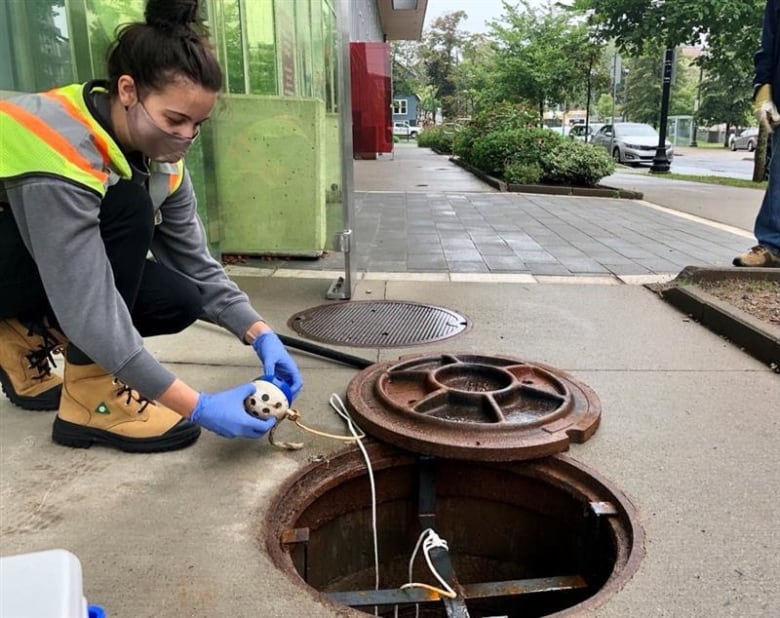
New Brunswick has expanded its COVID-19 wastewater monitoring to four more cities.
Saint John, Bathurst, Campbellton and Miramichi were added to the national COVID-19 wastewater surveillance dashboard on Tuesday, with their most recent test results dating from between March 20 and March 27.
Moncton and Fredericton were previously included.
Wastewater results can serve as an early warning of increased community infection levels and risks.
People who are infected shed the virus in their feces in the form of a genetic material called ribonucleic acid, or RNA, before they show symptoms of COVID-19. This can be found in raw sewage and can detect the virus in a community up to 10 days prior to clinical testing, according to Health Canada.
Now that New Brunswick has further restricted PCR testing, requiring a referral from a health-care provider, some experts have urged an increase in wastewater monitoring to track virus spread and any new variants.
Data for the four newly added cities shows a recent spike in viral load for Miramichi, a slight increase for Campbellton, a levelling off following a jump for Saint John, and slight decrease for Bathurst.
Moncton and Fredericton, meanwhile, both saw recent drops in viral loads, according to the dashboard.
In the works for months
The Department of Health told CBC in January that testing in Saint John and Bathurst was coming “in the near future.”
“It takes time for sites to get set up, as there is new equipment, processes and procedures for project participants to navigate,” department spokesperson Sean Hatchard said Wednesday in an emailed statement.
About three to four weeks of COVID-19 wastewater data are needed for “meaningful trend results,” said Health Canada spokesperson Anna Maddison,
Saint John and Bathurst have now met the data requirement for “trending results” and are included,” she said.
Hatchard did not respond to questions about how or why Campbellton and Miramichi were selected, or what, if any other sites are planned.
Delayed results
The Department of Health did not respond when asked how useful it is to post test results as much as 15 days after the fact, such as the case in Miramichi, if they do show increased levels, and whether that’s too late for people to try to protect themselves from potentially being exposed to people who were infectious all that time.
The Health Canada spokesperson did not answer directly.
“We are constantly working to improve this process to ensure results are available as soon as possible,” said Maddison.
Public Health Agency of Canada’s National Microbiology Laboratory in Winnipeg is “consistently optimizing its workflows to make data more readily available,” she said.
“We are also routinely communicating with our partners to address any delays in sample transport to help ensure samples arrive in our laboratory as soon as possible.”

Asked why some other sampling sites, such as Vancouver and Toronto, have more timely results than most of those in New Brunswick, Maddison said the differences in reporting times can be due to the time it takes to ship and transport samples to the national lab.
“On average, the shipping time for these [New Brunswick] sites is a day or two longer than other sites, which can contribute to the delays in reporting,” she said in an emailed statement.
In addition, if samples arrive on a Friday or during the weekend, it can further delay processing and testing by the national lab, Maddison said.
The lab maintains a consistent three-day turnaround time between sample receipt and results, she said.
“However, due to the complex nature of wastewater samples, sometimes retesting of samples is required to ensure the utmost confidence in the results, which adds more time to the process.”
The Department of Health has previously said New Brunswick wastewater samples are tested at the Dr. Georges-L.-Dumont University Hospital Centre laboratory in Moncton and are also being sent to the national lab in Winnipeg for “validation” and sequencing.
Maddison did not immediately respond to questions about why New Brunswick samples need to be tested by the national lab as well before the results can be posted on the dashboard.
Future of public health surveillance
Public Health Agency of Canada continues to collaborate with other federal departments, provincial, territorial and municipal governments and academics across the country to expand the COVID-19 wastewater surveillance dashboard to provide additional data to citizens, including additional cities, she said.
“With limitations to clinical testing in many provinces and territories, wastewater results have been a key tool for public health officials to monitor the levels of COVID-19 in a community. Wastewater results can also be used by people in Canada to help them make decisions about personal health measures when going out into their community.”
Wastewater monitoring is “one of the key tools for the future of public health surveillance,” according to Maddison.
“Knowing the daily or weekly changes in the amount of infectious disease detected in wastewater can help manage outbreaks (through public health action such as vaccination and testing) as well as health care resource allocation (such as hospital beds and staffing needs),” she said.
The selection of sites for wastewater sampling and the decision to release results on the national dashboard is always at the discretion of provinces, territories, and municipalities, she added.