

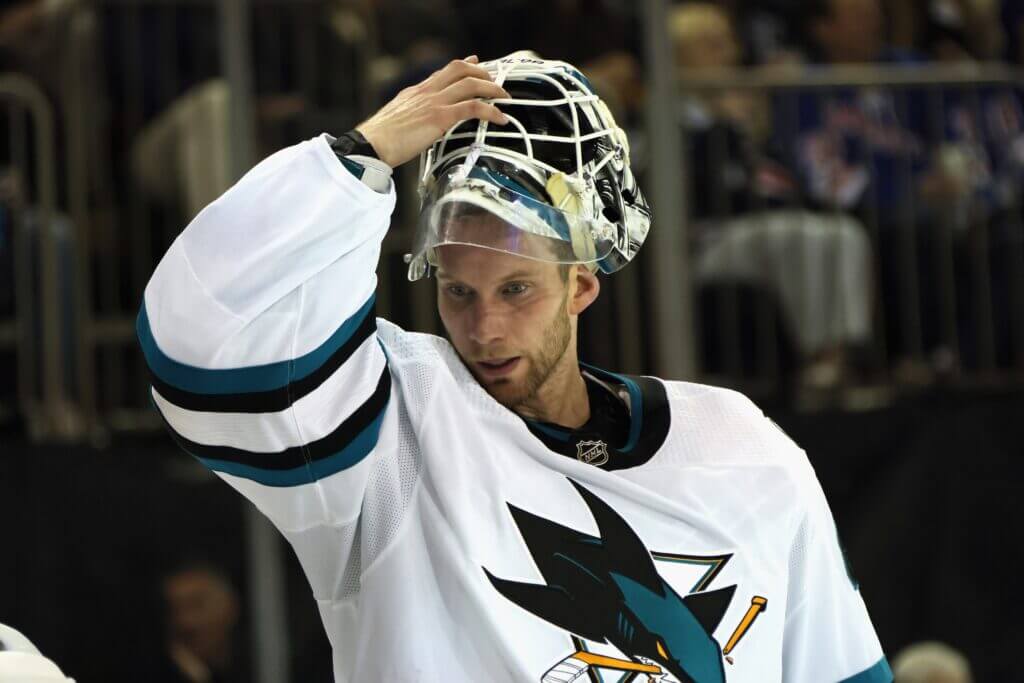

On Saturday night, Canadian broadcaster Tara Slone was on the air in California, covering a breaking story as part of her new job with the San Jose Sharks and NBC Sports. Goaltender James Reimer was refusing to wear a Pride-themed jersey during warm-ups, citing his religious beliefs.
“I think it is an active thing that he is doing by sitting out and not wearing the Pride jersey,” she said during the broadcast. “I think a lot of us are very disappointed. We were hoping that the whole team would show this act of solidarity and inclusion and acceptance.
“What’s hard to watch happen, I think, right now, is this sort of ripple effect.”
Flyers defenseman Ivan Provorov boycotted his team’s scheduled Pride night in January. Days later, the Rangers elected not to wear Pride-themed jerseys as scheduled. Earlier this month, the Wild declined to wear Pride jerseys during a pregame warm-up.
The rest of the Sharks wore the Pride jersey.
“I woke up today just really sad,” Slone said in an interview with The Athletic on Monday. “It’s less about James Reimer himself, and more about what’s happening in the world, which I find so painful.”
Slone relocated to California last fall, months after Sportsnet announced the cancellation of “Rogers Hometown Hockey,” which she had co-hosted with Ron MacLean. Her partner, former defenseman Dan Boyle, had settled in San Jose in retirement.
In November, Slone began working as host/contributor for the Sharks and NBC Sports Bay Area. As reaction continued to roll in from the weekend, she fielded questions from The Athletic.
(This interview has been edited for length and clarity.)
When did you hear about the stance James Reimer was going to take?
I think a lot of us were anticipating there would be a holdout or two. Coach (David) Quinn was asked about it a few days before the Pride game. And with his answer, it just didn’t seem like the whole team would be wearing them. So we were prepared for somebody to hold out.
I got a text from my producer, Sean Maddison, shortly after it was announced. It was Saturday morning.
How did you decide what you would say on the air?
Obviously, for me, it’s a balancing act, right? I work for the team. I also work for the broadcaster that works for the team. I knew I had to be careful. Honestly? My first feeling was I was so heartbroken for the organization itself, because I knew how much work had gone into all of the events leading up to the Pride game itself.
And I know how much work they do internally. That’s one of the things about being employed by the team: I know that this is an organization that puts their money where their mouths are in terms of internal education. It’s not just a one-night thing.
What really sucked is seeing that their efforts were being overshadowed by James Reimer’s decision. I knew that I had the faith of NBC. They brought me in for a reason. They knew exactly what they were getting when they decided they wanted me to be part of the team.
And I think part of it is to address issues like this, to have real conversations about hockey culture. If they were looking for another hockey talking head, I’m not it. I am not an analyst.
.@TaraSlone and @BrodieNBCS discuss James Reimer not wearing a Pride jersey during warm-ups pic.twitter.com/uqxz3wRn2A
— Sharks on NBCS (@NBCSSharks) March 19, 2023
Had you scripted what you were going to say?
I didn’t script anything, no. And I haven’t watched it back, actually, so I don’t really remember what I said. What made it easy for me is that I felt so aligned with what Brian Burke had sent me.
Did you interview him?
He texted it to me. I had spoken to him. He came through with the Penguins. I’d spoken to him after Ivan Provorov refused to wear his Pride jersey. I wanted to get Burkie’s thoughts. I knew that, in this case, he would have something to say. Reimer played under him. Reimer played for him at a time when Brendan Burke was out, and when Brendan died. (Reimer was with the AHL’s Toronto Marlies, and Brian Burke was the Maple Leafs’ GM, when Brendan Burke died in February 2010.)
To me, other than just being disappointing — and disappointing on behalf of the team itself — it is just such a dangerous time for that community. I felt so heartbroken that this was something that was going to be used as a further launch point for all the people who have demonized the LGBTQ+ community.
That was, and remains, the biggest heartbreaker of this whole thing.
What has been the reaction?
Really divided. A lot of people applauding NBC for allowing that to happen. Applauding the Sharks. Applauding me, I guess. But there’s just so much vitriol out there. People standing by Reimer’s freedom of religious expression. And just complete, horrible, weaponization. Using it as a platform to energize all these false narratives.
Honestly? I feel kind of sick to my stomach. It’s really not about what I’ve taken personally. It’s about what I’m seeing out there, and what is an indication of where the greater world sits. We’re a long way from equality and understanding, that’s for sure.
You’ve been on NBC for less than a year …
Yeah. I only got my work visa in December.
Were you concerned about what kind of editorial freedom you might have, given your brief tenure?
It wasn’t a matter of that. Like I said, they knew who I was coming into this. Both the Sharks and NBC really created a situation for me because of who I am, because of what I bring. And my outspokenness is part of what I bring. I’ve said this many times at this point: It’s really refreshing for me to be in a place where I am celebrated and not just tolerated — where my viewpoints are actually encouraged.
At the same time, it is a balancing act, and I have to be careful. I want to make sure that I’m honest, but also fair to the team. I spoke to Scott Emmert, who’s the (vice president) of communications. He knew that we were going to say something. I assured him. I said: “Scott, I’m going to be fair, but we have to talk about this.”
Nobody told me to watch myself. Nobody gave me anything to say or not to say.
How are people reacting around San Jose?
I don’t know. I’ve only been hanging out with my 13-year-old daughter. (Smiles) But certainly, in the hockey world and in the Sharks fan community, it’s the biggest topic of conversation.
What happens next?
I think it has opened some important discourse. I really wonder, though, moving forward, how the fans are going to react to Reimer. But as I’ve seen in hockey — over and over again — stuff, unfortunately, tends to be forgotten pretty quickly. I think what happens next is life goes on. It’s been a hard enough season for the team. It’s almost over. I think everybody would love the chance to just regroup.
How have you adjusted to working in California?
Working as a team is really different. You come across the challenge of finding stories about that one team, for however many broadcasts a year. And just making sure you are representing the organization properly.
The fanbase is different here. I think it is a much more diverse fanbase. A rabid fanbase. They’ve had a lot of years of success. With the team, it’s not the happiest place right now. But I think people have a lot faith.
Do you have a sense of how long you’ll stay in California?
(Laughs) Well, the man I love is here. If I left, that would mean leaving him, and I have no intention of doing that. He’s not leaving. He’s built his dream home. And job-wise, I’m really excited about the future with both the Sharks and with NBC.
I think we’ll re-assess what everything is going to look like in the offseason. But I certainly hope this is just the beginning for me.
(Photo of Reimer: Bruce Bennett / Getty Images)