


“I think that there were political challenges in the Trinidad and Tobago operation, where a new government there was trying to squeeze Nutrien and restrict its access to ports and force it into an unfavourable renegotiation of their agreements,” Mescall said. “I think Nutrien realized that was not in their best interest and so ceased those operations.”
Nutrien, he added, sees this as a good time to sell and use the income to focus on areas where they expect more economic strength in the years ahead.
Smyth said it’s possible that Nutrien is divesting assets to improve shipping efficiency, knowing that the rival Jansen mine will soon be operational. Its decision to build a terminal at the Washington port would also fit with the strategy, he said.
“The biggest problem with Vancouver from the commodities side of things is that it’s unreliable,” he said, adding that some countries are hesitant to buy commodities from Canada because of uncertainties over when those commodities will be delivered.
“That uncertainty is reducing Canada’s competitiveness at an international level,” Smyth added. “If Nutrien is looking at what is happening in commodity exports, why would they want to get in behind that? There’s a lot of economic sense for them to put money into enhancing a U.S. option, and do it with the increased certainty that if they put a deal in place they can pretty much guarantee that shipments are going to arrive within the requirements of the contract.”
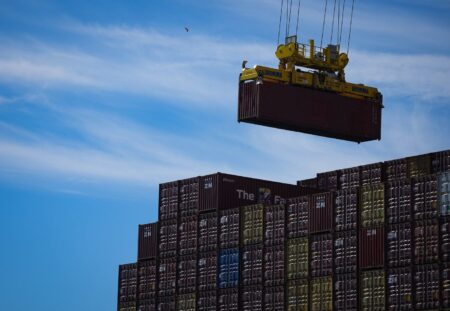
In November, Nutrien confirmed plans to build an export facility in Washington state instead of Vancouver, setting plans in motion to build an estimated $1-billion export terminal in the Port of Longview, a move met with disappointment by Canadian Transport Minister Steven MacKinnon.
Nutrien considered both Canada and the U.S. in its terminal plan but stated that current transportation options in Canada are not addressing the company’s needs, and that rail infrastructure bottlenecks in Metro Vancouver and labour disputes in Canada are disrupting its business. Nutrien said it’s trying to minimize supply chain disruptions and remain competitive in global potash markets.
Smyth said there appears to be a “short window” to address the the Government of Canada’s concerns over the terminal plans. But whether or not the government is trying to iron out the issue with Nutrien is anyone’s guess. “If they are, they’re keeping it awfully close to their chest,” he said. “There’s been nothing in the media.”
The final investment decision on the Longview terminal is not expected until 2027. The port is currently in lease negotiations with Nutrien, a process that should be complete by the end of January, 2026.
A recent note from CIBC stock analysts named Nutrien their “top pick” in the fertilizer and chemicals sector, saying the company “continues to demonstrate favourable capital allocation, including shedding non-core assets.”
Analyst Hamir Patel, author of the note, wrote the company is “well positioned to benefit from favourable potash supply/demand,” as demand grows by two to three per cent annually.
Pam Schwann, president of the Saskatchewan Mining Association, called potash “one of the baseline pillars of the Saskatchewan economy, the main mineral resource mined in Saskatchewan, and critically important to the province.”
While potash is a critical source of government revenue, job creation and economic growth for “many rural communities,” Schwann said, it’s important to remember that the industry is a global one.
“We are operating in global markets,” she said. “Most of our potash is exported, and about half goes to the U.S. and the other half goes to over 40 countries around the world. We are producing for global demand, which means that we have to be globally competitive.”
But Schwann sees obstacles making the Canadian industry less competitive.
“What we absolutely have to fix is our national supply chain,” Schwann said. “We cannot be subject, as a landlocked province, to an unreliable rail state or port state, where basically we cannot get products out to our overseas markets in a reliable and predictable manner.
“We can’t rely on the system as it currently is, and there needs to be some changes so when we produce a product in Saskatchewan we know that it can go overseas to our markets in a reliable, predictable and timely manner.”
Related Products
Follow Canada News Media
Get the day's top Canadian stories and our two daily 60-second news videos wherever you scroll.