


:format(jpeg)/cloudfront-us-east-1.images.arcpublishing.com/tgam/TGZPR666EJPV7PV4X6KTISTZJI.JPG)
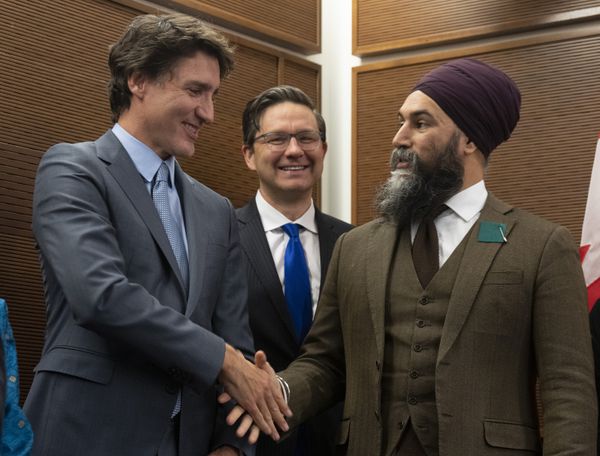
Prime Minister Justin Trudeau shakes hands with New Democratic Party leader Jagmeet Singh as Conservative leader Pierre Poilievre looks on at a Tamil heritage month reception in Ottawa, on Jan. 30.Adrian Wyld/The Canadian Press
Theo Argitis is managing director at Compass Rose Group and former Ottawa bureau chief at Bloomberg News.
The Bank of Canada’s pivot in June to a higher-for-longer interest-rate environment represented a meaningful escalation in its fight against inflation. It signals a readiness to risk a recession for the sake of price stability.
But whether federal politicians are as ready to fully get behind the central bank’s efforts is still to be determined – a potential source of uncertainty to the whole endeavour. While bank officials will scoff at the idea they could be swayed by political discourse or pressure, federal leaders have plenty of scope to handicap them.
A monetary tightening of this scale has a much better chance of success with at the very least implicit support from a broad cross-section of Canadian politics. Inflation control is an exercise in expectations management; workers and businesses need to believe it will work in order for it to work.
Furthermore, most Canadians don’t understand the nuances of central bank independence. The messages Canadians get from political Ottawa on the inflation fight matter, and right now all parties are falling short on that front.
The Liberals have been deferential to Governor Tiff Macklem on monetary policy, but they’ve also left him on his own – choosing not to bring other policy levers to the inflation fight. More spending discipline, for example, would ease pressure on the Bank of Canada to increase interest rates. So would temporarily scaling back large increases in international migration that appear to be short-term inflationary.
But the NDP, which is propping up Prime Minister Justin Trudeau’s minority Liberal government, is questioning the merits of Mr. Macklem’s policies outright, arguing that greedy corporations are the culprits behind inflation and that higher borrowing costs are unnecessary. The Conservatives, meanwhile, have done enough damage to the central bank’s credibility by accusing it of being in bed with the Liberals.
It will not get easier for the central bank. Inflation did fall in May, but only to 3.4 per cent. We’re at the start of what the Bank of Canada is warning could be a very long period of tighter monetary policy. Higher borrowing costs spread through the economy with long lags. The full pain of rate increases has yet to be felt, and Mr. Macklem is probably not even done hiking.
Will federal leaders give the Governor much latitude should a major downturn come? Will he remain resolute in the face of any backlash? It’s not a given.
A long time has passed since the political establishment was last tested with an inflation crisis: It was in the early 1990s, at the onset of the Bank of Canada’s adoption of price stability as its primary objective. Even then, with a much more inflation-fatigued electorate, the sharp rate hikes were not without plenty of controversy.
It’s easy to see how a “this time is different” mindset could develop today, or how some politicians could start toying with the idea of making tradeoffs between interest rates and inflation. Political constituencies could form around the idea of tolerating higher inflation to ease interest payment burdens, particularly among highly indebted young people. Generational political fault lines will deepen as higher interest rates trigger a large distribution of income from debtors to savers, and from young to old.
The Bank of Canada, meanwhile, will continue to struggle with credibility issues. Acting as a force of redistribution is an inherently political and uncomfortable position for any central bank to be in.