



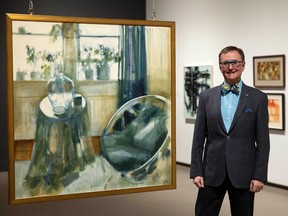
A set of connected exhibitions opening at the MacKenzie Art Gallery are offering a window into a “critical moment” of Saskatchewan art history in the 1950s.
“It’s one of those opportunities we have to look back and observe a lifetime of achievement, from very early days to a painting that was sitting on his easel at the time when he died,” Long said.
Thorn is a nationally renowned abstractionist whose career began in Regina, where he was born, before continuing in B.C. as he forged a path through the evolution of Canadian contemporary art.
“His independence of thought really went against the grain.”
Conceptualizing Thorn’s ties to his home province led Long to thinking about the show that introduced Thorn to Saskatchewan audiences as an emerging artist: an exhibition in 1955 titled Ten Artists of Saskatchewan.
The show debuted just two years after the MAG opened, as the first public art gallery in Saskatchewan, including Thorn and other artists who would go on to similar successful prominence like Dorothy Knowles and members of the Regina Five Ken Lochhead, Arthur McKay and Douglas Morton.
Long has revived this past show, re-collecting works as close to those featured in the original show as possible, to “recreate the feel of that exhibition” in Ten Artists of Saskatchewan: 1955 Revisited.
The collection partners with the exploration on Thorn’s career, tethered by a painting titled “Moses Diptych,” which was included in the original 1955 Ten Artists show.
“Moses” is from a period when Thorn worked under Mexican muralist David Alfaro Siqueiros, before it became part of a travelling art show program in Regina the 1960s. Long had it restored specifically for the exhibition.
“It’s like a time capsule of art in Mexico City in 1955. The image of Moses — he looks like Che Guevara holding the Ten Commandments in one hand, but that hand is a fist that’s punching into the future. It’s an incredible painting.”
The MAG is approaching 70 years since opening doors, and Long said these shows are an “opportune time” to consider how contemporary art in Saskatchewan has evolved.
It’s a decade that “hasn’t received a lot of attention, in terms of our history,” but Long feels offers insight into how these artists existed and grew together, as a group.
“Saskatchewan artists weren’t breaking new ground, at that point, but this was an important foundation for what they would explore in future years,” he said.
“Artists don’t work in isolation; they look at what each other and others are doing in their community, and so you get a sense of the shared effort to become modern, in terms of art in the province.”
In tying together the shows, the hope is audiences will get a sense of the province’s history, through the lens of Thorn, who revelled in the craft and had a penchant for retrospection.
The shows will be accompanied by a free talk on Thorn’s life and career with art historian and curator Ihor Holubizky on Saturday afternoon.