
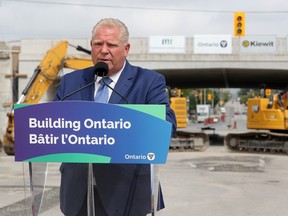
Until Phase 1 and Phase 2 of Ottawa’s massive LRT project are fixed, “we’re gonna forget about Phase 3,” Ontario Premier Doug Ford said Tuesday.
That leaves some very big questions.
In last fall’s municipal election campaign, Mayor Mark Sutcliffe said he would push to secure funding for Phase 3 of the LRT, which would extend rail service to Kanata, Stittsville and Barrhaven.
But earlier this year neither the federal budget nor the provincial budget delivered money for public transit in Ottawa. In March, the OC Transpo budget included $39 million in provincial Safe Restart funding, money the city was counting on to balance the budget.
A permanent fix will take much longer. The problematic axle hub assembly will be re-engineered and replaced, but it will take between a year and 18 months to design and produce a prototype, followed by a lengthy testing process, with two to three years before the redesign can be deployed on the full fleet.
At this point, the axle hub assembly, which contains the bearings, will be replaced as well as the axle shaft that goes inside the assembly. It’s unclear whether the axles will have to be replaced.
Ford did not say what would have to happen before the province committed to more funding for Ottawa’s LRT.
“We just want to see a system that runs efficiently,” he said. “We’re holding off on Phase 3 for now.”
City of Ottawa transit services general manager Renée Amilcar said Tuesday she could not speculate on what Ford had in mind, but the city would make sure Stages 1 and 2 were reliable before moving to Stage 3.
Ford’s comments on Tuesday marked the second time in a week that the premier was critical of the troubled LRT system and had taken a swipe at former mayor Jim Watson, although Ford did not name Watson specifically.

In July 2022, a possible derailment on the Confederation Line was averted after an LRT operator noticed an unusual vibration. An axle hub was on the verge of “catastrophic failure,” the Transportation Safety Board of Canada said in an advisory letter to the city, released in February.
Parts on Ottawa’s trains have been wearing out early and “well below industry standards for cartridge assemblies,” the advisory letter said.
There was also one derailment near Tunney’s Pasture Station in August 2021 and another near Tremblay Station on Sept. 19, 2021. Both incidents involved failures of the cartridge assembly connecting a train’s wheels and axle to the drive train.
The problem was “totally mishandled” by the “previous administration,” said Ford, who said he had more faith in Sutcliffe as mayor. “I’m confident he’s going to make things move a lot quicker than what happened previously.”
“It seems like every second week, there’s a problem,” he said. “It could be design. I’m not a design expert and not an engineer, but you don’t have to be just to see the problems that we’ve had.”
Ford said he was confident Sutcliffe would make things happen. “He’s gonna hold people accountable and get things fixed here.”
The axle bearings on 44 vehicles in the LRT fleet had been inspected, with six needing further investigation. In total, seven hubs were slightly out of tolerance, said Richard Holder, the city’s director of engineering services.
“The tolerance was exceeded by one-thousandth of an inch, so a very small amount,” he said.
Amilcar said she expected the next draft of the safety letter on Wednesday morning and would be able to talk more then about the return to service.
“But what I can tell you for now is that Blair (Station) to Tunney’s Pasture is on the radar,” she said.
She expected that Alstom would produce a “deep dive” into the redesign within a few weeks. “Alstom is the designer. Alstom will tell us what to do.”
Meanwhile, track measurements are being verified in the field prior to resetting the gauge. The restraining rail is being adjusted to an optimized position on several curves to help minimize contact between the wheel of the light rail vehicles and the rails to improve overall vehicle sustainability. That work is expected to be complete by July 30.
The axle hub that shut down the LRT on July 17 is now in France, where it is being analyzed by Alstom. A report is expected by this Friday.
An instrumented test train outfitted with an out-of-tolerance wheel hub was running along the track at regular speeds on Tuesday to determine the “vibration signature” that would help with analyzing the wheel hub problems.
Amilcar has been hesitant to say whether transit users would be reimbursed because of the LRT shutdown.
Ford said Tuesday that decision was not on his turf.