


We got a taste of food insecurity early in the pandemic as grocery-store shelves emptied. The race for the last package of toilet paper or bottle of hand sanitizer got the headlines, but even the availability of household staples like flour and eggs was suddenly in doubt.
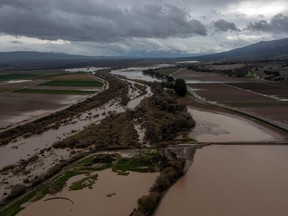
Then, just as that was settling down, the November 2021 atmospheric river swept in. Floodwaters overtook huge swaths of Fraser Valley farmland, and drowned cows, chickens, pigs and even bees by the thousands. Landslides and bridge collapses cut off trucking routes and rail lines — and once again, supermarket shelves emptied out.
Today, in the aftermath of an even more devastating atmospheric river and widespread flooding in California — the source of a lot of B.C. produce, especially in the winter and spring — questions are arising of where the next shortages will show up. Even at that, our situation pales in comparison to developing countries that until now relied on wheat from Ukraine. Russia has not only blockaded exports from that country, but is also launching relentless attacks on the energy infrastructure that helps keep food production running.
That may be disheartening to hear, given the many other dangers and challenges we’re facing, but then those crises have more than a little connection to a safe, reliable, affordable supply of food. Climate disruption means more extreme weather events; rising authoritarianism and nationalism threaten to unleash more wars; our global economy, built on assumptions about stability that today seem hopelessly naïve, can be expected to falter again and again.
All of these conditions erode the security of our food supply.
In turn, an insecure supply of food can undermine the stability of governments and local economies, prompt large-scale migrations and humanitarian crises, and heighten conflicts between countries.
Addressing food security requires a broad range of co-ordinated responses at every level, from individual neighbourhoods to international co-operation. We urgently need to have long-overdue conversations about just what that response must look like.
But not all the answers will have to be planetary in scale — or even provincewide.
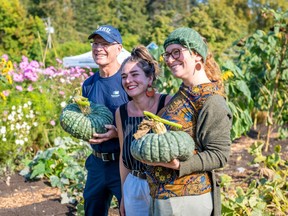
As you read this, the Giving Garden in the Farm at Royal Roads University is nearly ready for the first harvest of 2023. Driven by Dr. Hilary Leighton, program head in our School of Environment and Sustainability, it is both a living laboratory for Royal Roads students and a growing source of fresh produce for the Greater Victoria community, directly addressing food insecurity in the region.
Meanwhile, Dr. Robert Newell, the new Canada Research Chair in Climate Change, Biodiversity and Sustainability, is studying the use of systems mapping to show relationships among local farms, transportation networks, grocery stores, communities and key social and environmental issues. His program also looks at sustainability and novel food production methods, such as vertical agriculture (growing crops indoors using stacked shelves) and cellular agriculture (growing meat directly from cell cultures instead of relying on animals).
That can only happen if leaders at all levels start convening the public conversations needed to shape that vision.
If any good is to come from the food supply shocks of the past three years — and the more severe incidents that are sure to come — it’s that they’ve given us all an appetite for those conversations. It’s time for our leaders to get cooking.