



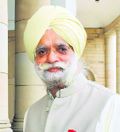

KTS Tulsi
Senior Advocate and Rajya Sabha MP
CRiminal law does not allow the victim to prosecute directly because the victim can hardly be expected to take a balanced view. Therefore, the entire investigation and prosecution is put in the hands of criminal law experts to ferret out the truth, i.e. the unvarnished, unbiased truth. The victim cannot dictate terms to the investigation or prosecution in the way that it has sought to do.
A victim cannot interfere in investigation and during the prosecution, is given a supplementary role in assisting the public prosecutor. Allowing all of these to occur has caused an absolute mockery of the criminal justice system. For example, Rhea Chakraborty is being vilified for abetment to suicide without any evidence of intention or positive act on her part to see Sushant dead. The Supreme Court case of West Bengal vs Orilal Jaiswal (1994) cautioned about careful factual scrutiny in abetment cases before acquittal or conviction.
If unbridled interference is allowed, no investigation would ever come to a conclusion. Allowing such interference at every stage facilitated media access. This caused a reversal of the “innocent until proven guilty” theorem in criminal law. Moreover, despite the absence of an iota of ‘reasonable doubt’, the media continued to concoct its own John Grisham novel. There is no difference between the mob lynching that occurs via ‘extra-judicial killing’ and a media trial. In both these cases, agencies other than the court assume the role of judge, jury and executioner. And eventually, even before the court hears the matter, the conjecture around the case causes competing narratives to engulf the public completely.
In Maharashtra vs Rajendra Jawanmal (1997), the court ruled that “a trial by press, electronic media or public agitation is the very antithesis of the rule of law.” Similarly, in Manu Sharma vs NCT of Delhi (2010), the court said, “The media publishes statements which outrightly hold the suspect or the accused guilty even before such an order has been passed by the court.”
The Contempt of Courts Act, 1971, says that “prejudicing trial and hindering the administration of justice” amounts to “contempt.” In the case of YV Hanumantha Rao vs KR Pattabhiran (1975), it was held that “when litigation is pending before a court, no one shall speak on it in such a way that there is a real and substantial danger of prejudice to the prosecution or, such as impact on the defendant, the witnesses or bias against a party to the case in general. Even if the person who makes the statement honestly believes it is valid, it is still a court contempt.”
Therefore, the actions of the media put them at the risk of having committed contempt. People’s perspectives are being made volatile puppets by being tailored by political-interest-fulfilling media houses that dish out narratives to suit whichever political parties they cater to.
There was a tremendous delay in filing the First Information Report (FIR). Until July 27 this year, there were no allegations made in this case. It was only 40 days after Sushant’s death that his family made allegations to the Bihar police. The delay in the filing of the FIR clearly shows how this was an after-thought. Legally, the Bihar police should have registered a zero FIR and then transferred it to the Mumbai police. But nothing of the sort happened. This caused the registration of an FIR at a place where no cause of action arose and was an abuse of the process of criminal law. Expecting the Bombay police to do their bidding was totally uncalled for.
There is also a privacy violation. Debatable, confidential facts about his mental health have been reported by TV channels. Sushant Singh Rajput has been accorded with several mental health conditions such as depression and bipolar disorder. The question that begs an answer here is whether such public disclosure amounts to a violation of the confidentiality which binds a doctor-patient relationship.
The reasoning employed by the court to allow the Patna police to exercise jurisdiction is problematic. The reasons are: first, Sushant’s father claims that his attempts to talk to his only son who was expected to light his funeral pyre were thwarted by the accused; secondly, under Section 181(4) of the CrPC, because of there being accusations of a criminal breach of trust and misappropriation of money — which had to be eventually accounted for in Patna — the court held that it was legitimate for the Patna police to hold jurisdiction. The question here is: — is the father the sole heir of his son’s monies? Also, if the legal heirs of a deceased are based in different states, does each state gain jurisdiction?
Setting one agency after another by the government was unfortunate. It only managed to divert the attention from the key issue of whether Sushant’s death was suicide or murder. Based on Section 6 of the Delhi Special Police Establishment Act, 1946, the CBI cannot carry out an investigation without the consent of the state concerned. There is one exception to this for constitutional courts which exercise their power under Articles 32 and 226: By handing over investigation within the jurisdiction of the state to the CBI — the court went on to exercise the power of a constitutional court.
The Criminal Procedure Code exists to ease investigation in each case with uniformity. The Sushant suicide case seems to have torn the procedural Code to pieces by failing to follow any semblance of what the Code mandates. Allowing the Bihar police to investigate a suicide that occurred in Mumbai amounts to ignoring the concept of federalism.
The case was formerly hijacked by ‘outsiders’ within the films to masquerade their bravado of having ‘made it’ despite not being products of nepotism. After this, it was about an easy target and a holy trinity of romance, with men shifting seats at the corners. Then, it moved on to Bollywood’s ‘drug problem’. Eventually, Sushant’s corpse became a vote-catcher for the political parties in poll-bound Bihar. Not once, not ever, was this about the actor himself.

Follow Canada News Media
Get the day's top Canadian stories and our two daily 60-second news videos wherever you scroll.
X Threads Facebook Instagram LinkedIn TikTok YouTube Pinterest Reddit Substack Flipboard Newsletter RSS