


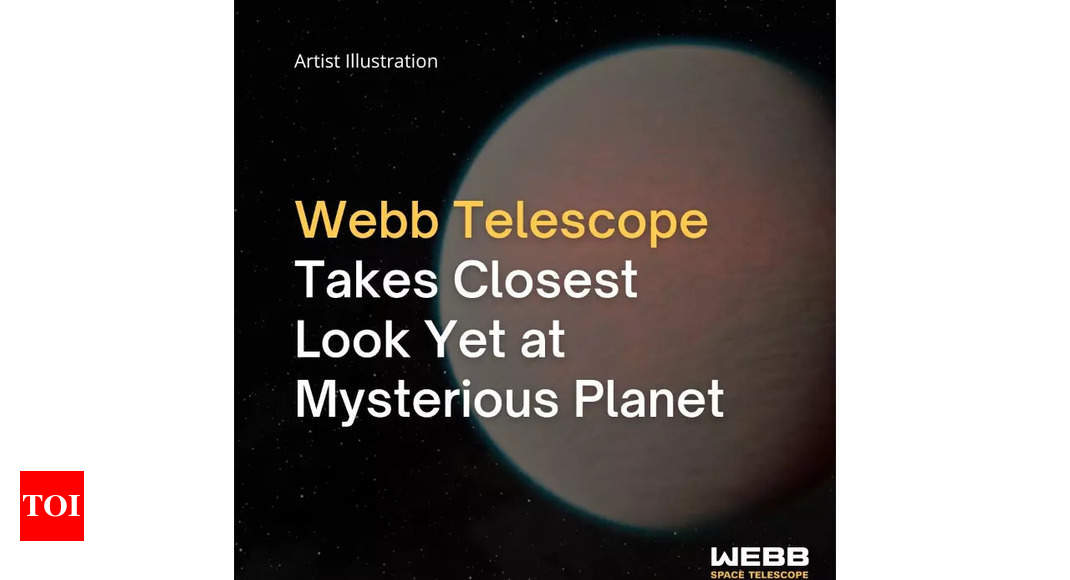
Astronomers using NASA‘s James Webb Space Telescope, the most advanced telescope ever built, have made a groundbreaking discovery: they’ve found an Earth-like planet located millions of light years away that exhibits conditions potentially suitable for supporting life.
This discovery centres around a molecule known as “Dimethyl Sulphide” (DMS), which has been detected by NASA. This molecule is significant because it is typically associated with environments conducive to sustaining life, similar to those found on Earth.
However, it’s crucial to note that this discovery was made using just one of the James Webb Telescopes, and further data is required to validate these findings. Nonetheless, preliminary estimates suggest that this planet is approximately 120 light years distant from Earth.
Experts have identified the presence of methane and carbon dioxide, both of which are greenhouse gases vital for supporting life, in the planet’s atmosphere. This finding also implies the existence of water on this distant planet, which has been designated as “K2-18b.”
Mr Nikku Madhusudhan, a professor from the University of Cambridge, and his research team were astounded by their findings. Professor Madhusudhan explained that Dimethyl Sulphide is typically produced by phytoplankton in marine environments. However, he emphasized that these results are provisional, with more data expected to be available within a year.
Professor Madhusudhan also stressed the responsibility that comes with making such a significant claim, given the controversies surrounding past claims, such as the 2020 assertion of phosphine in Venus’s clouds, which sparked considerable debate among astronomers.
Dr. Robert Massey of the Royal Astronomical Society in London expressed his excitement about these results, emphasizing his optimism about the eventual discovery of signs of extraterrestrial life in the coming decades.
The James Webb Space Telescope (JWST) has the remarkable capability to analyze the light passing through the atmosphere of distant planets. By examining the resulting spectrum of light on paper, scientists can infer the presence of various molecules in the planet’s atmosphere. Absent spectral lines indicate absorption by chemicals, allowing researchers to identify substances such as DMS and other life-supporting compounds.
This discovery underscores the remarkable capabilities of JWST, considering that the target planet is an astonishing 1.1 million kilometres away, resulting in a minimal amount of light reaching the telescope.
The spectral analysis released by JWST also suggests the potential presence of life-supporting gases like methane and carbon dioxide in the planet’s atmosphere. Earlier observations from NASA’s Hubble Telescope had already indicated the existence of water on K2-18b, leading experts to speculate that oceans might be present, which would be a significant advancement.
The conditions necessary to support life on a planet include temperature, the presence of carbon, and liquid water. Current observations suggest that K2-18b meets these criteria. However, the confirmation of DMS would solidify the belief that the planet can sustain life both presently and in the future.
Furthermore, K2-18b is nearly nine times the size of Earth and, though not as rocky, still holds remarkable potential for life.
Dr Subhajit Sarkar, a member of the analysis team from Cardiff University, emphasized that sub-Neptune exoplanets—those with sizes between Earth and Neptune—remain poorly understood, mainly due to their atmospheres and the presumption of their lifelessness. He added that their detailed spectrum analysis of K2-18b’s habitable-zone sub-Neptune atmosphere has provided valuable insights into the molecules present, shedding light on the potential for life beyond our solar system.

Follow Canada News Media
Get the day's top Canadian stories and our two daily 60-second news videos wherever you scroll.
X Threads Facebook Instagram LinkedIn TikTok YouTube Pinterest Reddit Substack Flipboard Newsletter RSS