

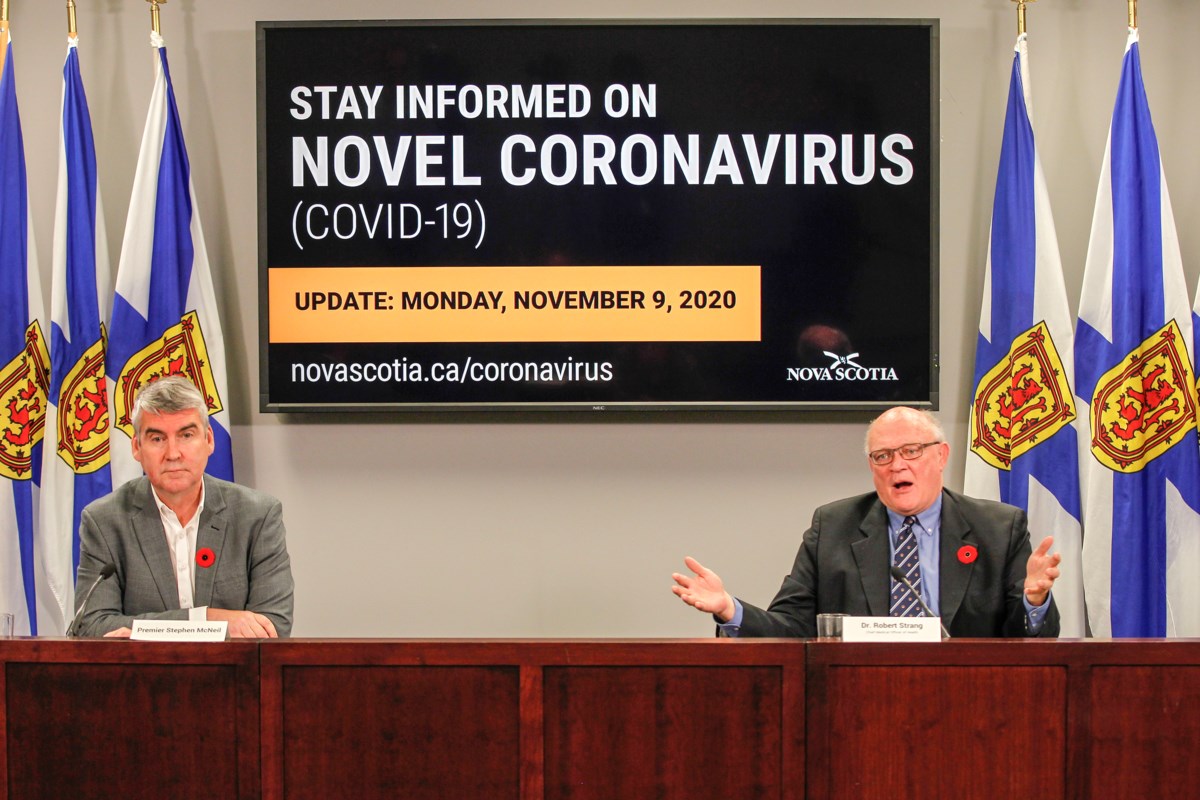
A briefing held this afternoon by the province reinforces the 14-day self-isolation period for all travellers entering Nova Scotia outside of the Atlantic bubble.
Starting today, anyone entering Nova Scotia from outside of the Atlantic bubble is required to self-isolate alone for 14 days upon arrival. If they cannot self-isolate alone, the entire household they’re self-isolating in must quarantine for 14 days.
“As we see the surge in COVID-19 cases in other parts of Canada, we need to take further steps to slow the spread here,” said Premier Stephen McNeil. “I am worried people are becoming complacent. We all have our part to play in keeping each other safe and I remind everyone again to follow public health protocols — wash your hands, wear a mask, practise social distancing and limit social contacts.”
BREAKING: Nova Scotia changing rules for those who are self isolating. Premier McNeil says starting today if you are coming into Nova Scotia from outside of the Atlantic Bubble you must self-isolate for 14 days alone.
— NEWS 95.7 Halifax (@NEWS957) November 9, 2020
During the briefing, Nova Scotia’s chief medical officer Robert Strang clarified the details of self-isolation.
A traveller who self-isolates at a hotel or another location for a few days but then continues to self-isolate with another household forces the members of that household to also self-isolate. Moreover, the amount of days for the self-isolation period resets to 14 days for everyone in that household.
As Nova Scotia reopened over the summer, these restrictions were relaxed as the risk was deemed minimal. Now as other provinces begin seeing more cases, the risk rises.
Regarding self-isolation for rotational workers, the province is looking at an isolation period similar to Newfoundland and Labrador.
In that province, residents who travel within Canada but outside of the Atlantic provinces must self-isolate for either seven days with a negative COVID-19 test or for the full 14-day self-isolation period with no test. Testing can occur any time after the fifth day of self-isolation.
Since the last briefing on Nov. 3, there were 15 new active cases announced.
Nine active cases were in a cluster in the Clayton Park area which Strang said are under “active investigation.” The cluster includes the Rockingham area and extends over to Kearney Lake Road between the Bedford Basin, Highway 102, Bayers Lake and Lakeside.
Strang said they’re not trying to single out or place blame on anyone or any community since there have been potential exposures all over the Halifax Regional Municipality.
Moreover, anyone at the three new clusters of COVID-19 cases must call 811 and get tested for the virus.
The three new clusters include:
Strang said he’s not yet comfortable saying the recent cases are from community spread, but that it’s not being ruled out. He said they have some work to do before making a firm conclusion.
“We need people to help us out if we’re going to get in front of this cluster and stop it in our tracks and minimize the change to spread further,” he said. “It is a wake-up call for all of us.”
Strang also realizes there was some miscommunication between 811 and people who were at these cluster locations. He clarified that those people must call 811 back and make arrangements to get tested.
“When it comes to COVID, things can change very quickly,” he said. “We are at a tipping point in Nova Scotia.
“We all need to make changes if we’re going to make changes to our trajectories.”
In terms of testing, Strang said the province is trying to make it faster and easier.
The Halifax Infirmary testing site will now be dedicated to people who have been at locations where potential COVID-19 exposures have occurred. Other people who want to get tested will be directed to other testing sites.
Strang also said people without health insurance will now be able to get tested at no cost.
“We’re making sure that cost is not an issue and people come forward for testing,” he said.
While these are the only changes made to public health regulations today, Strang said he’s working with the public health team to see if more changes must be made.
He reinforces that people must wash their hands frequently, practice good cough and sneeze etiquette and properly wear masks. He said wearing a face shield does not replace the need to wear a mask.
While Strang said his team doesn’t plan on locking down the province, they plan to take a much more “targeted approach” based on geography.
Despite not being an official order, Strang suggested that Nova Scotians now start reducing the number of social activities they partake in.
For the upcoming holiday season, Strang said this season will have to look differently.
“We are in the middle of a pandemic,” he said. “Non-essential travel in and out of Atlantic Canada needs to stop. Now is not the time for casual visiting.
“We need to think about, ‘What did we do in wave one that stopped the wave and kept us safe?’”