


Sunsets on the moon, the human spirit, and more
If you could ask an astronaut any question about space, what would your question be?
Back in October 2023, kids had the opportunity to do just that during a screening of a documentary called Space Explorers: Moonrise on the ISS at Hot Docs in Toronto.
CBC Kids News contributor Ainara Alleyne sat down with Canadian astronaut Jeremy Hansen, who will be travelling to orbit the moon in September 2025.
She asked some questions of her own and some from the audience.
So while we eagerly await for the first Canadian in history to orbit the moon, let’s find out what he has to say about space travel, human resilience and more.
This interview has been edited for length and clarity.
Q: What’s the most important quality in an astronaut?
The most important thing is teamwork, by far.
When we’re looking for astronauts, we go to great depths to look into the soul of the human and make sure this isn’t someone who just cares about themselves. Yes, they have all the skills we need and work hard, but they care about other people.
The astronaut core spends about a day a month focusing just on improving on our abilities to take care of one another, communicate with one another and make sure that we’re going to be a high-performing team once we get to space.
Q: What training do astronauts do?
Once you’re selected to be an astronaut, you go through two years of training to learn the basics.
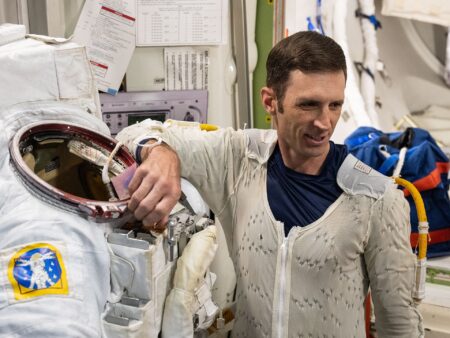
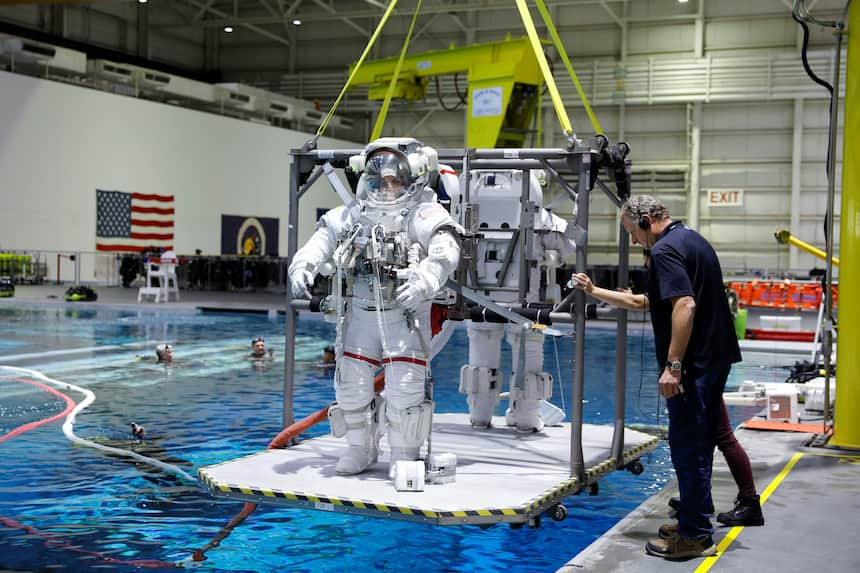
We learn how to do spacewalks. We practise them in a space suit in a big pool in Houston (Texas) called the NASA Neutral Buoyancy Laboratory.
We learn, sort of like playing video games, how to control Canadarm2 on the ISS.
Finally, we learn how to operate a spacecraft, how the space station works and we do a type of training where we go out and do a backpacking expedition just to practise our teamwork skills as a group.

NASA astronauts Sunita Williams and Josh Cassada are seen lowered into the water at NASA’s Neutral Buoyancy Laboratory (NBL) training facility in Houston, Texas, as part of their training in 2019. (Image credit: Mike Blake/Reuters)
Q: What is the coolest thing about space?
The thing I am most proud of with the space program is demonstrating to humanity that we can do amazing things when we work together. This is so important for our future on this planet.
We’re now eclipsing eight billion people on this planet and the challenges we have ahead are significant. But space is showing us that if we really set big goals, we can do some crazy stuff as humans and we can solve these problems.

Hansen, left, and Jenni Gibbons, centre, take part in a demonstration of how astronauts will receive medical care during long-duration space missions and how that can be applied in remote regions here on Earth at the Canadian Space Agency in Longueuil, Quebec, on Feb. 5. (Image credit: Sidhartha Banerjee/The Canadian Press)
Q: What are you most excited about with the moon mission?
I’m most excited about the view, by far. I’m going to see the Earth get small through the window, I’m going to see the moon get big through the window. At some point, I’m going to see an Earth rise from the other side of the moon, just like a sunrise, and that will be extraordinary.
Q: What do you think it will be like when you come back to Earth after the moon mission?
Everyone is different. A lot of people feel nauseous. If you watch them walk around, they’re very deliberate because they don’t have their balance back yet and will always have somebody holding their arms. Their vestibular system, which helps them balance their body, has learned that there is no gravity for six months, and now it has to relearn gravity. It takes a while for your brain to remap that stuff.

Hansen, left, gives a high five to American astronaut Reid Wiseman while Victor Glover and Christina Hammock Koch applaud. They were celebrated on stage in April 2023 in Houston, Texas, as they were announced as the Artemis II crew during a NASA ceremony naming the four astronauts who will fly around the moon. (Image credit: Michael Wyke/The Associated Press)
Also, what doesn’t get used in orbit is all the little muscles that help you balance your body, and all of those have to be built back up.
Q: Do you feel that our generation can build a good future?
I do. I’ve seen some extraordinary things from humans. Your future is in your hands. Every human’s journey includes adversity. Each and every one of you will face challenge and failure, and it’s what you do with those challenges…. With a team, you can create a solution for every problem out there.
Have more questions? Want to tell us how we’re doing? Use the “send us feedback” link below. ⬇️⬇️⬇️