
Jobs market key to severity of downturn to come, says economist

Canadians won’t have to wait much longer to find out if the slowing economy sticks a soft landing or suffers a hard one.
That’s because the labour market over the next six months will show whether employers are responding by merely implementing hiring freezes or going into full-blown layoff mode, said Charles St-Arnaud, chief economist at Alberta Central.
The labour market is in good shape right now, but, as a lagging economic indicator, “labour statistics are usually strongest on the eve of a recession,” the former member of the Bank of Canada’s economics team said.
Economists such as Benjamin Tal at CIBC World Markets say Canada is in a downturn as measured by gross domestic product per capita. Others believe the economy is likely already in a technical recession, which is two quarters of negative growth.
After increasing interest rates to a two-decade high of five per cent, the Bank of Canada in its Oct. 25 decision said its policy decisions are cooling inflation and economic activity. As higher rates work their way through the economy, a process that usually takes six to seven quarters, their effects are expected to finally hit the labour market.
“The next six months may be the window to observe a more meaningful deterioration in the labour market,” St-Arnaud said, and should establish whether Canadians find themselves in the midst of a hiring freeze or broad-based layoffs, which will make a huge difference to indebted households and to the economy.
For example, people are allocating 15 per cent of their disposable income to service their debts. The ratio of household debt to disposable income is roughly 180 per cent and insolvencies have rebounded to pre-pandemic levels.
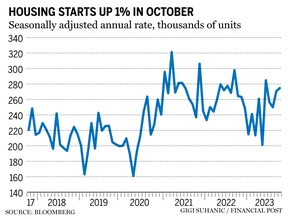
Canada Mortgage and Housing Corp. says the annual pace of housing starts for October ticked up from September.
The national housing agency says the seasonally adjusted annual rate of housing starts in October came in at 274,681, up one per cent from 270,669 in September.
The increase came as the pace of urban housing starts rose two per cent to 257,357 units, with multi-unit urban starts up one per cent at 209,887 and single-detached urban starts up nine per cent at 47,470.