


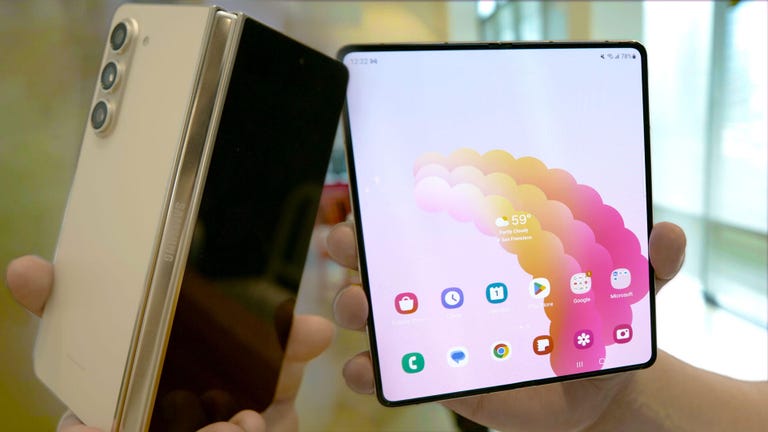
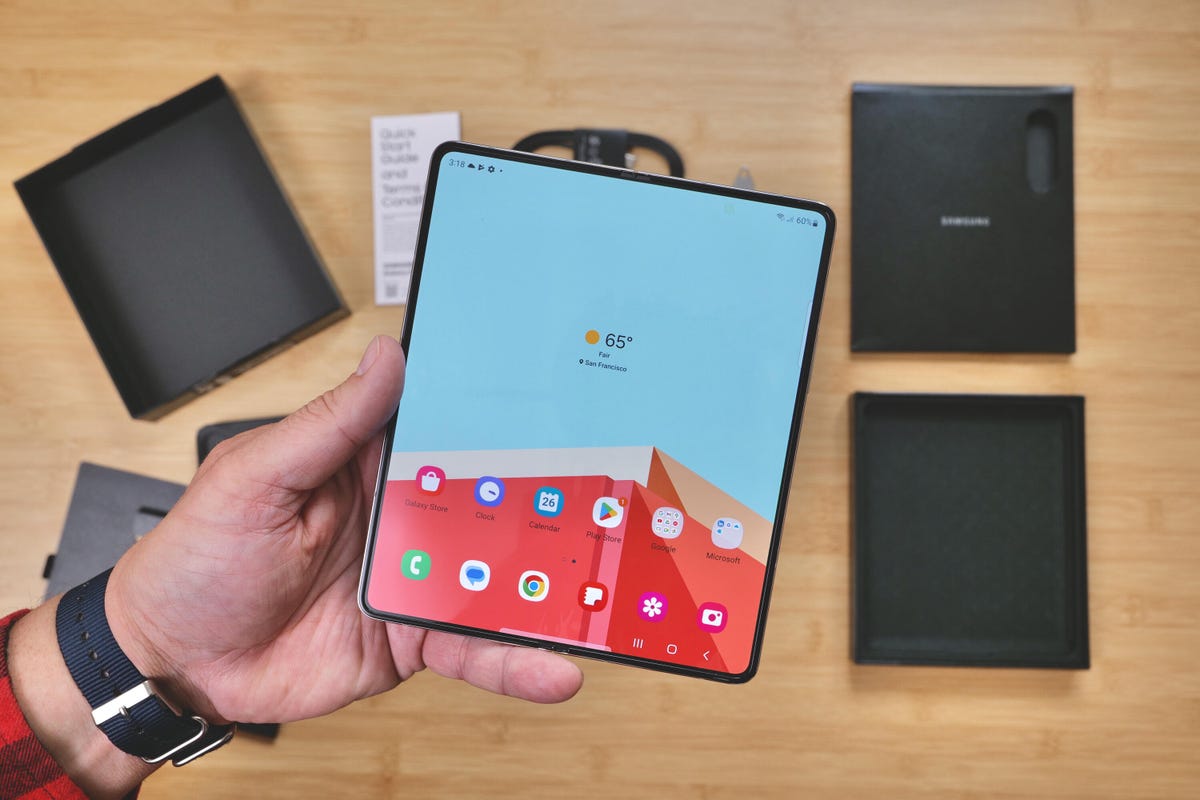
I used the Samsung Galaxy Z Fold 5 for a week as a replacement for my phone and my work laptop. Though apps like Slack aren’t exactly optimized for the new $1,800 foldable, the phone proved more than capable of handling the majority of my daily tasks. But it did have its quirks.
For example, Zoom calls over the main screen’s under-display camera were awkward, and not because of the poor image quality. Truth is, most people on the call had no idea I was on the Galaxy Z Fold 5 aside from the strange camera angle, which looked up my nose (unless I put the phone on a pile of cookbooks).
Last year’s Galaxy Z Fold 4 had the same issue when I reviewed it. I share all this because it’s easy to dismiss the Z Fold 5 as a minor upgrade. Yes, it’s definitely an incremental improvement, but it’s a tweak to an already solid and well-established foldable: the Z Fold 4. And when the Z Fold 4 came out last year, it proved how far ahead Samsung was in terms of phones that fold open into a tablet.
The problem is that the Z Fold 5 keeps not only the Z Fold 4 features I enjoyed, but also most of its shortcomings, like that poorly placed low resolution under-display camera. When the Z Fold 5 has its screen bent at a 90 degree angle, the hidden camera sits off to the left side of the screen, which is really only good for checking out my nose hair situation (luckily that’s pretty tidy).
Read more: Samsung Galaxy Unpacked Event: Everything Announced
The other problem is that over the past year, competitors like Google launched their own versions of the Fold, or teased them, like OnePlus has. In my tests, Google’s Pixel Fold had better cameras than the Z Fold 4, though it didn’t beat Samsung’s device overall as “this is as good as it gets right now” for foldables. And that’s where the new Galaxy Z Fold 5 comes in.
It doesn’t bring sweeping design changes but instead tries to improve on the Z Fold 4 in three areas: durability, battery life and cameras. And the Galaxy Z Fold 5 gets two out of those three right… mostly.

Watch this: Review: Our Samsung Galaxy Z Fold 5 Video Review
08:09


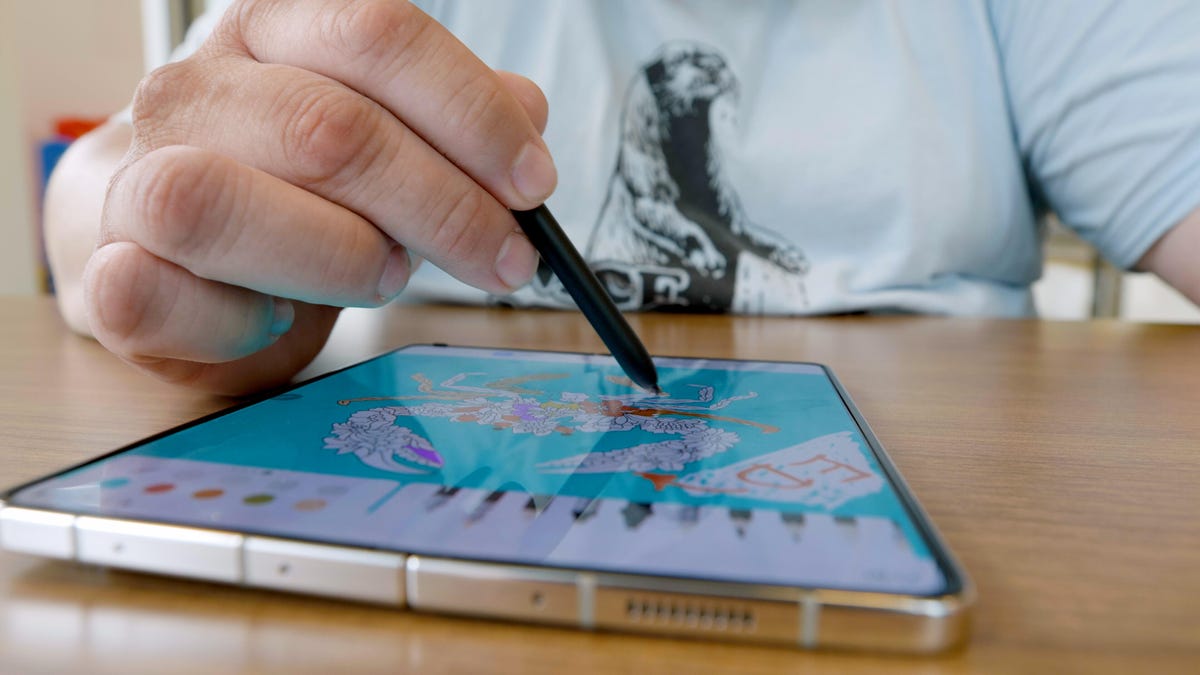
An animation showing the inner workings of Samsung’s new Flex hinge on the Z Fold 5.
In my time with the Z Fold 5, it’s much less awkward to hold when it’s folded closed and more enjoyable to use as a “phone.” It still has the same tall thin Sony Xperia 1 V phone aspect ratio that will still be hit or miss for some.
Samsung said the new hinge has fewer mechanical parts and is more durable than previous Z Folds. It’s hard for me to tell if that’s true from just holding it. Though, the Z Fold 5 has an air of being more solid, but that might be because it closes flat now.
The Z Fold 5 is 10 grams lighter than the Z Fold 4, according to Samsung’s specs, and about 12 grams lighter, according to my coffee scale. And that’s definitely something I noticed every time I picked it up.
When I used the Z Fold 5 for work I was amazed by how much I could do. Granted it’s largely the same software experience as the Z Fold 4, but there are some welcome refinements, like the better drag and drop functionality between apps. I also had a much easier time than I did with the Z Fold 4 when it came to pairing Bluetooth headphones and a keyboard and having them reconnect instantly.
Galaxy Z Fold 5 processor and battery
We’ve seen the Snapdragon 8 Gen 2 in a lot of phones this year and it’s excellent in terms of performance and efficiency. The Z Fold 5 and Z Flip 5 have the Snapdragon 8 Gen 2 for Galaxy, a customized version of the chip that debuted in the Galaxy S23 series. Its CPU and GPU get slightly higher speeds than the regular chip, but it’s the efficiency gains that are welcome here.
In use the Z Fold 5 was peppy, and it easily handled having three apps open and active at the same time, even when I made the ultimate time waster and had TikTok, Instagram and X (formerly known as Twitter) open side-by-side on the screen.
In benchmark tests, the Z Fold 5 easily bested the Pixel Fold, the Z Fold 4 and even the Galaxy S23 Ultra in Geekbench 6.
Benchmark testing results
PhoneBattery loss over 45 minutesGoogle Pixel Fold5%Samsung Galaxy S23 Ultra6%Samsung Galaxy Z Fold 512%Samsung Galaxy Z Fold 418%
Lower percentages are better.
For the next test, I charged the Z Fold 5 up to 100% and streamed a video over Wi-Fi on the phone’s interior screen, checking in hourly to see how much charge it lost. The Z Fold 5 did better than the Z Fold 4, the Pixel Fold and even the Galaxy S23 Ultra. See the results below.
Streaming video test with full battery











Samsung Galaxy Z Fold 5Samsung Galaxy Z Fold 4 5GSamsung Galaxy Z Fold 3 5GGoogle Pixel FoldDisplay size, tech, resolution, refresh rate, brightnessCover: 6.2-inch AMOLED (2,316 x 904 pixels), 1-120Hz; internal: 7.6-inch AMOLED (2,176 x 1,812 pixels), 1-120HzCover: 6.2-inch (2,316 x 904; internal: 7.6-inch AMOLED (2,176 x 1,812 pixels)Cover: 6.2-inch AMOLED (2,268 x 832 pixels); internal: 7.6-inch AMOLED (2,208 x 1,768 pixels)Cover: 5.8-inch (2,092 x 1,080 pixels) 60-120 Hz; internal: 7.6-inch OLED (2,208 x 1,840 pixels)Pixel densityCover: 402 ppi, internal: 374 ppiCover: 402 ppi, internal: 374 ppiCover: 387 ppi, internal: 374 ppiCover: 408 ppi, internal: 380 ppiDimensions (inches)Open: 6.1 x 5.11 x 0.24 in; closed: 6.1 x 2.64 x 0.53 inOpen: 6.11 x 5.12 x 0.25 in; closed: 6.11 x 2.64 x 0.62 inOpen: 5.04 x 6.22 x 0.25 mm; closed: 2.64 x 6.22 x 0.63 in; hinge ~0.57in (sagging)Open: 5.5 x 6.2 x 0.2 in; closed: 5.5 x 3.1 x 0.5 inDimensions (millimeters)Open: 154.94 x 129.79 x 6.1 mm; closed: 154.94 x 67.06 x 13.46 mmOpen: 155.1 x 130.1 x 6.3 mm; closed: 155.1 x 67.1 x 15.8 mmOpen:128 x 158 x 6.4 mm; closed: 67 x 158 x 16 mm; hinge: ~14.4mm (sagging)Closed: 139.7 x 79.5 x 12.1 mm; closed: 139.7 x 158.7 x 5.8 mmWeight (grams, ounces)253 g (8.92 oz)263 g (9.27 oz)271 g (9.56 oz)283 g (9.98 oz)Mobile softwareAndroid 13Android 12LAndroid 11Android 13Camera50-megapixel (main), 12-megapixel (ultrawide), 10-megapixel (telephoto)50-megapixel (main), 12-megapixel (ultrawide), 10-megapixel (telephoto)12-megapixel (ultrawide), 12-megapixel (wide), 12-megapixel (telephoto)48-megapixel (main), 10.8-megapixel (ultrawide), 10.8-megapixel (telephoto)Front-facing camera4-megapixel (under display); 10-megapixel (cover screen)4-megapixel (under display); 10-megapixel (cover screen)4-megapixel (under display); 10-megapixel (front cover)8-megapixel (inner screen); 9.5-megapixel (cover screen)Video captureTBD4K4K4KProcessorSnapdragon 8 Gen 2Snapdragon 8 Gen Plus 1Snapdragon 888Tensor G2RAM/storage12GB + 256GB/512GB/1TB12GB + 256GB/512GB/1TB12GB + 256GB/512GB12GB + 256GB, 12GB + 512GB (US, UK, Germany)Expandable storageNoneNoneNoneNoneBattery4,400 mAh (dual-battery)4,400mAh4,400 mAh4,821 mAhFingerprint sensorSideSideSideSideConnectorUSB-CUSB-CUSB-CUSB-CHeadphone jackNoneNoneNoneNoneSpecial features5G-enabled, IPX8 water resistance, S Pen support, 25W wired charging, wireless charging, wireless power share, triple SIM5G, 30x space zoom camera, IPX8, 25-watt fast-charging (no in-box charger)5G-enabled; Foldable display, 120Hz refresh rate (front cover and main display), water resistance, S Pen support5G (mmw/Sub6), IPX8 rating, 5x optical zoom, dual SIM, estimated 24-33 hours battery lifeUS price off-contract$1,800$1,800$1,800 (256GB); $1,900 (512GB)$1,799UK price£1,749£1,549£1,599 (256GB); £1,699 (512GB)£1,749Australia priceAU$2,559AU$2,499AU$2,499 (256GB); AU$2,649 (512GB)Converts to AU$3,340
How we test phones
Every phone tested by CNET’s reviews team was actually used in the real world. We test a phone’s features, play games and take photos. We examine the display to see if it’s bright, sharp and vibrant. We analyze the design and build to see how it is to hold and whether it has an IP-rating for water resistance. We push the processor’s performance to the extremes using both standardized benchmark tools like GeekBench and 3DMark, along with our own anecdotal observations navigating the interface, recording high-resolution videos and playing graphically intense games at high refresh rates.
All the cameras are tested in a variety of conditions from bright sunlight to dark indoor scenes. We try out special features like night mode and portrait mode and compare our findings against similarly priced competing phones. We also check out the battery life by using the phone daily as well as running a series of battery drain tests.
We take into account additional features that can be useful, like support for 5G; satellite connectivity; fingerprint and face sensors; stylus support; fast charging speeds; and foldable displays, among others. And we balance all this against the price to give you the verdict on whether that phone, whatever price it is, actually represents good value.