



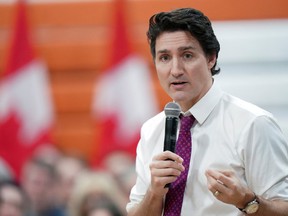
Though not always seen as his forte, Prime Minister Justin Trudeau does often take big swings on economic narrative, and he did exactly that at a keynote speech this week in Toronto.
Speaking to the U.S.-Canada Summit — a conference organized by Bank of Montreal and Eurasia Group — Trudeau took the opportunity to outline some of the core thinking and motivations behind his recently released budget, and defend what appears to be a pivot toward a more inward-looking and corporate-heavy set of policy choices, particularly around investment.
While Trudeau and his finance minister, Chrystia Freeland, have a tendency to oversell their decisions as responses to “historic moments,” the current situation does have an element of momentousness to it.
The budget we released last week was all about meeting this moment
Justin Trudeau
Yet some of the other touch points in the speech also reveal just how challenging things will be for Trudeau going forward.
The prime minister took pains, for example, to pitch the costly measures as benefiting all Canadians.
Politically, the Liberals know they will need to convince average Canadians that all this money being allocated to businesses (much of it to foreign corporations) is consistent with their underlying governing philosophy to “choose people every time,” as Trudeau said in concluding his speech.
There are also questions about whether the measures are sufficient to do the job. Trudeau spent much time championing not just the new tax credits but the government’s project-by-project direct involvement in recent investments by large multinational firms such as Volkswagen AG and Nokia Corp.
Investment
Then again, at least the government is beginning to think seriously about private investment, an area where it’s struggled to find success these past seven years.
Trudeau characterized his climate measures as an attempt to “crowd in” capital — an apt way of thinking about the problem given how much direct investment our businesses do abroad.
As the world moves away from cheap money, policymakers could become covetous of these monies. That will be especially true as many businesses feel the pull of subsidies south of the border.
But the trend has accelerated, and Biden’s climate transition plan threatens to turn that stream of money going to the U.S. into a flood.
Net direct investment flows between the two countries has favoured the United States to the tune of $320 billion since 2007. About 80 per cent of that “deficit” has come since 2015.
The bulk of these net flows have been driven by Canada’s banks and other financial institutions, which have been keen to grow south of the border. (In manufacturing, for example, Canada continues to draw in U.S. capital.)
Given how much Canadian financial institutions are invested in the United States, it would probably be wise to consider them as critical players in any bid to bring (and keep) capital at home.
Theo Argitis is managing director at Compass Rose Group.