




Three indicators that are so powerful they could change U.S. business and political landscapes in … [+]
Getty
While culture shift moves at a snail’s pace, change itself is built on societal indicators that, occurring consistently over time, make way for something new. In hindsight, it’s easy to see how and why cultural change occurred: the industrial revolution resulting in the creation of a middle class and (eventually) child labor laws; the civil rights movement in the U.S. making racial discrimination, disenfranchisement and segregation illegal; and, most recently, how technology has shrunk the world and put global information at our fingertips. But what indicators predict opportunities for a massive societal shift in 2020?
Having spent the last year researching, interviewing and writing in this space, I’m reflecting on indicators I’ve seen. And while nothing is certain, I’m convinced of this: shift happens.
What 2020 opportunity indicators are so powerful that, if executed, could change U.S. business and political landscapes?
2020 Election:
It can be argued that the economy has never been stronger. And, while the markets have bounced considerably given the China/U.S. trade war, overall returns have been positive. Reported unemployment, which cannot be used as a source for complete information, is at historic lows.
On the other hand, the U.S. population is increasingly dissatisfied and mistrustful of political leaders–especially among Millennials and Gen Zs, according to a 2019 Deloitte study. Overall, public trust in the government remains near historic lows. A Pew Research Center report released earlier this year indicates that only 17 percent of Americans today say they trust the government in Washington to do what is right “just about always” or “most of the time” (three to 14 percent, respectively). Pew also reports that Boomers have less trust in the government than Millennials (16 to 19 percent, respectively).
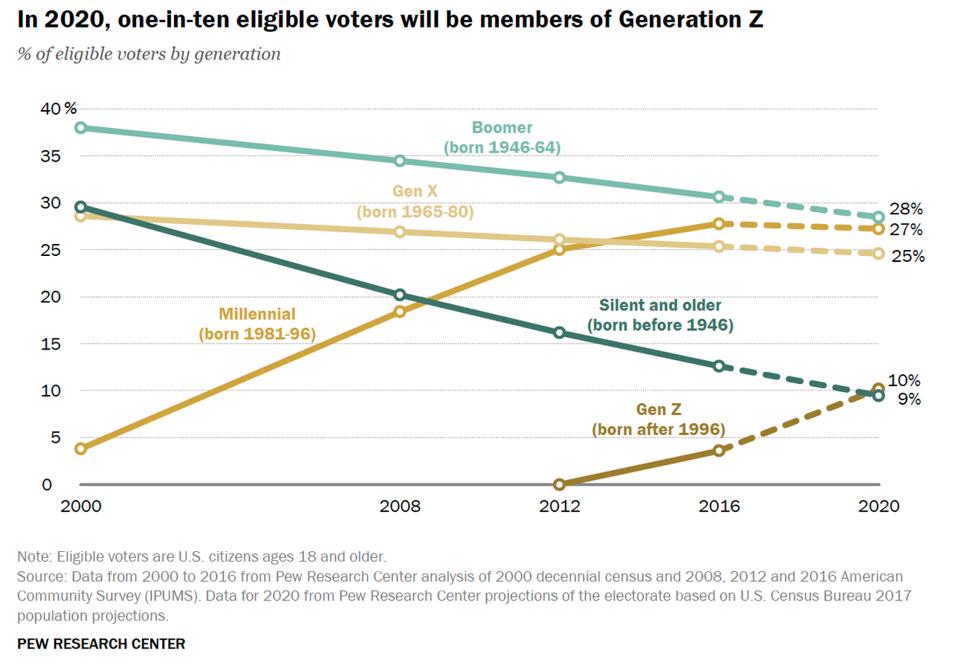
By the 2020 election, Gen Zs will represent ten percent of the eligible voters.
Pew Research Center
Using mid-term voting data as an indicator of younger voter engagement (also at historical levels), the 2020 election has the potential to set records. It is estimated that by election time, ten percent of the voter demographics will be Gen Z which, combined with the 27 percent of Millennial voters, could significantly sway the election–if they exercise their right to vote. In the 2016 election, even though Boomer and older voters accounted for 43 percent of the population, they cast 49 percent of the ballots.
Increasing CEO Responsibility and Leadership
If Americans are mistrustful of their government, who do they trust most? According to the Edelman Trust Barometer, 75 percent of global respondents look to their employer as their most trusted relationship; in the U.S., 80 percent of respondents put their trust in their employers.
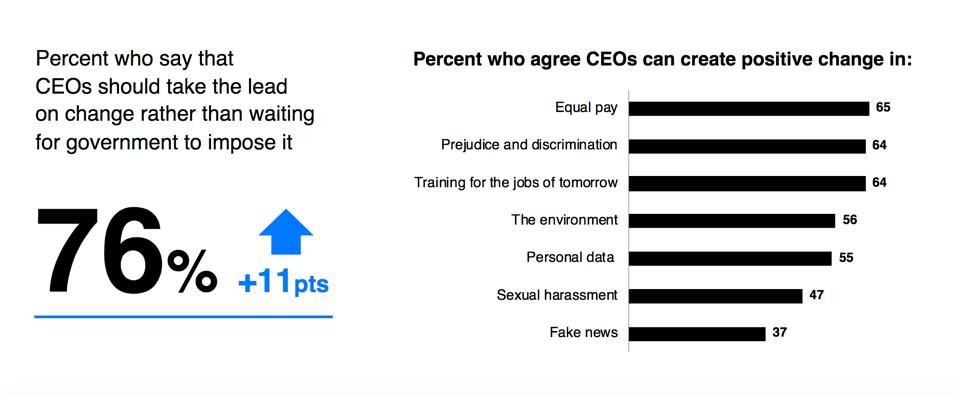
The 2019 Edelman Trust Barometer global report shows employees expect a lot more from the CEOs than … [+]
Edelman Trust Barometer
These statistics amplify responsibility on business leaders who, in addition to running a business, must manage employees’ expectations that include everything from addressing prejudice and discrimination to addressing environmental concerns. Business leaders willing to step into this role of omnipotence will need to establish a powerful circle of trusted advisors to research issues, collect data and curate responses.
Other growing pressures on business leaders include the changing landscape of work, from increased flexible working demands across the generations to incorporating gig models into workforce strategy. Increased employment litigation, especially around age-related hiring, promotion and retention systems leaning toward younger employees, require systemic correction. And, given that the 50+ population is driving the economy, companies will increasingly feel the pressure to ensure products and services address the needs of a longevity economy.
Technology-driven Solutions
What if every social media site had a reliable method for identifying and prohibiting the spread of fake news? What if finding non-profit collaborators and supporters were as easy as a few clicks? What if artificial intelligence (AI) curated diverse candidate pools without age, race, gender or other bias included?
Without a doubt, technology has changed the way we work and live. Now that we have a world of information at our fingertips, it’s time to find a better way to leverage this data and better meet our needs.
AI is automating many processes, but it is only as good as the algorithms running it. Most programs, whether determining if someone is eligible for a mortgage or if they are worthy of consideration for a job, are programmed by young white or Asian men. Left out of the equation? Women, other minorities and anyone over 35.
In fact, in December 2017, New York’s city council and mayor passed a bill calling for more transparency in AI, prompted by reports the technology was causing racial bias in criminal sentencing. Such calls for transparency at a Federal level has the potential to change the landscape of equality.
What Role Will You Play?
Every new year brings the possibility for transformational change, and 2020 is no exception. The question is, what role will you play? What’s important to you? How will you collaborate, influence and convincingly voice your opinions?
I’m always looking for unique perspectives, especially as it relates to age in the workplace–all ages, all perspectives with no limits because every voice counts. If you have a story to share, contact me through my website, LinkedIn or Twitter.