


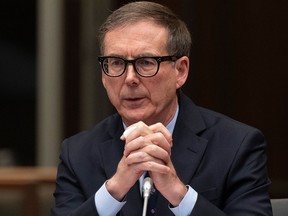
Bank of Canada governor Tiff Macklem is sticking with his plan to pause interest rate increases, despite evidence the economy ended the year much stronger than the central bank expected.
The most recent development was Statistics Canada’s estimate of hiring in January. The agency on Feb. 10 said employers added 150,000 workers in January, far more than anyone expected, including the central bank, which had updated its forecasts that month with a prediction that economic growth would effectively stall at the start of the year.
“A robust labour market is a challenge for the Bank of Canada,” Charles St-Arnaud, chief economist at Alberta Central, said in a note on Feb. 10. The central bank “needs to slow growth and create some excess capacity in the economy to fight inflation. This will likely lead to a rise in the unemployment rate and job losses. With this in mind, continued strength and tightness in the labour market may not be a welcomed outcome for the BoC.”
The Bank of Canada’s next policy announcement is March 8. The governor made his conditional pledge to pause interest rate increases on Jan. 25, when it lifted the benchmark rate a quarter-point to 4.5 per cent, extending the most aggressive series of rate hikes in the central bank’s history.
It would take a lot for the governor to back down on such an explicit promise after less than two months. Now that he’s dangled the possibility that interest rates have peaked, reneging so quickly could damage the Bank of Canada’s credibility. Rightly or wrongly, that’s now a variable when policymakers debate what to do with interest rates going forward, and an example of why purists argue that central bankers should never box themselves in by offering explicit forward guidance.
“The recent (Bank of Canada) pause decision is looking more dubious by the day,” Phil Suttle, a former economist at the Bank of England and the New York Fed who now runs his own consulting firm, said in a note to clients this week.
Suttle said market-based expectations of where inflation will be in a year remain elevated in most rich countries, suggesting central banks will have to raise interest rates even higher to snuff out price pressures. Inflation expectations are especially high in Canada, according to his calculations.
What’s more, higher borrowing costs and slower wage growth in January have done little to slow consumer spending, Royal Bank of Canada economist Carrie Freestone said in a Feb. 16 report, citing the bank’s credit-card data. Discretionary spending remained strong through early February, based on the four-week average of daily transactions, and restaurant meals have even increased, she said.
“We know it takes time for higher interest rates to work through the economy to slow demand and reduce inflation,” he said. “That’s why policy needs to be forward-looking. Guided by what we have seen so far and our outlook for economic growth and inflation, we think it time to pause interest rate hikes and assess whether monetary policy is restrictive enough to return inflation to the (two per cent) target.”
But before he explained the rationale for the pause, Macklem made a point of emphasizing the conditional nature of his guidance, giving himself flexibility to resume raising rates in the spring or summer.
“This is a conditional pause,” he said very early in his opening statement to the committee. “It is conditional on economic developments evolving broadly in line with our forecast.”
In other words, don’t be angry if Macklem decides to raise interest rates again. You’ve been warned.