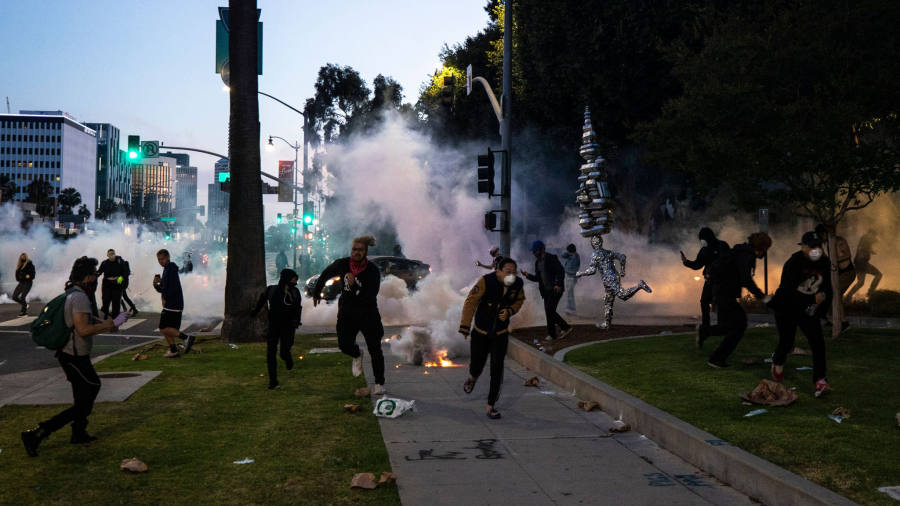

What has happened in US cities in recent days is no less distressing for its familiarity. The country has known protests to turn violent before, as it has known police aggression and racial strife. If there is a difference now, it is the immediacy with which camera phones and social media bring home the severity of the unrest — and, at times, enable them to spread.
There are evening curfews from Los Angeles to Philadelphia, and in Minneapolis, where the death in police custody of a black man, George Floyd, prompted the first marchers last week. The criminal proceedings against an officer who was filmed kneeling on his neck have not staunched the anger (most of which, it must be said, is peacefully expressed). Some states have fielded the National Guard to restore and maintain order.
The clashes beleaguer a country where more than 100,000 people have died of Covid-19, and the pandemic has pushed unemployment to 15 per cent. Both the health and economic crises have brought out underlying inequalities. In early May, a video was released showing the killing of another black victim, Ahmaud Arbery of Georgia. A racial incident in New York’s Central Park was non-violent, but led to enormous anger and the firing of a woman from her investment company. These are disparate events, but they add up a certain mood. Perhaps not since 1968, a year of urban riots and a losing war in Vietnam, has a presidential election taken place against a more fraught context.
It matters, then, how the current holder of that office comports himself. Donald Trump is not responsible for the street skirmishes or the events that led to it. American politics was combustible long before he entered it. The issues at hand — race, police conduct — will post-date him.
Through rhetoric, however, a president makes an outsized contribution to the national atmosphere. This is doubly true at tense moments. And Mr Trump’s interventions have been incendiary of late. Typically for a social media platform, Twitter is loath to be seen as taking a political position. But even it decided to hide a presidential tweet that seemed to glorify the “shooting” of looters.
Mr Trump has also goaded the “Democrat mayor” of Minneapolis for losing control of the city. He proclaimed “MAGA night at the White House” as protesters gathered outside, and pinned the troubles on the leftwing group Antifa. (Speculation about out-of-state, far-right or even foreign involvement is rife, though not rich in evidence.)
The president’s better-judged remarks in Florida, where he called for “healing”, seem to elude him on social media. Most of the time, his online truculence is merely undignified. On this occasion, it is no metaphor to say that he is playing with fire. It is mostly property that has been damaged in recent days, but human life is also at stake. A stray word can incite. Even silence would be better.
A more responsible leader would try to soothe the streets, as lots of municipal and state-level politicians have attempted. Joe Biden, Mr Trump’s Democratic challenger, has condemned the treatment of George Floyd but also those who seek to avenge him themselves. He might go further and pledge to confront the vexed question of how police officers are trained. Even the occasional celebrity has found measured and unprovocative things to say of late. No one in the world has a platform to match the US president’s, though. If he misuses it, the consequences are for ordinary Americans to live with.