

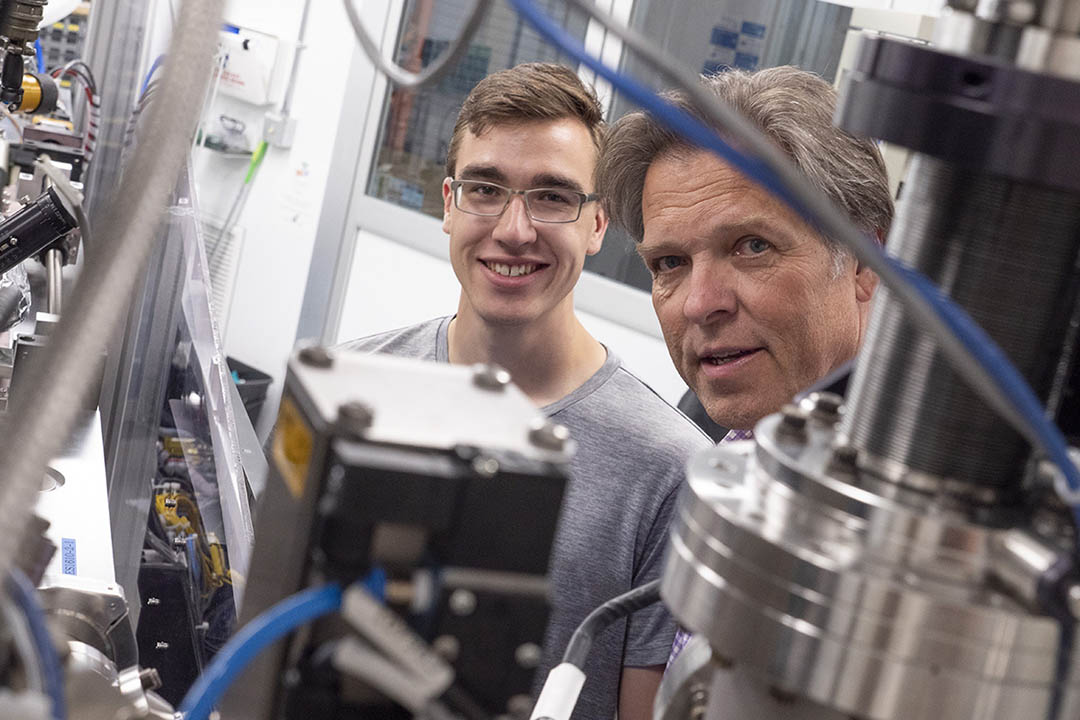
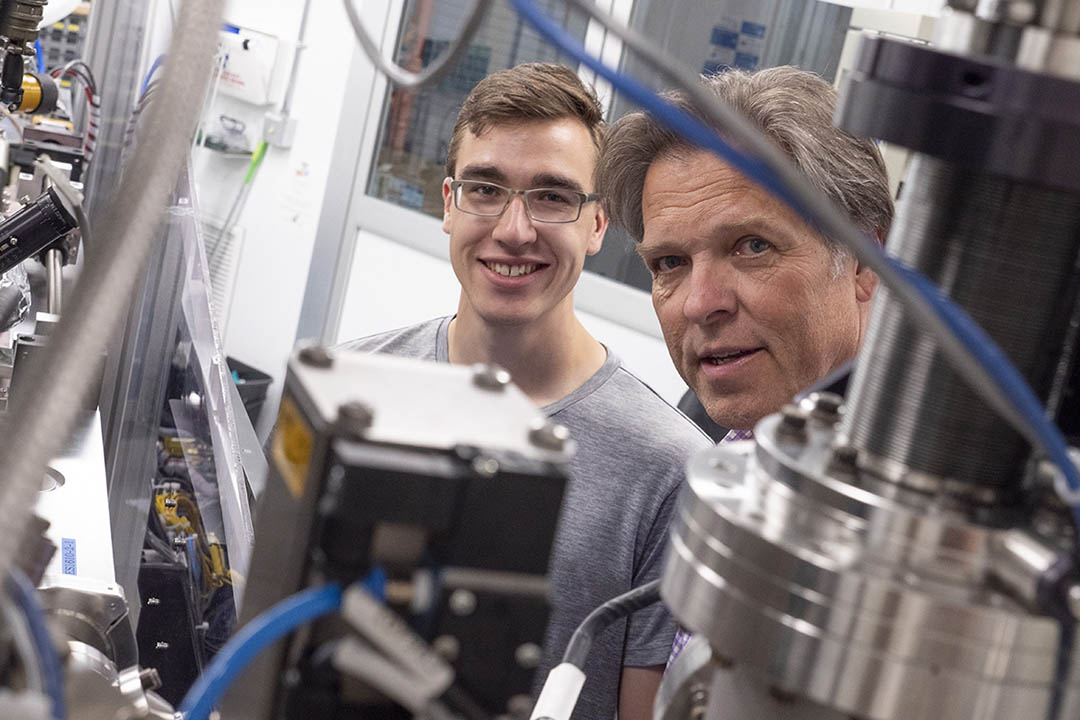
A research team led by USask College of Arts and Science researcher in physics and engineering physics, Dr. Alexander Moewes (PhD), Canada Research Chair in Materials Science with Synchrotron Radiation, is investigating a brand-new compound—potentially leading to new material properties such as ultra-hardness and luminescence.
“There’s not one, single ‘home run’ application, but it’s a big step forward,” said Moewes.
At 800oC and at pressure nearly 60,000 times greater than normal atmospheric conditions on Earth, research collaborators at Ludwig-Maximilians-University Munich (LMU) succeeded in creating a new, never-before-seen compound by ramming together nitrogen and phosphorous with germanium—a hard, lustrous, grey element related to silicon and carbon.
Moewes’ research team, including post-doctoral fellow Dr. Tristan de Boer (PhD) and undergraduate student Cody Somers, then analyzed this new compound experimentally at the team’s beamline at USask’s Canadian Light Source (CLS) synchrotron, finding it had two electrons in its outer shell that did not bond – so-called “lone pairs.” This is the first time that lone pairs have been observed with germanium in nitrogen-phosphorous compounds.
“Outer electrons—or valence electrons—typically bond, but these lone pair electrons do not participate in bonding, and can be used to tailor properties of materials,” said Moewes.
The research, which was published in Angewandte Chemie, established through calculations that there was an imbalance in the structure of the material due to the lone pair, making this compound structurally different from every other similar compound.
“You have this large, enclosed channel, like an empty straw in the material,” said de Boer. “In this case, the lone pairs are kind of stabilizing it.”
The USask team then used synchrotron light at the CLS, bombarding the substance with X-rays to understand its structure, and confirming it had a pair of non-bonding electrons, as anticipated. The results were published in Journal of Materials Chemistry A.
The findings open a door to developing a new variety of advanced materials in the same class as the hardest materials on Earth, as well as holding promise to create new semiconductors and new insulators, and other materials that take advantage of this type of material’s unique structure.
“The Holy Grail is that we gradually deepen our understanding, and we can then ideally design materials on the computer first, to then ultimately realize them in the lab,” said Moewes.
Moewes’ research was funded by Canada’s Natural Sciences and Engineering Research Council (NSERC) grants, including an NSERC Undergraduate Student Research Award for Somers, and funding from the Canada Research Chair Program.

Follow Canada News Media
Get the day's top Canadian stories and our two daily 60-second news videos wherever you scroll.
X Threads Facebook Instagram LinkedIn TikTok YouTube Pinterest Reddit Substack Flipboard Newsletter RSS