

“By understanding this splitting, we begin to understand how Salmonella survives better in the environment and perhaps how to stop it,” he said. “We start to understand our immune response to Salmonella, and the long-term impacts of Salmonella infection.”
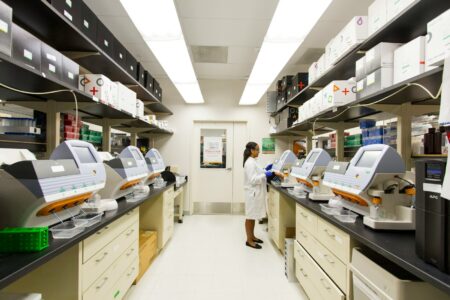
The team’s research program is already underway, using mice. White lauded master’s student Michelle Gerber for creating a “reporter strain” of Salmonella that turns green when it transforms into a biofilm cell, and red when it remains in its single-celled, virulent form.
The reporter strain is one of the ways they’re able to closely monitor the change in Salmonella bacteria, and pursue research that White said is unlike anything else in the world.
“It’s quite exciting,” he said. “It’s great for trainees. We have a chance to redefine how we approach this bacterium, make better vaccines and control infections, by studying these new ideas.”
While they are on the cutting edge of research already, White is looking ahead to what might come next. He said through their NSERC-funded research they have already identified a connection between the proteins present at the formation of biofilm cells and those that exist in human neurodegenerative diseases such as Alzheimer’s.
“It’s still in the early stages, but that might be the most exciting thing to come out of my research,” he said. “It’s a big subject to tackle.”
As the team learns more about what causes Salmonella to split and survive, White is excited about the questions his program might answer about the troublesome bacteria — and other questions this research could answer in the future.