
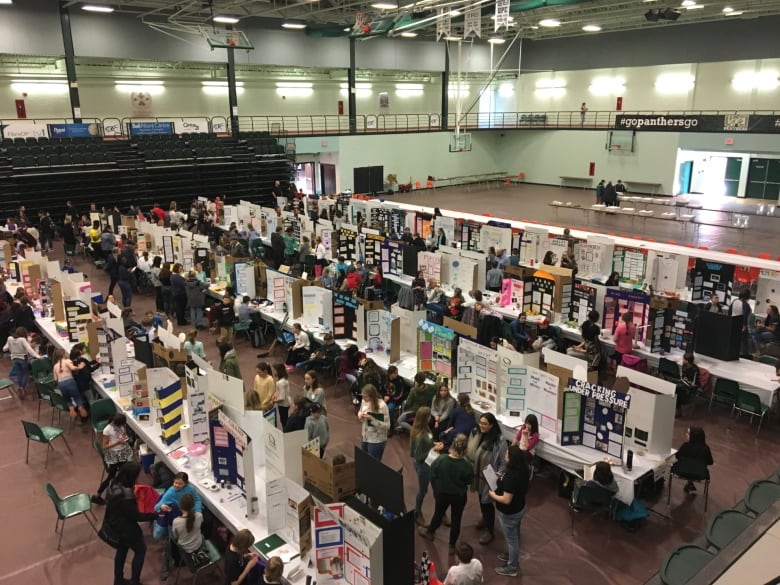

Goodbye, gym. So long, cafeteria. Another time, cluster of poster boards.
Students across Newfoundland and Labrador have been moving online with their projects to what is becoming the new normal for science or heritage fairs, as the COVID-19 pandemic has not only closed schools but made it impossible for students and judges to gather together.
On Wednesday, the Eastern Newfoundland Science and Technology Fair saw 20 entrants take part, down from its usual 100 entrants in a physical fair setting.
But that didn’t hurt the quality of the work, as judges doled out six gold, seven silver and six bronze medals with some honourable mentions in addition.
John Scott Pearce, a Grade 12 student at Holy Heart High School in St. John’s won gold and was chosen Best of Fair for highest overall score. Emily Meade, a Grade 12 student from Holy Heart High School in St. John’s, placed second, and also won a gold medal. Third place, and a gold medal, went to Linnaea Bird, a Grade 10 student from Holy Trinity High in Torbay.
In addition to the medal certificates, monetary prizes were provided by the Newfoundland and Labrador Teachers’ Association Math Science Special Interest Council. These included $500, $300 and $200 for first-, second- and third-place winners, respectively.
Things will look a little bit different on the national scale this year as well. Youth Science Canada is hosting an Online STEM Fair for any student in the country in grades 7 through 12. Registration closes on May 18.
N.L. history
For students still interested in learning about Newfoundland and Labrador’s vast history, while K-12 schools remain closed under public health orders, the Young Citizens program, coordinated by the government of Canada’s Department of Canadian Heritage, is a go.
Students can submit a heritage fair video project to Young Citizens by June 8 for a chance to win a trip to a gala in Ottawa. A winner will be picked from each province and territory.
Carleigh Robinson of Eastport is an ambassador for Newfoundland and Labrador on Canada’s Youth History Council.
Robinson, 15, told CBC Radio’s On The Go the panel of judges are looking for video projects from across the country about Canadian heroes, legends, key events and special things about a community, among others.
“They want you to go to museums and stuff, but unfortunately with the current situation you can’t do that. So, they can be [done] at home, you can read books, websites, anything you want,” she said.
Robinson competed in 2017, with a report on the history of logging in Gambo. Her father, an employee of Parks Canada at Terra Nova National Park, brought her to the park’s archives where Robinson uncovered details about the logging industry in the area.

She also visited a sawmill in Gambo and took a tour.
“It was really cool. It was a fun experience,” Robinson said. “[I] and another girl from Newfoundland did it. Unfortunately I didn’t win but she did and I think she had an amazing experience in Ottawa.”
Robinson said she didn’t know much about the logging industry or its history in Newfoundland and Labrador until embarking on her project for the competition.
She said her project helped her understand how and why the province got involved in logging.
“It gave me a little bit of information about things I really didn’t know, and it taught me a lot of cool skills and a lot of cool stories,” Robinson said.
All information for submissions can be found on the Canada’s History for Kids website, where each video will also be uploaded for public viewing and voting ahead of the panel’s vote.
Read more articles from CBC Newfoundland and Labrador