



Our planet‘s population is always increasing, and with this uncontrollable momentum ever-present, so too the many problems presented to humanity caused by this increase and climate change.
1. Rising sea levels could devastate coastal cities.
2. How and where will the food needed to feed the population of our planet come from?
Since 1880, the world’s average sea level has risen by 8-9 inches, one-third of that increase over the past 25 years.
3. Rising sea levels are eroding the coasts of landmasses at an alarming rate.
4. Rising sea levels are flooding coastlines and contaminating freshwater supplies.
5. An estimated 41% of the world’s population lives within 62 miles of the coastline.
6. In addition, cities built on the coastline tend to sink over time.
Regions like New Orleans, Kolkata, Bangkok Ho Chi Min City, Jakarta, London, and New York City face increasing pressure from flooding and saltwater intrusion.
The earth is drying up. Drought has spread throughout our planet, especially in those areas that mass produce/grow our food. whether due to climate change or simply the planet’s climate cycle, drought has taken away our precious fertile landmasses giving us dessert in return. The earth’s underground aquifers are being depleted at an alarming rate. three-quarters of the planet is covered by water, yet 96.5% of this water is undrinkable. 3.5% of our water is found in the form of ice, in our Polar Regions, but it is melting. What to do?
Do you remember a movie with Kevin Costner as the lead…WaterWorld? The planet was covered in water, and the surviving population lived on boats and artificial floating devices. The possible solution to the world’s problems can be found in this movie’s premise that we can use the water that surrounds us.
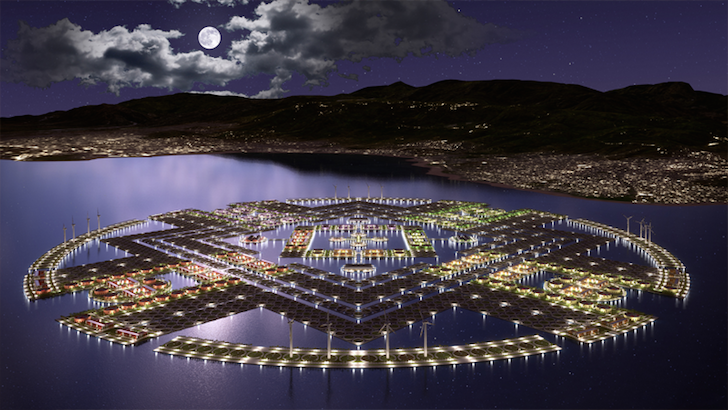
Floating Cities could combat this problem, but no one has ever built such a marvel before. Well off the coast of South Korea such an ambitious project is underway. Known as “Oceanix Bruan, this collaboration between the United Nations, the Port of Busan and the Contract Firm is building such a city. Oceanix was founded in 2018 with the goal of designing and building a prototype sustainable floating city. In 2022 The United Nations unveiled the program to the world.
Neighbourhoods would be interconnected with one another and the mainland via bridges. A living area will be developed, creating living space, lodging platforms, and areas for community activities such as retail and food vendors and recreation. Employment would be centred upon research and development of the project and fulfilling the needs of their neighbourhoods. With a temperature-controlled atrium at its center, the floating city would have its own center for hydroponic agriculture. Each neighbourhood would be secured firmly to the ocean floor with enough slack to take into account the movement of the ocean. Biorock will be used to make the buildings, and surfaces of this city. Biorock is a material that is produced using low electric currents applied to materials that become stronger than concrete yet are buoyant. The floating city is pedestrian-friendly, with no roads. Electric vehicles will be used.
Each neighbourhood will have its own water treatment and recycling plants. Turning saltwater into drinkable water will fulfill the new cities’ needs. The first segment of the neighbourhood will be built by 2026, with a cost of approximately 630 million dollars. Estimates of $10,000 per square meter have arisen, but with further development and research, the project will present to the world a far more affordable living option. Imagine a livable, prosperous island, a neighbourhood that is self-supporting in every way. Such imaginative and bold projects will hopefully pave the way to Earth’s transformation into an all-inclusive living space.
Steven Kaszab
Bradford, Ontario
[email protected]
Sourced from United Nations, Smithsonian archives.
Follow Canada News Media
Get the day's top Canadian stories and our two daily 60-second news videos wherever you scroll.
X Threads Facebook Instagram LinkedIn TikTok YouTube Pinterest Reddit Substack Flipboard Newsletter RSS