

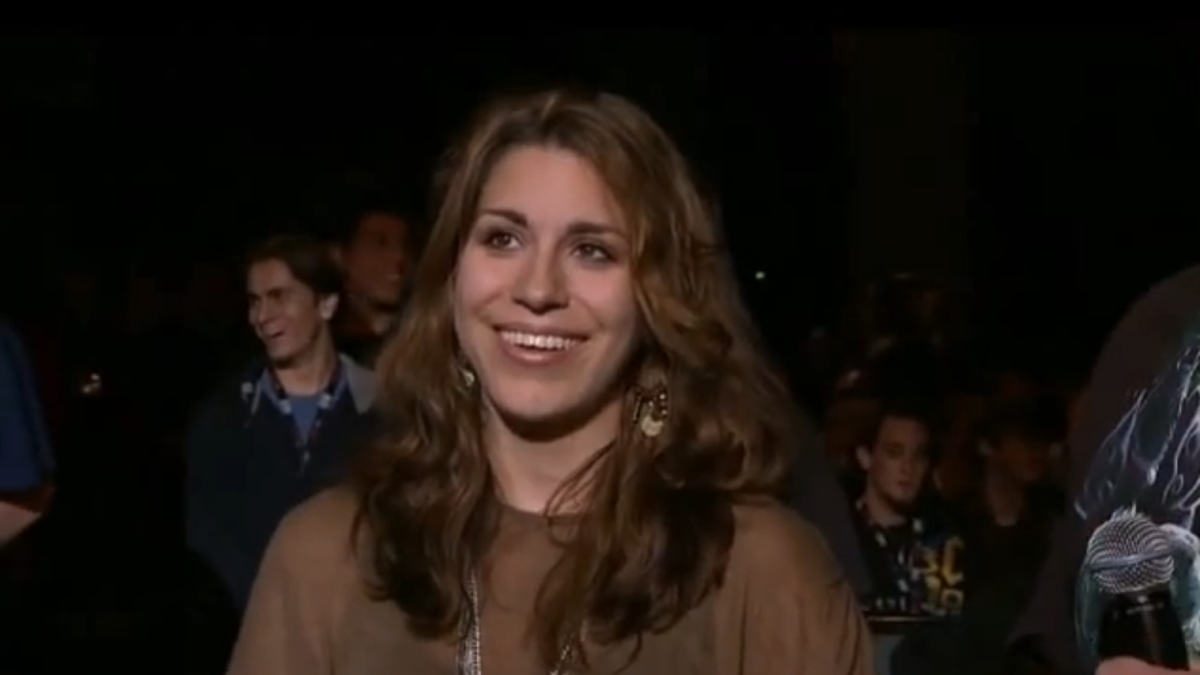
“I didn’t think that much about it, because there’s always been for the longest time a certain amount of sexism in the games industry that is just there and you learn to roll your eyes and do your best to ignore it and just try to appreciate the things that you do like about it,” Xantia said.
“I loved Diablo II back in the day. Did I love the character model for the Amazon? No, not really. Hell, one of my earliest memories of gaming was being excited about the first Tomb Raider game and thinking, ‘That’s so cool it has a female protagonist.’ And then you see the first model of Lara Croft in the game and you’re like, oh, cool, great, great…”
There’s an audible exhaustion in her voice when she recalls this memory. The 2010 BlizzCon panel wasn’t an anomaly. It wasn’t the mask slipping in front of thousands on video. It was what she had come to expect from a space dominated by men with little regard for anyone else, and as California’s lawsuit and new reporting has confirmed, who were at times explicitly dangerous to the women around them.
Afrasiabi is one of the only people named in California’s lawsuit, accused of sexually harassing and groping female Blizzard employees. It also accused him of having a “Cosby Suite” at BlizzCon where he would also prey on women.
Based on images obtained by Kotaku, the “Cosby Suite’’ was an actual booze-filled party room at BlizzCon 2013 in which Afrasiabi and others would pose with a giant portrait of the comedian. Activision Blizzard confirmed to Kotaku that Afrasiabi was terminated last year for “misconduct.” Brack, the only other person named in California’s lawsuit for failing to address sexual harassment compalints against Afrasiabi, is still currently in charge of Blizzard.
Despite the experience at the panel, Xantia said she tried to get a job at Blizzard in its Strategic Initiatives Department around 2012 and was in the running for a while before ultimately being rejected. “I was pretty heartbroken about it at the time, but man, talk about being lucky in your failures,” she said. “I now feel like I dodged a bullet there.”
Following the resurfacing of the BlizzCon 2010 moment, former World of Warcraft lead designer Greg Street, currently at Riot Games, took to Twitter to apologize in a somewhat meandering tweet thread. He first qualified the “shitty answer” by saying it can be hard to see who’s asking the questions. He also mentioned that developers are nervous up there, in front of the crowd, out of fear they will say the wrong thing. Eventually he settled on, “I find the video embarrassing and I apologize to the player who asked the question and all others who were disappointed with our ‘answer.’”
Xantia said part of what’s been so weird about seeing the video brought back up over a decade later is seeing responses like Street’s.
“I guess Greg Street now knows who I am now. Cool. OK. And also that wasn’t really an apology, but sure you do you. Whatever gets you to sleep at night,” she said. “I was joking with a friend when I saw it, when I saw everything he was writing about that, just, you know, ‘Oh, I couldn’t see her react, I couldn’t see her face’ and how he’s disappointed in all of these things. Yeah, but your ears were working just fine. Did you not hear hundreds of people booing me? What would it have taken to say, ‘Hey, guys, come on, that’s not cool’? “Whenever you start explaining yourself to that degree, it stops being an apology.”
Xantia thinks Blizzard needs to be more candid too.
“One of the biggest things that they could do is, actually be honest and have that kind of ‘boys club’ not be above reproach,” she said. “It has to be more than just a show of ‘We did these couple acts of penance and now we’re all better.’ I think there actually has to be a fundamental reevaluation.”
Xantia’s found the recent actions of other developers at Activision Blizzard, including an open letter and walkout, to be cause for optimism. And despite how bizarre it’s been to play such a visible role in the public outcry that’s currently unfolding after all these years, she’s hopeful the negative experience is now making a positive contribution.
“I’ve gotten a moderate amount of attention for all this when I’m only tangentially connected to it,” she said. “I think the important voices are for the women who were actually at Blizzard who have had to endure far, far more than just being dismissed at a convention.”
“There are worse reasons to go viral. And if this helps to actually bring about change then that would be something profoundly good that came out of a pretty small, but still shitty moment.”