


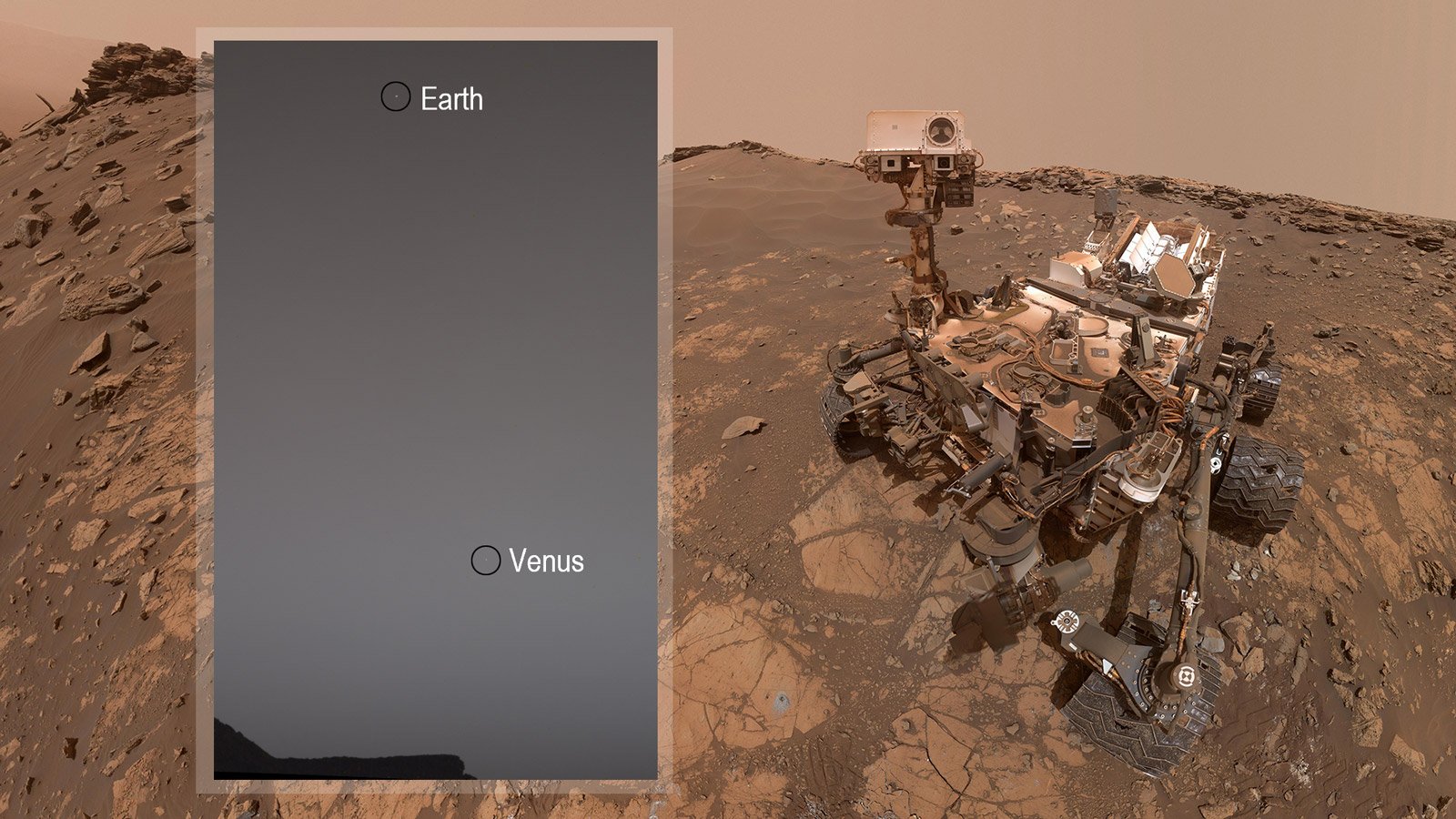

This new portrait of the Red Planet’s neighbors was taken during a time when there’s more dust in the air on Mars.
NASA’s Curiosity Mars rover occasionally stops to stargaze.
Recently, it captured a shot of Earth and Venus in the Red Planet’s night sky.
Curiosity aimed its Mast Camera, or Mastcam, at the
heavens about 75 minutes after sunset on June 5, 2020, the 2,784th Martian day,
or sol, of the mission. A two-image twilight panorama reveals
Earth in one frame and Venus in the other. Both planets appear
as mere pinpoints of light, owing to a combination of distance and dust in the
air; they would normally look like very bright stars.
The brief photo session was partly to gauge the twilight
brightness: During this time of year on Mars, there’s more dust in the air to
reflect sunlight, making it particularly bright, said Mastcam
co-investigator Mark Lemmon of the Space Science Institute in Boulder, Colorado.
“Even moderately bright stars were not visible when
this image of Venus was taken,” Lemmon said. “Earth also has bright
twilights after some large volcanic eruptions.”
When Curiosity’s Mastcam
imaged Earth and its Moon in 2014, the color and brightness of the sky were
significantly different than from these most recent images because of all the
high-altitude dust in the Martian air right now.
At the bottom of the new images
is the top of a rock feature called Tower Butte in the “clay-bearing unit,”
which Curiosity has been exploring for more than a year. Since landing in 2012,
the rover has captured blue
Martian sunsets and passing
asteroids as well as Mercury and Mars’ two moons, Phobos
and Deimos, transiting across the Sun.
More information about
Curiosity:
https://mars.nasa.gov/msl/home/
News Media Contact
Andrew Good
Jet Propulsion Laboratory, Pasadena, Calif.
818-393-2433
[email protected]
Grey Hautaluoma / Alana Johnson
NASA Headquarters, Washington
202-358-0668 / 202-358-1501
[email protected] / [email protected]
2020-110

Follow Canada News Media
Get the day's top Canadian stories and our two daily 60-second news videos wherever you scroll.
X Threads Facebook Instagram LinkedIn TikTok YouTube Pinterest Reddit Substack Flipboard Newsletter RSS