


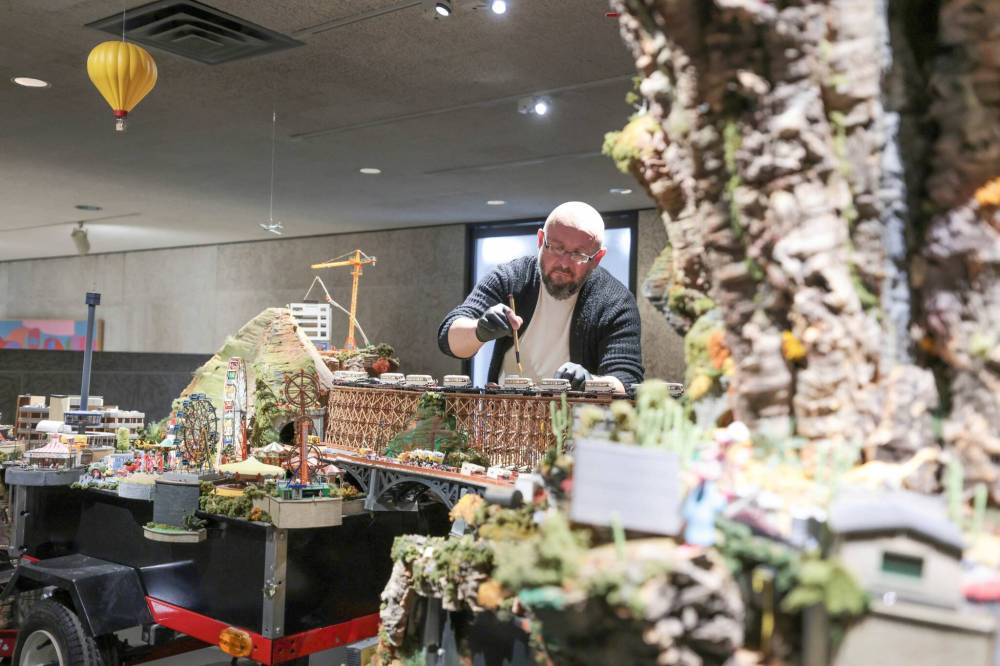
Vitaliy Yatsevych looks a bit like a giant as he leans over a tiny trestle bridge conveying a passenger train past a fairground scene, a hot air balloon floating just above his head.
Behind the Scenes
How is the stage lit? Who hangs the paintings? What happens in the dish pit? Behind the Scenes is a recurring series highlighting the important and often invisible work happening at arts and culture venues across Winnipeg.
Yatsevych, 52, is WAG-Qaumajuq’s conservator. His job — and it’s a big one — is to clean, maintain, preserve, repair and sometimes even restore artworks. Today, he’s taking another good look at Earth Wagons, the elaborate 1991 sculpture by Canadian assemblage artist Kim Adams that uses HO-scale (toy-train size) models to create teeny-tiny everyday scenes that compose much larger worlds.
“There’s an enormous number of little parts,” Yatsevych says. And he has to look at all of them.
Earth Wagons, which has been on view on the mezzanine level of the WAG building since December 2023 and will come down sometime this month, is part of the gallery’s permanent collection. It’s not often on display owing to its size, so this was a chance to give it some extra TLC.
Before it went on display, Yatsevych figures he dedicated about 40 hours of conservation work to it, looking for instability, yellowing glue, glue that has become brittle, parts that have become loose, which he then carefully re-affixed with tweezers and glue administered by a fine-gauge syringe.
“It’s storytelling — each section tells a different story, so, for me as a conservator, it was important to put the objects exactly in the same spot,” he says.
“We have to always preserve what was done by artists originally. My job is just to stabilize the artwork and make sure it’s preserved for future generations.”
Indeed, conservators are stewards of art. Their work is painstaking and time-consuming, and requires a great deal of patience and keen attention to detail.

WAG-Qaumajuq conservator Vitaliy Yatsevych maintains the gallery’s displays, preserving the artwork for future generations.
“It’s a good examination of the personality,” he says.
But it’s also fun — especially if you’re working on a piece essentially made out of toys.
“It was not easy to determine if I was playing or if I was working,” he says of Earth Wagons with a laugh.
If you’ve been inside the main WAG building and have taken the grand staircase up to the galleries on the mezzanine level, you’ve walked right by Yatsevych’s lab without ever noticing it.
It’s tucked behind the back wall in the Main Hall, perfectly concealed by a jut of Manitoban Tyndall stone.
A door labelled Conservator — and fitted with the kind of knocker you might see on a residential house — opens into a surprisingly expansive space.
Yatsevych’s lab has various workstations and a special HVAC system. All manner of solvents, scalpels, teeny-tiny paint brushes, spatulas, waxes, paints and pigments can be found on the worktops. Everything he uses is conservation specific, meaning it won’t harm the artwork, and “everything we do in conservation should be reversible and can be changed anytime in the future,” he says.
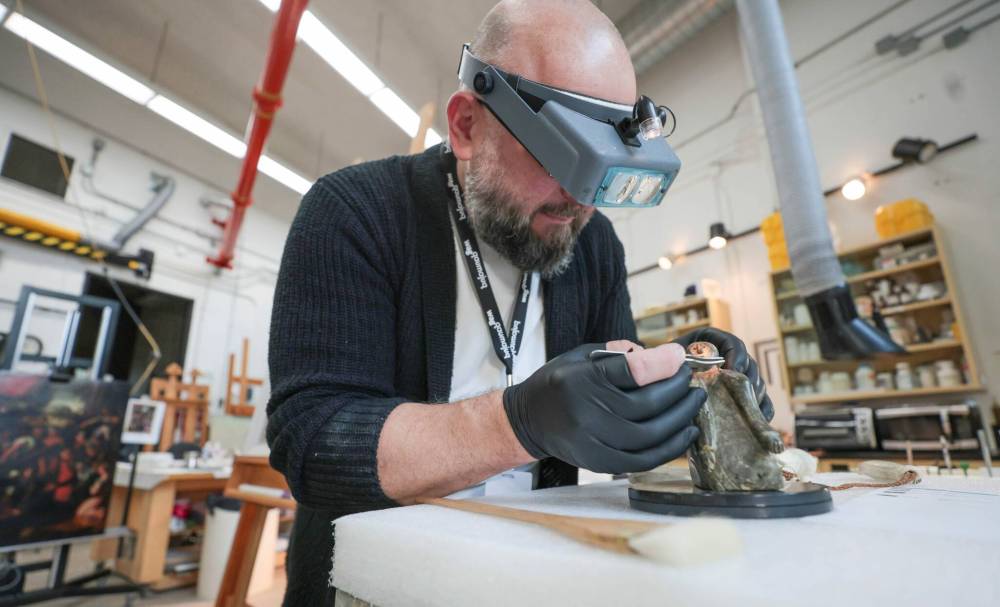
Yatsevych recently embarked on one of the biggest restoration projects of his career: Kim Adams’ Earth Wagons, which is composed of teeny-tiny model train parts.
And when conservation work is described as “surgically precise,” it’s not a misnomer.
“We use a lot of tools from the dental industry,” he says, sliding open a drawer to reveal the same set of tools you’d see wielded by your hygienist.
Conservation, Yatsevych says, is a blend of art, science and history. His own background is well-rounded. He was enrolled in art classes when he was a 10-year-old boy growing up in Ukraine, and has known since then he wanted to work in visual arts. He started as a painter (impressionist), then moved into art conservation and museum studies, studying both in Ukraine and Canada.
He loves making art, but also collecting things and fixing things. Conservation appeals to all of those interests.
Yatsevych has been at WAG-Qaumajuq for 14 years, working in a variety of different areas, including archival work and installation. All of it adds to his knowledge base, especially since he works closely with a variety of departments in the organization.
When Yatsevych gets a request from a curator about a specific work they’d like to include in an exhibition, he will first assess the art.
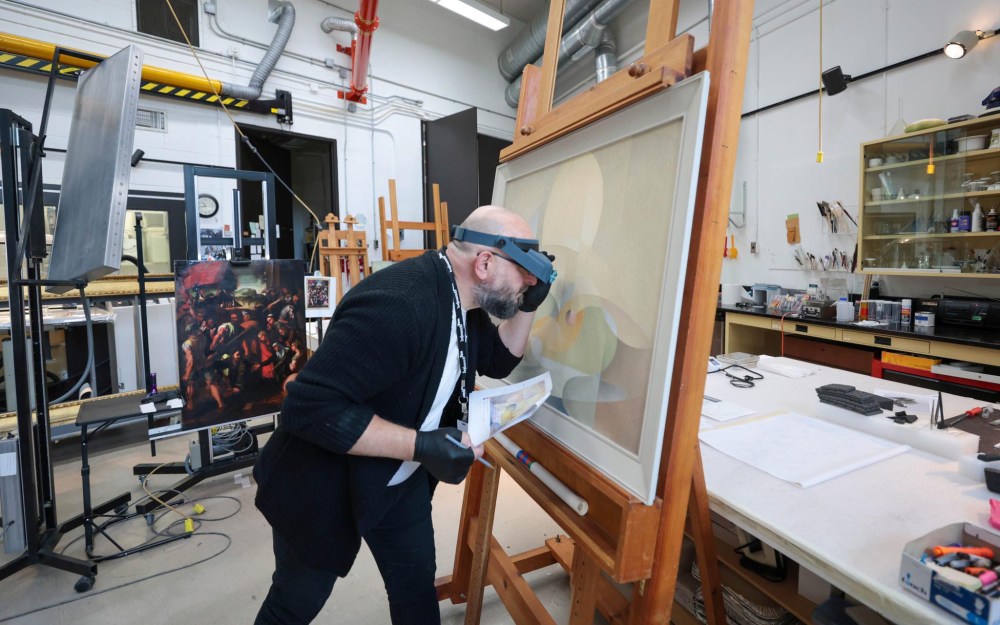
Yatsevych will first assess the art and find even the smallest flaw.
If he’s looking at a painting, for example, he’s looking for discoloration (fading, staining, yellowing, fingerprints, smudges), dirt and grime, embrittlement (cracking, crazing), physical damage such as scratches and abrasions, paint and pigment loss (flaking, chipping) and previous restorations.
His examination isn’t limited to the image layer, however; he’s also looking at the canvas and frame. Many of these flaws are small — it’s Yatsevych’s job to catch them.
Some artworks can only be displayed for a certain amount of time to limit how often they are exposed to light. UV light is a big concern, as it speeds up deterioration, he says. Sometimes he will recommend that an artwork displayed too frequently go back into darkness for another year. Humidity and temperature fluctuations are likely the next biggest threats, but the gallery is a controlled, stable environment.
He will then make a treatment proposal: “Sometimes, it’s very minor, but necessary to prevent further losses and deterioration,” he says. After his approval, the artwork can go on display.
If a work is going out on loan, he will provide a formal condition report to the exhibiting institution. The conservator at the other institution will also look it over to see if anything happened in transport.
Photo documentation is a critical part of the job.
“It’s my job not only to fix the art, but preventive conservation procedures as well.”–Vitaliy Yatsevych
“Before installation and after installation, I do the condition check to determine if any changes appear while it was on the display, on transportation, or even storage,” he says.
“It’s my job not only to fix the art, but preventive conservation procedures as well.”
Sometimes, a more involved reconstruction is required — such as carefully removing the image layer and putting it on a new canvas, say. The stakes are high: this is someone’s art, after all. But Yatsevych always goes into a project informed.
“Before each project I have to do research of the artist, artworks, techniques, materials and maybe other details that will be helpful for me while I’ll do some major treatments,” he says.
He’ll also consult other professionals. Resting on his worktop is a pair of 1990s works on birch bark that have suffered some water damage; he’ll need to do more research into best practices for birch bark and how it behaves before embarking on that project. He’s always, always learning.
Some of that knowledge exchange is with artists themselves — particularly with artists from the North. Since WAG-Qaumajuq is famously home to the largest public collection of modern and contemporary Inuit art, Yatsevych necessarily works on a lot of carvings.
Winnipeg Art Gallery conservator Vitaliy Yatsevych’s job is to care for and restore artworks to their former glory.
He shows off a palette of pigmented wax in a gradient of shades from black to white — a fairly recent innovation he’s excited about. “It’s easy to fill up the cavities, and it’s reversible, easy to remove, so it wouldn’t affect the artwork over time,” he says.
Occasionally, parts of a work need to be replaced, which can pose some creative challenges. Ivory, for example, is no longer used; instead, conservators will use tagua nut — “vegetable ivory”— or polyester ivory to reconstruct, say, a missing tusk, and mark it as a replacement.
It should be as though he was never there. “I try to minimize any of my influence on the artwork,” he says.
Yatsevych has been doing ongoing work on a painting that had a large split down the side, as well as some other paint losses. He shows off a fun party trick: when he shines his UV flashlight over the painting, the conservation work comes into view. When he takes it away, it disappears as if by magic. All you see is the painting, not Yatsevych’s labour. As it should be.
The pride Yatsevych takes in his work beams from his face.
“It’s a dream job,” he says.