As the 2022 IIHF World Junior Championship gets underway in Edmonton and Red Deer, the Alberta setting may feel familiar, but we’re in uncharted territory.
That goes beyond the welcome presence of some fans in the stands after an empty Rogers Place during the 2021 tournament. Even in pre-pandemic times, our annual U20 showcase has long featured wild unpredictability. No U20 tournament is ever the same.
Sure, the “Big Five” nations – Canada, Finland, Russia, Sweden, and the U.S. – may dominate the medal haul, but even within those parameters, almost anything can happen.
As we prepare to discover new hockey heroes and follow captivating storylines, let’s take a look at eight big questions about the 2022 World Juniors.
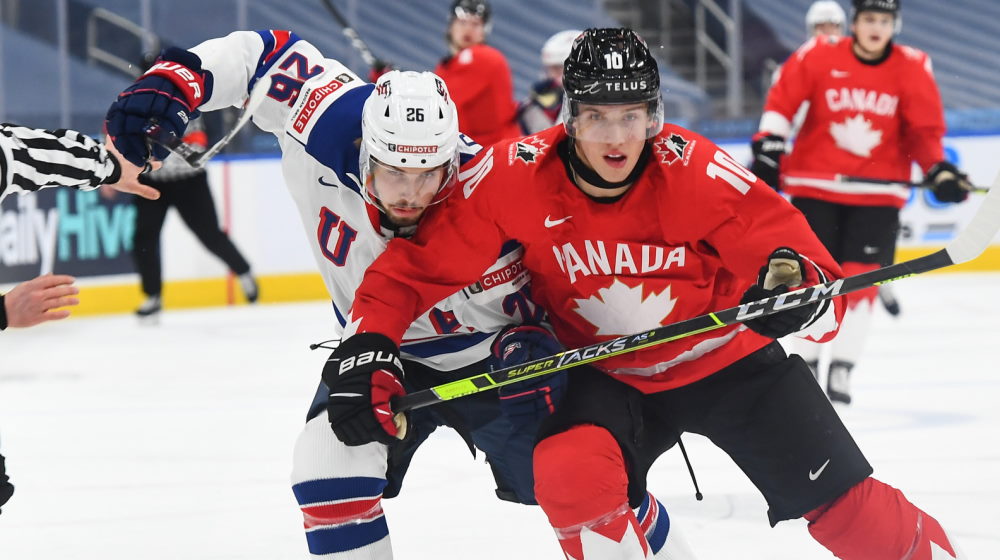
1) Will there be a U.S.-Canada gold-medal rematch?
More standard questions would be “Will the defending champion Americans win a second straight title on Canada’s ice?” or “Will Canada take revenge on its southern neighbour and rule the junior hockey world for the third time in five years?”
However, just having a rematch between the North American archrivals would be unusual enough, as silly as that might sound at face value.
Get this: not only has no nation won back-to-back gold medals since the Canadian five-peat of 2005 to 2009, but Canada’s 5-1 win over Sweden in the 2009 final in Ottawa was also the last time the same nations tangled for gold two years in a row. (Canada beat Sweden 3-2 on Matt Halischuk’s overtime goal in the 2008 final in Pardubice.)
So U.S.-Canada II: They’re Back and This Time It’s Personal on 5 January would be especially noteworthy.
2) Which U18 star will prove most dominant?
How many times have Canadian TV viewers heard TSN’s sages proclaim, “This is a 19-year-old tournament?” Most years, that holds true. For instance, every skater on the 2021 tournament all-star team – except Germany’s Tim Stutzle – was 19. But in 2022, it could be a festival of young whippersnappers.
Take Shane Wright, the projected #1 overall pick in the 2022 NHL Draft. The 17-year-old centre (Kingston Frontenacs, OHL), who captained Canada to the IIHF U18 World Championship gold in April with a team-high nine goals, has scouts drooling with his heads-up playmaking and leadership skills.
Yet arguably, the comparisons between Wright’s U18 teammate Connor Bedard (Regina Pats, WHL) and Russia’s Matvei Michkov (SKA St. Petersburg, KHL) – both potentially the #1 pick in 2023 – will be even more hotly scrutinized. Both young men bring unlimited flash and dash.
Bedard had a slow start in Saskatchewan this year, but the 16-year-old North Vancouver native tore up the World Junior selection camp with six points in two games versus Canadian university all-stars. Meanwhile, Michkov’s 12 goals at the U18 Worlds in Texas were just two short of the record shared by Russia’s Alexander Ovechkin (2002) and the U.S.’s Cole Caufield (2019). He just turned 17 on 9 December and should be better than ever.
Finnish forward Joakim Kemell (JYP, Liiga) has sparkled with 12 goals in just 21 games with JYP this season at age 17.
Don’t forget about Slovakia’s Dalibor Dvorovsky (AIK, Sweden). The tall 16-year-old puck wizard turned heads when his eight goals tied him with Michkov for the Hlinka Gretzky Cup lead in August and helped the host Slovaks earn a surprising silver medal. Could Dvorovsky be the dark horse who goes first overall in 2023? Stay tuned.
Also watch out for dynamic 17-year-old D-man Simon Nemec (HK Nitra, Slovak Extraliga), who had four assists at the 2021 World Juniors.
3) Which Russian team will show up in the end?
As great as they are, game-in, game-out consistency is rarely a strong suit for Russian teams. Really, when you talk about young Russians and “a full 60,” you might as well be referencing the number of goals Pavel Bure scored for Vancouver in both 1992-93 and 1993-94.
Under new head coach Sergei Zubov, the Russians were up and down in their 6-4 exhibition loss to Canada on Thursday night. Full credit to Canadian aces Mason McTavish and Kent Johnson for their instant offensive chemistry, but a ready-to-play Russian squad wouldn’t have gone down 4-0 after 20 minutes.
However, the Russians woke up to make it as close as 4-2 and 5-3 in the second period. Matvei Michkov’s wicked release yielded two goals. Goalie Yaroslav Askarov, entering his third World Juniors, didn’t get the confidence boost he wanted as Canada outshot Russia 38-25.
The last two years saw similar erratic Russian play at crunch time. Russia blew Canada out 6-0 in the preliminary round in 2020, but blew a 3-1 third-period lead to fall 4-3 to coach Dale Hunter’s boys in a wild final in Ostrava, which was longtime coach Valeri Bragin’s swan song. Last year, the Russians were given increased freedom for offensive creativity under IIHF Hall of Famer Igor Larionov, but their gold medal hopes died in a 5-0 Canada semi-final romp, and the players ran out of gas in a 4-1 bronze-medal loss to Finland.
A more consistent effort is a must if Russia intends to end its 11-year gold medal drought in Edmonton.
4) Is it time for Sweden to celebrate in Alberta again?
It’s been 10 years since Sweden won its last gold medal and second of all time, but it feels like a lot longer. Think about it. On 5 January, 2012, when the Juniorkronorna edged Russia 1-0 in Calgary on Mika Zibanejad’s sudden-death marker, the world was very different.
The Los Angeles Kings had never won the Stanley Cup. LMFAO’s “Sexy and I Know It” topped the Canadian charts. TikTok didn’t exist. (Just to cover a few major global issues.)
Edmonton wasn’t kind to Sweden last year. The Swedes didn’t beat a single “Big Five” rival. They fell 4-3 in overtime to Russia and 4-0 to the U.S. in the preliminary round before a 3-2 quarter-final loss to Finland. But with skaters like William Eklund and Simon Edvinsson on board, the Swedes have enough talent to contend this year, and if top goalie Jesper Wallstedt is on his game, look out. It might be another awesome Alberta moment in Swedish hockey history.
5) Who will lead the tournament in goals?
Every year, we wonder if someone can shatter Markus Naslund’s single-tournament record of 13 goals (1993). Yet unless there’s a blowout like Sweden’s 20-1 dismantling of Japan that year, in which Naslund’s linemate Peter Forsberg registered 10 points, it’s a long shot.
Matvei Michkov, of course, is being touted as this year’s great Russian sniper. Interestingly, only six players in history have led the World Juniors in goals twice, and four of them are Russian: Vladimir Krutov (1979, 1980), Pavel Bure (1989, 1991), Alexander Korolyuk (1995, 1996), and Alexander Ovechkin (2003, 2005). The other two are Czechoslovakia’s Vladimir Ruzicka (1982, 1983) and Naslund (1992, 1993), who got his 13 goals on home ice in Gavle in his final stint.
Yet obviously, there won’t be any repeat goal-scoring champ this time. Canada’s Dylan Cozens, who topped the 2021 World Juniors with eight goals, has taken his talents to the Buffalo Sabres, for whom he has also scored eight goals this season. The highest-scoring returnee from last year is Germany’s Florian Elias, who scored four goals on a line with Tim Stutzle and JJ Peterka.
There are tons of great options for the 2022 goals leader, from Canada’s Mason McTavish to Sweden’s Alexander Holtz to the USA’s Sasha Pastujov.
6) Whose power play will be a game-changer?
Special teams can be crucial in a short tournament. At the 2021 World Juniors, it was no coincidence that the three medal-winning teams had the most effective power plays: the U.S. (40.9 percent), Finland (38.1 percent), and Canada (31.5 percent).
Even with projected top-line centre Aatu Raty out due to COVID-19 protocols, the Finns showed the deadliness of their power play in their 4-3 comeback win over the U.S. in Thursday’s exhibition play. Trailing 3-1 in the third period, they pounced when World Junior first-timer Red Savage was ejected with a five-minute major for a high hit on Joakim Kemell. With under two minutes left in regulation, Finland scored twice at 6-on-4 with goalie Joel Blomqvist pulled for the extra attacker. Captain Roni Hirvonen added one more in overtime on the same man advantage to seal the deal.
Of course, this is just the tip of the iceberg. The Canadians and Russians both cashed in twice with the man advantage in Canada’s 6-4 exhibition win. The Americans and Swedes are brimming with PP potential as well. If you sit in the sin bin against these elite squads, expect to get punished.
7) Can we avoid breaches of protocol?
The top priority is to maintain the health and safety of players, coaches, officials, and everyone else connected with the 2022 World Juniors. So observing COVID-19 protocols conscientiously right through this tournament is essential.
However, protocol-wise, we also want to avoid further incidents like the Savage hit on Kemell or Finnish blueliner Ruben Rafkin’s knee-on-knee collision with U.S. forward Brett Berard, which also yielded a five-minute major and game misconduct. Playing with controlled emotion is key, even when you’re excited to suit up for your U20 national team. In an ideal world, the IIHF Disciplinary Committee would be left twiddling their thumbs.
Breaches of protocol can also happen outside the regular course of play. For example, defenceman Ziat Piagin hurled his stick into the Toronto crowd in 2015 after his Russians lost 5-4 to Canada in the gold medal game. Swedish captain Lias Andersson chucked his silver medal over the glass in Buffalo after the Juniorkronorna fell 3-1 to Canada in the 2018 final in Buffalo. In 2020, Canadian captain Barret Hayton kept his helmet on during the Russian anthem after a 6-0 round-robin loss in Ostrava.
Such offences, naturally, vary in severity, but the bottom line is the same: remember to conduct yourself in the spirit of fair play and sportsmanship.
8) Which coach will crack the biggest smile?
Let’s face it: the focus is justifiably on the players at the World Juniors. And it’s tough to tell if coaches, who hate to flash their pearly whites at the best of times, are smiling with masks on.
Nonetheless, the U.S.’s Nate Leaman should be grinning from ear to ear if he joins the elite group of World Junior head coaches who have won consecutive gold medals. That group includes the Soviet Union’s Vitali Davydov (1977-79), Czechia’s Jaroslav Holik (2000-01), Canada’s Brent Sutter (2005-06), and Canada’s Craig Hartsburg (2007-08).
Dave Cameron will have reason to smile if he gets his long-awaited golden payback for Canada’s shocking 5-3 loss to Russia in the 2011 final. Russian coach Sergei Zubov – visibly more outgoing behind the bench than he was as a Hockey Hall of Fame defenceman – will rejoice if he can lead his nation to gold for the first time since 2011.
Tomas Monten has been named Sweden’s head or assistant coach at eight World Juniors dating back to 2014. After remaining off-site in 2021 due to COVID-19 exposure, this is the 44-year-old’s final go-round. Just imagine Monten’s smile if his Juniorkronorna finally go all the way after settling for silver twice (2014, 2018) and bronze once (2020) during his tenure.
Finland’s Antti Pennanen used a grim metal song – Children of Bodom’s “Are You Dead Yet?” – to motivate his players to defeat Russia 4-1 in last year’s bronze medal game. Yet if the Finns are champs for the fourth time in nine years in Edmonton, he’s sure to be all smiles.
From top to bottom, there are bench bosses here who could discover smiley tendencies they never even knew they had. Hey, if Austria, under coach Marco Pewal, or Switzerland, under coach Marco Bayer, evades relegation, that will also be smile-worthy. Marco our words.

Follow Canada News Media
Get the day's top Canadian stories and our two daily 60-second news videos wherever you scroll.
X Threads Facebook Instagram LinkedIn TikTok YouTube Pinterest Reddit Substack Flipboard Newsletter RSS