



There are thousands of pieces of space junk and debris orbiting around our planet, and just before 7 p.m. Eastern Time on Wednesday, January 29, an old NASA telescope and a defunct military satellite will pass so close, there’s a chance they may collide.
LEOLabs, a California-based company that monitors space junk and satellites using ground-based radar, flagged this potential accident on Monday, posting an alert to Twitter.
1/ We are monitoring a close approach event involving IRAS (13777), the decommissioned space telescope launched in 1983, and GGSE-4 (2828), an experimental US payload launched in 1967. (IRAS image credit: NASA)
IRAS is NASA’s Infrared Astronomical Satellite, which was launched in 1983 as the first mission to map out the stars in infrared light from above the atmosphere. The telescope operated for just ten months before it was decommissioned and has been circling the Earth as junk for nearly 37 years.
GGSE-4, the Gravity Gradient Stabilization Experiment, was a science payload attached to the POPPY 5B U.S. military surveillance satellite. Launched in 1967 and deactivated in 1972, it has been part of the cloud of space junk around our planet for nearly 48 years.
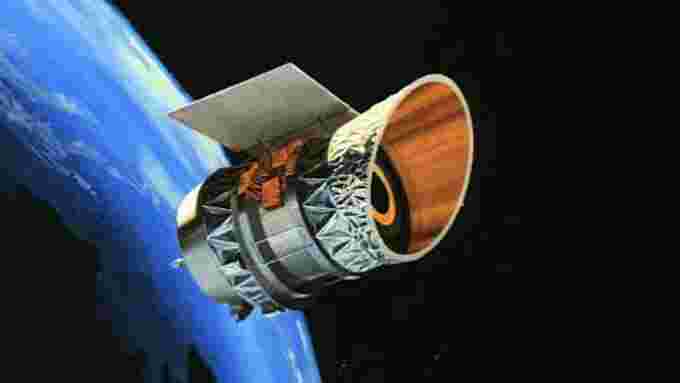 The Infrared Astronomical Satellite. Credit: NASA
According to Jonathan McDowell, an astronomer at the Harvard-Smithsonian Center for Astrophysics, IRAS has a mass of nearly one metric ton, while POPPY 5B is roughly 85 kg. While IRAS seriously outweighs POPPY 5B & GGSE-4, since the two are travelling at 14.7 kilometres per second (nearly 53,000 km/h) relative to one another, even a glancing blow between the two would tear both objects apart.
According to LEOLabs, the two satellites were originally predicted to pass within 15-30 metres of one another on Wednesday night. Normally, that would still count as a clean miss. As McDowell pointed out on Twitter, however, POPPY 5B/GGSE-4 has 18-metre-long gravity gradient booms – long antenna-like structures that extend far out from the satellite’s centre of mass. If the two were to pass within 18 metres of each other, it would very likely result in a high-speed impact.
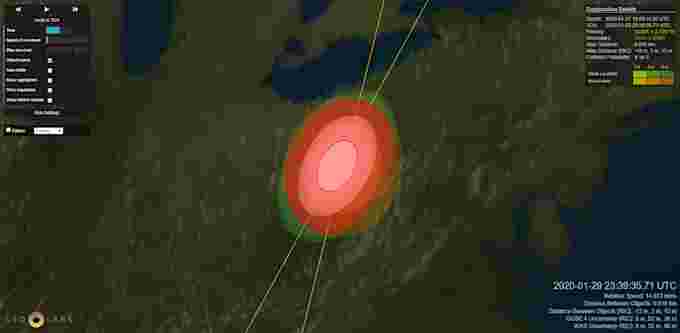 Satellite collision map for NASA IRAS and NRO/USN GGSE-4, in LEOLabs’ interactive viewer. Credit: LEOLabs
As of Tuesday night, LEOLabs updated their prediction, which now shows that the two satellites’ closest pass will likely bring them to within 13-87 meters of one another. Although the update includes the potential for the satellites to be even closer than in Monday night’s prediction, the farthest pass is nearly three times the original distance. Thus the chance of impact went down from 1 in 100 to 1 in 1,000.
Our latest data on the IRAS / GGSE 4 event shows potential miss distances of 13-87 meters, with a lowered collision probability currently at 1 in 1000. Time of closest approach remains at 2020-01-29 23:39:35.707 UTC
If these two dead satellites do end up colliding, it will result in a cloud of shrapnel and debris, which would continue to orbit the planet. There is very little chance of the satellites crashing to Earth, as they are too far up to be dragged down by friction with Earth’s atmosphere. There is the chance that some of the debris could end up in orbits that put other spacecraft – functional satellites and even the International Space Station – at risk of further impacts.
Although a sensationalized, extreme version of what is known as the Kessler Syndrome, the 2013 movie Gravity is an excellent example of the cascade effect impacts in orbit can have.
This potential impact highlights the need for space agencies and corporations to do everything they can to reduce the amount of space junk in orbit of our planet – both by removing the junk that is already there, and reducing the amount of junk that is added during future launches.
This story will be updated as the situation develops.
Teaser image is a combination of artist impression drawing of IRAS and POPPY 5E, credited to NASA and NRO/USN, respectively, and combined by Scott Sutherland
Sources: LEOLabs | NASA | Jonathan McDowell