

TORONTO —
B.C. is bracing for a second storm as the province continues to recover from the aftermath of last week’s heavy rain, which brought flooding and landslides.
As of Monday morning, six B.C. communities are under a snowfall warning from Environment and Climate Change Canada, including the Fraser Valley, which saw thousands of residents evacuated last week. The Coquihalla Highway, which had already been partially destroyed due to mudslides, is expected to see 25 to 30 centimetres of snow from Monday afternoon to Tuesday.
Three communities in the province are also under wind warnings. Winds gusting up to 110 km/h are expected in the Central Coast, Haida Gwaii and the costal sections of the North Coast.
Environment and Climate Change Canada is also warning of possible freezing rain, localized flooding and landslides in the inland sections of the North Coast. The region is under rainfall, wind and winter storm warnings, and could see up to 90 millimetres of precipitation. In the North Coast town of Stewart, B.C., near the Alaskan border, snow is expected to melt as temperatures rise Monday, which could overwhelm or block drainage systems.
Officials from Environment and Climate Change Canada are scheduled to give an update Monday afternoon.
ABBOTSFORD DIKE SEALED
The City of Abbotsford announced on Sunday that a breach on the Sumas River dike had been sealed and the floodgates had been open.
The closure of the breach in the dike and the opening of the floodgates means that water is no longer flowing from the Sumas River into the former Sumas Lake bed, which was artificially drained in the 1920s to make way for farmland. Instead, the Sumas is flowing directly into the Fraser River, as intended, and the pump station is pumping water out of the former lake and into the Fraser.
The city remains under a state of emergency until Nov. 29. Abbotsford officials are also expected to provide an update on the flooding Monday afternoon.
HELP FROM THE FEDS
The federal government announced Sunday that employment insurance applications would be expedited for those left jobless or displaced due to the flooding in B.C.
Employment Minister Carla Qualtrough said affected residents should immediately apply for employment insurance benefits — even if they wouldn’t normally be eligible.
Amid shortages at gas stations and grocery stores, Emergency Preparedness Minister Bill Blair said that British Columbians living near the border could cross into the U.S. to purchase essential supplies and return without requiring a COVID-19 test for re-entry.
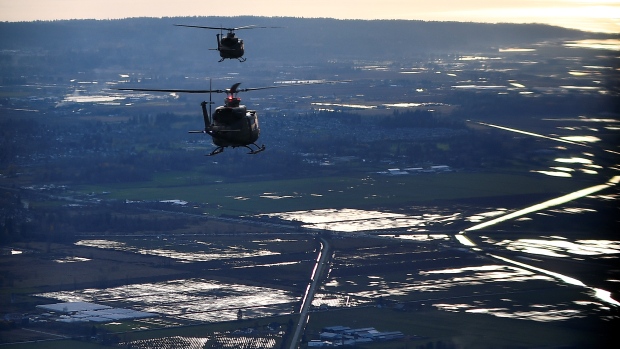
The feds have also sent 500 members of the Canadian Armed Forces to help with sandbag efforts. Defence Minister Anita Anand says thousands more are ready to go if needed.
EVACUEES WAITING FOR HOTEL REIMBURSEMENTS
While the B.C. government has promised accommodation reimbursements for those who were forced to leave their homes, evacuees say they are still waiting.
“For those who have been waiting, we will be reimbursing accommodation costs for those who are eligible. The process for that reimbursement is being worked through right now,” Deputy Premier Mike Farnworth said during a news conference Saturday.
The province has not provided an estimated number of flood-impacted British Columbians awaiting reimbursements.
The entire town of Merritt — home to over 7,000 residents — was forced to flee to hotels and motels in Kelowna or Kamloops, unless they had friends or family elsewhere who could temporarily house them.