


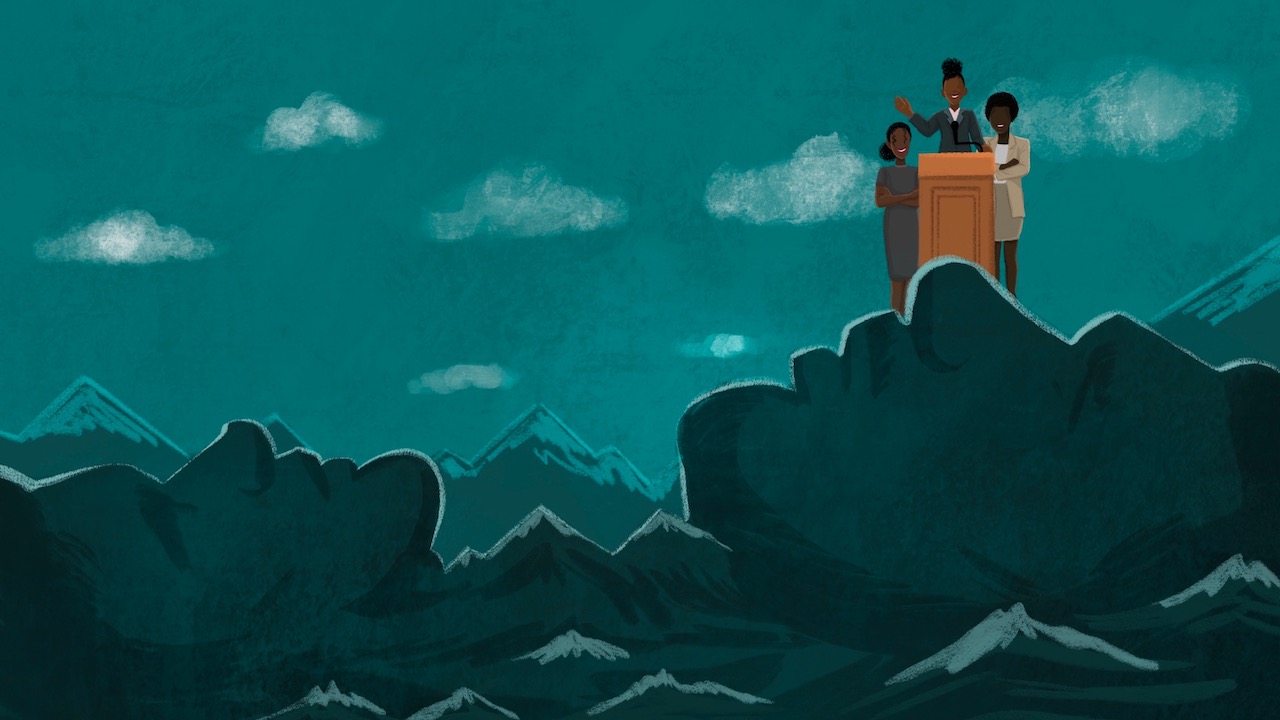
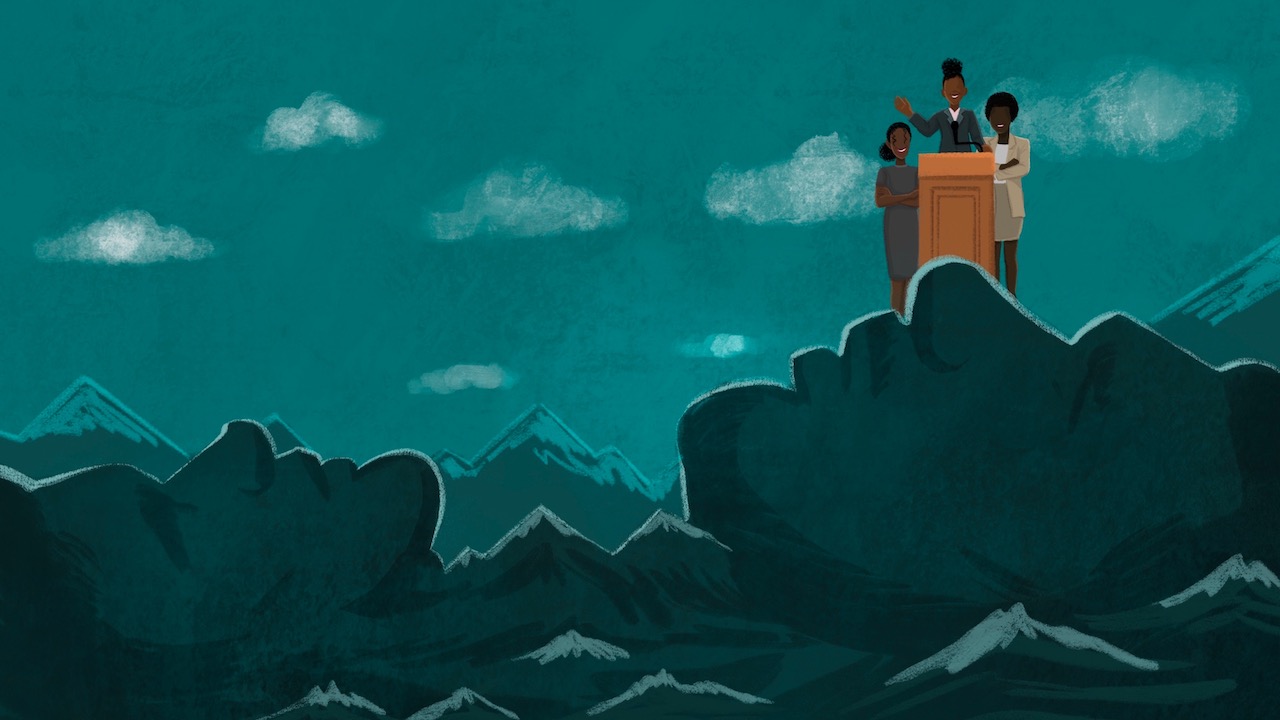
The first time Amber Morley saw Jean Augustine, she thought to herself, “That’s how you do it.” At the time, Morley was a student in middle school, and Augustine was serving as a member of parliament for Morley’s home riding of Etobicoke–Lakeshore, in Toronto. “Seeing this strong, beautiful Black woman grace our hallways with all her energy, leadership, care, and compassion, I always remember thinking, ‘That’s how you do leadership,’” Morley says.
When Black women in Ontario politics speak about their role models, Augustine’s name is often one of the first mentioned. The former MP was born in Grenada and arrived in Canada in 1960 through an immigration program that brought 3,000 women from the Caribbean to Canada to work as domestics. Later on, she pursued a career in education, eventually becoming an elementary-school principal. Augustine says that a number of people suggested she consider a career in politics but that she was reluctant at first: politics was often portrayed as a corrupt old-boys’ club, and as a Black woman, the idea of running seemed almost unimaginable to her and others then.
“We didn’t have people who were conscious of the fact that [Black women] needed to be there,” she says. “As a matter of fact, there were people in the community at the time saying, ‘What do you think you’re doing? Can you see anybody out there that looks like you?’ We did not, as a community, have the confidence that the system was ready for us.”
In 1993, Augustine made history as the first Black woman to be elected to Parliament; after serving as an MP for 13 years, she was appointed as Ontario’s first-ever fairness commissioner in 2007 and held that role until retiring in 2015. Her career inspired Black women across the country to get involved in politics — women like Morley, who, two decades after Augustine was first elected, ran for Toronto city council in Etobicoke–Lakeshore. While her 2018 bid was unsuccessful, Morley says she has every intention of running again: “It’s going be a different race this time around. They know I’m coming, and they know I’m not playing.”
According to Velma Morgan, chair of Operation Black Vote Canada —an organization that supports the election of Black people to public office — while Black women run at rates roughly equal to those of Black men, they still run in lower numbers compared to other demographics. She cites a number of possible reasons for this: Fundraising can act as a barrier for Black women who aren’t able to tap into major financial networks. So can preconceived notions about the kind of credentials a politician needs. “We think that only certain people run,” says Morgan. “A lot of us think that you have to be in business or in law to run and don’t realize that politics needs everybody. We need people from different demographics and different experiences in order to create good policies.”
When Black women do decide to enter politics, Morgan says, even though they might be newcomers, their lived experiences give them a wealth of political insight. “Black women are extremely political in terms of the work they do on a daily basis, the work they do in their community. We do a lot of political work, but when it comes to actually running for political office, we tend to either get deterred or shy away from it.”
For Kemi Akapo, the idea of becoming an elected official came from being a transit rider. In 2011, when Peterborough’s municipal government was considering cuts to the city’s transit system, Akapo went to city hall to share her point of view. “I was and continue to be a transit user,” says Akapo. “At that point, it was my only means of transportation, so I was very invested.” After that, she became involved in local campaigns; not long after, following nudges from others in local politics, Akapo ran her own in 2018 and was elected as the first Black female councillor in Peterborough.
Akapo calls the feat an honour, especially as she is not originally from Peterborough: she moved there from Nigeria in 2005 to attend Trent University. But being the first, Akapo says, comes with its own pressures: “If in people’s eyes, I don’t do a good job, then the next Black woman that comes forward, they might be like, ‘We tried a Black woman once, and we didn’t love her. So, I don’t know if we’re going to try that again.’”
Arielle Kayabaga, who in 2018 became the first Black woman ever elected to London city council and last year was elected as the Liberal MP for London West, says it was important for her to run for public office because she “realized that there were people who were making decisions for a number of us who don’t have an idea of our lived experiences.” Kayabaga was born in Burundi but moved to Canada at 11, fleeing the civil war in her home country. She says her background has allowed her to connect on a deeper level with constituents who have similar experiences and are looking for someone in power who understands them: “I’ve heard people say they are just happy because they can finally have a representative who has experienced the same struggles.”
The public judgment that comes with being a public figure can also be a deterrent for Black women, Morgan says: “Women are judged on the way they look, the way they dress; things are said to women online if people disagree with them. No one really wants to get into that kind of environment.”
Erin Tolley, an associate professor of political science at Carleton University, notes that politics can be a hostile environment, particularly for racialized women. “Historically, there haven’t been a lot of highly visible role models,” she says. “And when those role models come forward, in some cases, rather than being role models of what one is able to accomplish in politics, they instead become role models for how hostile the space is.”
When Black women are elected, many say their race and gender affect how others respond to them and inform their approach to navigating a political landscape that wasn’t created with them in mind. “Yes, I have experienced racism; I have experienced sexism in the legislature,” says Toronto–St. Paul’s New Democrat MPP Jill Andrew. “And it’s an interesting blend of being Black and being a woman, what the theorists have called misogynoir,” says Andrew. “The assumption is when I am being powerful and passionate in the legislature, for some reason, I’m rude, I’m aggressive, I’m the one that has to ‘watch her tone.’”
Zanana Akande, who in 1990 became the first Black woman to be elected as an Ontario MPP, has spoken openly about how she was received by her colleagues and the press. In 2018, the New Democrat told The Kit that “in the newspapers, they wrote about the fact that my nails were manicured. They would make reference to the car my husband drove. I wanted to ask the media, ‘Who do you expect the first Black woman in Ontario government to be?’”
Last year, Akande told TVO’s Steve Paikin, “I was rather disappointed because I thought, here I’m going to be sitting with people who are really focused on the issues that affect our lives — the finance, the education, the social services. I was excited, and I was prepared. I read. I read everything that I could read, and yet the conversation was quite different from that. And I realized all the intelligence isn’t existing in this room.”
In 1994, Akande resigned from the legislature. Three years earlier, Akande had stepped down as a minister due to a dispute over properties she owned. When asked to describe her time in provincial politics, Akande told reporters in 1991, “It’s been hell.”
In recent years, more Black women in politics have also left due to difficult experiences in office. Annamie Paul stepped down as leader of the Green Party of Canada in September 2021, calling her experience “the worst period in my life in many respects.” In 2019, Celina Caesar-Chavannes resigned as a member of the federal Liberal caucus, saying she’d dealt with racism, microaggressions, and tokenization during her interactions with Prime Minister Justin Trudeau.
Morgan says that these hostile environments can force Black women out of politics and that, while parties claim to prioritize diversity, they do very little to support Black women who attain public office. “Political parties say ‘come,’ because they’re Black women, and they bring their unique experiences. However, political parties don’t want them to bring their whole selves; they want them to bring pieces of themselves. And I think after not being heard, it gets to a point where they say, ‘Is it worth it?’ I think for a lot of them, the environment pushes them out.”
So what can parties do to support Black women? Morgan says they should provide adequate resources and information for Black women considering political life, mentor Black women, and run them in winnable ridings. Most important, Morgan says, they have to change the environment in politics if they’re serious about attracting and retaining Black women: “Right now, the environments is created for middle-class white men, and that needs to change.”
When it comes to voters, Tolley says the evidence shows that bias against Black women is not a significant hindrance. “People are fairly willing to vote for candidates regardless of their race or gender, as long as that candidate is a candidate for their preferred political party,” says Tolley.
Even in municipal elections, in which candidates are not often affiliated with provincial or federal parties, race and gender might not be a major stumbling block for Black women.
Kristin Murray, a Jamaican-Cree municipal councillor in Timmins, says that she was initially worried that her 2018 race would be a topic of conversation. According to the 2016 census, Black people make up less than 1 per cent of the city’s population; in 2018, the Ontario Human Rights Commission called racism “pervasive” in the city.
“People weren’t that concerned about that,” says Murray. “They just wanted something different. And maybe they saw that in me.”
Supporting Black candidates doesn’t simply affect government — a range of diverse candidates will likely increase the participation of diverse voters, says Tolley: “There is a definitive link between the presence of a more diverse range of people in public life and the desire and willingness of a broader range of voters to get involved and participate.” Tolley says there is evidence that, when members of historically underrepresented groups begin to run for office and get elected in larger numbers, that encourages voter participation. And there’s also a spin-off role-model effect, she adds, pointing to the fact that Hillary Clinton and Barack Obama increased the desire of young women and Black people to participate in politics
The impact extends to those who aren’t even old enough to vote. Kitchener Centre NDP MPP Laura Mae Lindo says, “I’ve had Black young women that have run up to me when they’ve seen me in the hallways and say that they couldn’t even believe their eyes when they saw somebody with [dreadlocks] standing in the chamber.”
Lindo says that, through her work with Black students in the region, she’s come across students who say that her example makes them feel like politics could be an option for them.
“A lot of young Black women, high-school students in particular, reach out to me. They are like, ‘Oh my gosh, I can’t believe that I could be doing that.’”
Ontario Hubs are made possible by the Barry and Laurie Green Family Charitable Trust & Goldie Feldman.
(left) closeup of a smiling, long-haired woman; woman wearing a purple blazer image widget

Follow Canada News Media
Get the day's top Canadian stories and our two daily 60-second news videos wherever you scroll.
X Threads Facebook Instagram LinkedIn TikTok YouTube Pinterest Reddit Substack Flipboard Newsletter RSS