


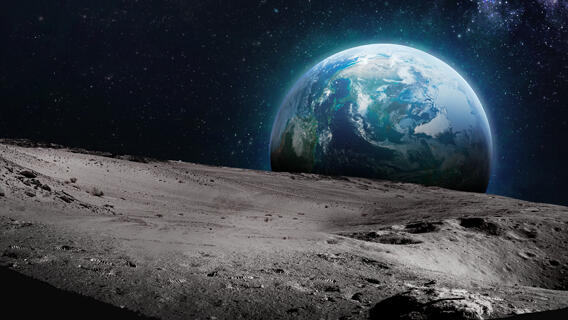
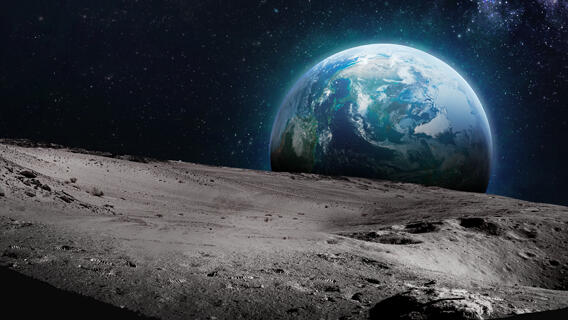
The Artemis rocket, NASA’s behemoth Space Launch System (SLS) designed to take humanity back to the moon is scheduled for its first test launch on August 29th. Leading up to that launch, the megarocket began rolling out to its designated launchpad, 39B, earlier this week at an incredible speed of 1km/h. The launch, which will send an unmanned Orion space capsule into lunar orbit, is a test run for ultimately sending astronauts back for a lunar flyby in 2024 and a lunar landing as early as 2025.
That test launch, which is slated to last up to 42 days and should reach within 100 km of the lunar surface, will end only months before the 50th anniversary of the last time man was on the moon. The Apollo 17’s twelve-day mission returned home in mid-December 1972. In Greek mythology, Artemis is the twin sister of Apollo.
There will also be a Snoopy doll. Snoopy has long been associated with NASA’s space efforts, and this doll and other toys will be used as zero-gravity indicators to let researchers know when the rocket has entered zero gravity. Four Lego minifigures will also be on the flight in a nod to the longstanding relationship between NASA and Lego and as part of an effort to promote STEM education.
In addition to the scientific efforts of the Orion capsule, the ship will also carry over fifty kilograms of mementos, including a space time capsule, seeds, and an Amazon Alexa embedded in a device called Callisto, who in keeping with NASA’s Greek mythology inclinations, was Artemis’ hunting attendant.
In spite of this memento laden crewless Orion capsule, NASA claims that once it gets figuratively off the ground, its new Artemis program will, in contrast to the earlier Apollo missions, be less focused on ‘flags and footprints’ and more on science research and getting humanity ready for longer term habitats on the moon and ultimately Mars.
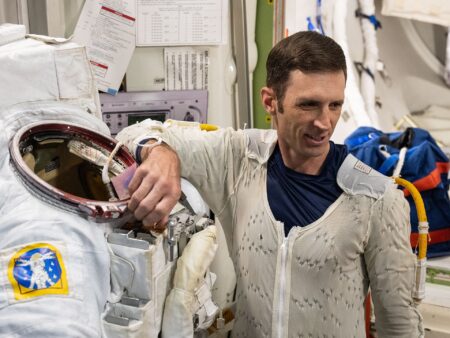
Notably, Israel isn’t the only country collaborating with the United States on its return to the moon. The Artemis program is a multinational effort of which Israeli is a recent member. Saudi Arabia just signed on as the 21st nation to the Artemis Accords during US President Joe Biden’s recent middle east trip. Canada is another collaborator on the Artemis project. The Canadian government will be providing a third iteration of its famous robotic Canadarm, as well as a moon rover for the project. A Canadian astronaut will also fill one of the four seats on the first crewed Artemis flight to the moon.
Given its interest in mankind’s return to the moon, Canada is keen on having its astronauts on their best behavior. As such, there was a recommendation to amend Canada’s criminal laws to specifically include the possibility of prosecution for misdemeanors committed on the moon by Canadians. Crimes committed on the International Space Station by Canadians already fall within the long-arm of the Canadian justice system.
While the US has not yet followed suit with similar legislation, US Vice President Kamala Harris recently announced an interest in revising other aspects of US space regulations so that they are more in-line with the current state of commercial space exploration. A follow-up tweet announced that this will be explored in greater detail next month, around the same time that the Artemis rocket will be sitting in Lunar orbit
However, expanding Canadian, or any other jurisdiction for that matter, onto the moon might come in conflict with what NASA administrator Bill Nelson claims is China’s goal of claiming the moon as its own: “We must be very concerned that China is landing on the moon and saying: It’s ours now and you stay out.” In their defense, China rejects that assertion.
Related articles:
Of course, China isn’t the only national player that might lay claim to some or all of the moon. The Artemis Accords to which Israel is a signatory, allow for national efforts to mine and extract valuable resources from the moon and other celestial bodies — a potentially, hugely profitable endeavor. In spite of non-appropriation and ‘province of all mankind’ language within the universally accepted Outer Space Treaty.
All these lunar land claims could create some interesting legal precedent. The last time NASA had a legal tussle with putative private property proprietors in space. they won against the pro se claimant on a technicality (Nemitz v. NASA, 126 Fed. Appx. 343 (2005). Hopefully with so many potential claimants and the possibility of a manned lunar base, the next time NASA is sued for landing on someone’s lunar claim, the outcome will be more interesting.
Prof. Dov Greenbaum is the director of the Zvi Meitar Institute for Legal Implications of Emerging Technologies at the Harry Radzyner Law School, at Reichman University.

Follow Canada News Media
Get the day's top Canadian stories and our two daily 60-second news videos wherever you scroll.
X Threads Facebook Instagram LinkedIn TikTok YouTube Pinterest Reddit Substack Flipboard Newsletter RSS