


Hundreds of thousands of customers in Eastern Canada are without power as post-tropical storm Fiona brings intense, hurricane-strength winds and torrential rains to swaths of Nova Scotia, Prince Edward Island, New Brunswick, Newfoundland and Quebec’s Magdalen Islands.
Part of the town of Port aux Basques, N.L., has been placed under an evacuation order after storm surge swept away multiple homes and structures to sea. It’s unclear if there are any casualties. The town has also declared a state of emergency.
Fiona made landfall in Nova Scotia shortly after 4 a.m. AT between Canso and Guysborough.
The Canso Causeway, which links Cape Breton to mainland Nova Scotia, is closed to high-sided vehicles.
As of 10:45 a.m. AT, more than 405,000 Nova Scotia Power customers were without electricity. The company says it has more than 525,000 customers. It said people can go the utility’s outage map for estimated restoration times.
- CBC Radio is providing live updates on Hurricane Fiona around the clock. Listeners are invited to call in to share their storm experiences and any emergency updates from their communities at 1-800-565-5550. Listen online via CBC Lite, which uses less data, or over the air (90.5 FM in Halifax, 92.1 FM in Sydney, 96.1 FM in Charlottetown or check your local frequency here).
P.E.I.’s Maritime Electric said more than 82,000 out of a possible 86,000 customers were without power.
N.B. Power was reporting more than 55,000 outages, concentrated in the province’s southeast. The outages are mostly in areas the company groups as “Shediac Cap Pelé,” “Moncton Riverview Dieppe” and “Sackville Port Elgin.”
Conditions are like nothing we’ve ever seen. We are logging reports of downed trees and wires but will only be responding to emergency calls. -Dispatcher Kelly ☎️ <a href=”https://t.co/gX7YPTPDSN”>pic.twitter.com/gX7YPTPDSN</a>
—@ChtownPolice
Newfoundland Power was reporting 1,133 customers without power, and Hydro Quebec reported 4,232 without power in the Gaspésie–Îles-de-la-Madeleine region and1,684 in the Magdalen Islands.
Hurricane or tropical storm warnings are in place throughout most of Atlantic Canada and southern Quebec.
State of emergency declared in Cape Breton
The Cape Breton Regional Municipality and neighbouring Victoria County have declared a local state of emergency and are asking residents to stay at home.
The Canadian Red Cross has opened a shelter at Centre 200 in Sydney, N.S., however it was without power on Saturday morning. The municipality is planning to open additional comfort centres when local travel is safe.
North Sydney fire Chief Lloyd MacIntosh spoke with CBC News as he was transporting a woman from her home to a safe location after the roof blew off her house.
“We pulled up, well, literally half of the roof was gone,” MacIntosh said. “It’s been an adventurous night to say the least.”

MacIntosh said there’s been a lot of damage in North Sydney.
“Every intersection, every block of North Sydney is filled with trees. Trees have come down on homes, trees have come down on cars, there’s buildings that have collapsed and there’s quite a bit of damages,” he said.
“The daylight will bring quite a few surprises for a few people.”
Part of a steeple came down from St. Joseph Church in Cape Breton Regional Municipality, a building that’s more than 100 years old.
Cellular networks spotty
Cellular networks were spotty across Nova Scotia and P.E.I. Saturday. Many were unable to get a cell signal to make calls or access internet.
Bell Aliant acknowledged the outages in a tweet posted Saturday morning. The telecom company they were working with utility companies to restore full power to their cellular sites as soon as possible.
“Numerous wireline and cell sites in Atlantic are impacted by power outages across the provinces. As battery back up power will begin to deplete, our teams will be activating generators to keep sites up and running,” the company tweeted.
Rogers also tweeted they are aware of the outages and their local crews will work to get services up and running.
CBC News has contacted Bell Aliant and Rogers for an update on restoration times.
Tree fell on fire truck with crew inside
Erica Fleck, the assistant chief of Halifax Regional Fire and Emergency, said a tree fell on a fire truck that had a crew inside. There were live wires.
She said the fire crew stayed in the truck as Nova Scotia Power technicians worked to get the crew out safely.
“The power lines are down everywhere,” she said. “It’s not safe to be on the roads.”

Fleck cautioned that response times will be longer because fire crews will have to remove downed trees that are in their way.
In a tweet, Environment and Climate Change Canada said the highest wind gust reported in Nova Scotia has been 179 km/h in Arisaig, north of Antigonish on Nova Scotia’s coast.
CBC meteorologist Tina Simpkin said wind gusts of 100 km/h were recorded in Moncton, N.B., shortly after 6 a.m.
Wind gusts of up to 100 km/h are expected in some areas of the province over the next 24 hours, with sustained winds clocking in at 65 km/h.
‘Like nothing we’ve ever seen’: Charlottetown police
In a tweet, Charlottetown police said they are logging reports of downed trees and wires but are only responding to emergency calls.
“Conditions are like nothing we’ve ever seen,” the force said in a post on Twitter.

CBC meteorologist Ryan Snoddon said the storm approached Nova Scotia at 64 km/h but slowed significantly as it arrived in the province. This will be a long-duration event for P.E.I. and eastern Nova Scotia, he said.
By 9 a.m., the centre of the storm will be moving to the western side of Cape Breton and it will slowly depart Nova Scotia.
Winds will ease in mid-to-late morning for central Nova Scotia and late afternoon or evening for eastern Nova Scotia, he said.
Nova Scotia Power’s efforts to restore electricity are being hampered by strong winds.
“We’re still seeing significant wind gusts, specifically Cape Breton,” said Peter Gregg, company president and CEO. “Until those wind gusts come down, we won’t be able to get crews out there. But we’re making progress in Halifax.”

Environment Canada said Fiona will reach the Quebec Lower North Shore and southeastern Labrador by late Saturday night.
The agency said severe winds and rainfall, large waves and storm surges were all occurring.
Environment Canada said rainfall will be significant, particularly north and west of Fiona’s track, where it could lead to flooding. Some areas could see as much as 200 millimetres of rain. About 120 millimetres had already been reported in some weather stations in eastern Nova Scotia by 3 a.m.

Some waves along Nova Scotia’s Eastern Shore could build to be more than 10 metres, with waves along southern Newfoundland on Saturday morning reaching higher heights.
“Waves over eastern portions of the Gulf of St. Lawrence and Cabot Strait could be higher than 12 metres,” Environment Canada said.
While we wait for the NHC’s official call, it looks like <a href=”https://twitter.com/hashtag/Fiona?src=hash&ref_src=twsrc%5Etfw”>#Fiona</a> has recently made landfall between Canso and Guysborough. With an unofficial recorded pressure at Hart Island of 931.6 mb, this makes Fiona the lowest pressured land falling storm on record in Canada. <a href=”https://t.co/TYo9G05sUz”>pic.twitter.com/TYo9G05sUz</a>
—@ECCC_CHC
It said the western Gulf will see waves from the north up to eight metres in some places, “which will probably cause significant erosion for north-facing beaches of Prince Edward Island.”
The forecaster said the Magdalen Islands will also see some coastal erosion from waves.
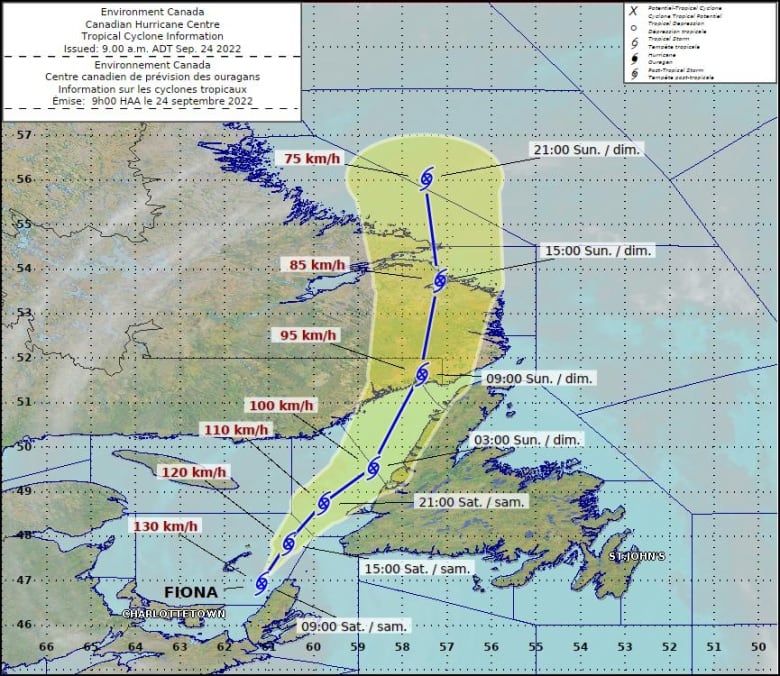
Coastal flooding is a big concern for Nova Scotia, Prince Edward Island, the Magdalen Islands, eastern New Brunswick and southwest Newfoundland.
“The highest risk for coastal flooding will be a combination of storm surge with large waves moving onshore,” Environment Canada said.

Hurricane Fiona arrived in Nova Scotia as a post-tropical storm Saturday morning. In Halifax, the largest community impacted, as CBC’s Ellen Mauro reports, there were widespread power outages and downed trees throughout the city.
“This is is definitely going to be one of, if not the most powerful tropical cyclones to affect our part of the country,” said Ian Hubbard, meteorologist for the Canadian Hurricane Centre in Dartmouth, N.S. “It’s going to be definitely as severe and as bad as any I’ve seen.”