

Mission will pave the way to send astronauts to the moon
⭐️HERE’S WHAT YOU NEED TO KNOW⭐️
- The Artemis I mission has launched to the moon.
- It serves as a test flight for the next mission: Artemis II.
- The goal is to soon land astronauts on the moon.
- It also serves as a stepping stone toward deeper space travel.
- Read on to find out what else Artemis I will do. ⬇️ ⬇️ ⬇️
Fourth time’s the charm?
After three cancelled launches, NASA’s Artemis I mission is finally a go.
On Nov 16 at 1:47 a.m. ET, NASA’s Space Launch System rocket with the Orion spacecraft took off from Kennedy Space Center in Florida, en route to the moon.
The spacecraft is part of a mission called Artemis I.
It has no astronauts aboard (yet) and will spend 26 days in space, entering the moon’s orbit before eventually returning to Earth in the Pacific Ocean.
The mission is a test flight for the rocket for a series of future missions that NASA hopes will eventually land astronauts on the moon for the first time in 50 years.
The larger goal of the Artemis program is to better learn how to keep humans alive in space to pave the way for future missions that will send humans to other planets, such as Mars.
What will Artemis I do?
Artemis I has several objectives.
First, there are three high-tech mannequins on board with special equipment designed to test the effects of radiation on the human body.

Space travel with humans has been historically difficult because space is incredibly dangerous to the human body. Orion spacecraft has three mannequins aboard to test what astronauts may experience during flight. (Image credit: NASA)
Radiation is a huge barrier for space travel since it can cause things like cancer, so better understanding the role of radiation will inform how to more safely send humans to space.
Artemis I will also launch 10 miniature satellites, called CubeSats, into the moon’s orbit to run experiments to further help future moon travel.
One of those experiments will test the safety of the lunar surface in order to pinpoint optimal landing points for astronauts.
But the main goal of Artemis I is to serve as a test flight.
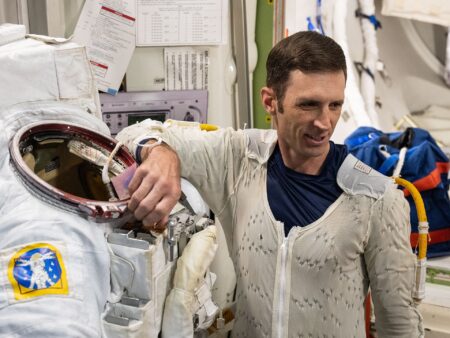
NASA scientists want to ensure the craft will run smoothly before sending humans on the same trip around the moon for Artemis II in 2024 — including a Canadian.
The hope for Artemis III, slated for 2025, is to actually land astronauts on the moon.
What’s the goal of the larger Artemis program?
The Artemis program has many goals, including sending the first woman and person of colour to the moon and studying the lunar surface.
But the Artemis program more broadly is a stepping stone toward future, more ambitious missions that send humans to planets like Mars and beyond.

An artist’s depiction of Orion spacecraft, left, preparing to dock the lunar gateway, right. The lunar gateway will serve as a base to allow astronauts to more easily study the moon’s surface. (Image credit: NASA)
For example, future Artermis missions will establish something called the lunar gateway, a space station in the moon’s orbit that could allow astronauts to travel back and forth between the moon’s surface.
It will serve as a model for future missions to Mars, and is just one facet of the program that will prepare humans for travel to farther planets.
You can learn more about the Artemis mission by clicking here.
Have more questions? Want to tell us how we’re doing? Use the “send us feedback” link below. ⬇️⬇️⬇️
With files from Nicole Mortillaro/CBC
TOP IMAGE CREDIT: Malcolm Denemark/The Associated Press