



NEWARK – Sheldon Keefe exhaled in between the answers he gave at his media availability on Monday with good reason. The loss of Ryan O’Reilly to LTIR with a broken finger was far from the only news the Maple Leafs coach had to cover.
What comes next for a team whose lineup remains in a state of flux?
Let’s start with O’Reilly, who took a shot off his left hand late in the second period on Saturday against the Canucks. Keefe confirmed O’Reilly broke his finger but didn’t put an exact timeline on his return as O’Reilly returned to Toronto to see a specialist for an accurate diagnosis. Keefe did stress multiple times that O’Reilly would be fit to return for the playoffs.
“We’ve acquired him to be healthy and ready to go for the playoffs,” Keefe said. “To that end, it’s not bad.”
Any player going on LTIR must remain out of the lineup for 10 games and 24 days.
“In essence, you go back to the way we were,” Keefe said of how he sees the forward group shaking out.
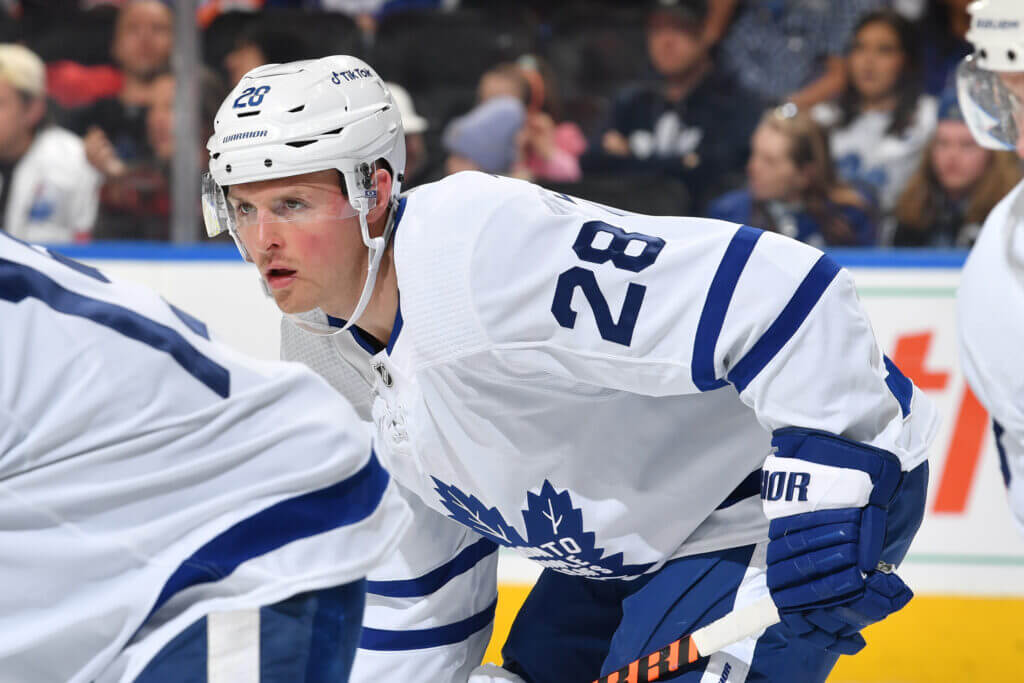
The most notable benefactor of the injury, at least immediately, is fellow new Leafs forward Sam Lafferty. Monday’s practice saw the speedy new acquisition deployed between William Nylander and Calle Jarnkrok after Lafferty spent his first three games on the wing.
“It gets (Lafferty) back into a position of comfort,” Keefe said.
The Leafs have been interested in plugging Lafferty into the middle of the ice, having been impressed while scouting him playing centre with the Blackhawks. That Lafferty kept his head above water playing in difficult head-to-head matchups with the Blackhawks stuck out to Keefe.
Lafferty could stick at centre when O’Reilly returns should the Leafs biggest acquisition this season end up playing on the second line with John Tavares. That would keep David Kampf in a fourth-line role. Whether Lafferty can use his wheels and form some chemistry with the Jarnkrok, more of a skilled and cerebral forward, might go a long way to determining his role down the stretch.
“Just try to use my speed, get pucks back and get it to those guys,” Lafferty said of his approach alongside Jarnkrok and Nylander. If he can also bring more of the physical element that’s been lacking from that line, all the better.
The loss of O’Reilly was further complicated by Tavares struggling with an illness on Monday. The Leafs captain practiced in a grey sweater and won’t play on Tuesday. Keefe said that decision was “out of an abundance of caution” and that a return for Saturday’s game against the Oilers is likely. Still, getting a clear picture of how the Leafs forward groups will look throughout this upcoming stretch without O’Reilly will therefore be difficult, at least against the Devils.
Keefe was hesitant to correlate Tavares’ missing Tuesday’s game with the hit he took from Canucks defenceman Tyler Myers.
Tyler Myers catches Tavares pic.twitter.com/u9JE81u6Pf
— Omar (@TicTacTOmar) March 5, 2023
“You’re a little bit more mindful of it. But there’s a lot more. There’s a bug going around, we’re travelling a lot, we just want to be sure. He got through the entire practice today and felt good,” Keefe said.
With O’Reilly on LTIR, the Leafs had the ability to call up both Pontus Holmberg and Alex Steeves from the Marlies. Holmberg and Steeves have spent the previous seven games together on a line with the Marlies, with a combined eight points in the process.
Steeves struggled with his early season AHL form but has improved as of late with responsible two-way play. And Holmberg has shown off more offensive touches in his game in the AHL while looking like an NHL-ready defensively-minded centre during his 36 games with the Leafs this season.
“Their skill sets match,” Keefe said of the pair, who are projected to play with Michael Bunting.
With 19 games remaining in the regular season, this call-up feels like one of the last opportunities both players will get to earn a spot in Keefe’s playoff lineup, if there is any space for them at all. Holmberg in particular has shown, despite a few errors here and there, that he can earn Keefe’s trust with his ability to read plays in the offensive and defensive zones.
Sticking with the forward group, Bunting continues to see his role diminish. Once seen as a de facto left winger with Auston Matthews and Mitch Marner, Bunting’s offensive effectiveness has waned. As Jonas Siegel recently noted, Bunting averaged 15.5 minutes ATOI in February, down from 17 minutes a game in January.
“I don’t know,” a perturbed-sounding Bunting said when asked where he thinks his game is at right now. “It is what it is. I’m hopefully going to get it back here.”
Coupled with some unnecessary penalties as of late, it feels like both Bunting and Keefe are looking for the player to hit the reset button.
“I just want him to worry about his game,” Keefe said. “That’s a big part of why we changed the lines. When you’re playing up on that top group, not only is the expectation high in terms of production, but the matchups are difficult.”
The expectations have shifted. Now, Keefe wants Bunting to use his speed, tenacity and playmaking to drive a line with two relatively inexperienced players alongside him. Doing so could help solidify his case that he should be back beside Matthews and Marner sooner rather than later.
“There’s a bit of a mental block there for him right now,” Keefe said. “And we’re trying to help him through that. He’s an important guy. I have full confidence he’ll end up back with Matthews before long.”
And as if that wasn’t enough on the news front, new Leafs defenceman Luke Schenn was absent from practice. The former Canuck stayed in Vancouver after Saturday’s loss as his family is expecting the birth of their third child.
The defence pairs saw some movement as well as a result, with Timothy Liljegren joining Morgan Rielly on a pair. Liljegren had spent the last two games in the press box as a healthy scratch as Keefe experimented with a lineup featuring 11 forwards and seven defencemen. Keefe will, rightfully, return to 12 forwards and six defencemen against the Devils on Tuesday.
Liljegren should slot in on the team’s second power-play unit as well.
“As I’ve talked to him about, our team is deeper on defence than it was prior to the deadline. So with him, and the rest of our defence, the standard is higher in terms of staying in and competing with that,” Keefe said.
For his own part, Liljegren believes his game has taken a step forward this season because of how often he’s played against top forward lines compared to sometimes being sheltered in previous NHL stints.
All in all, the Leafs adjustment to the steady stream of new faces in the days leading up to the trade deadline and then after the deadline itself continues to be a work in progress. It was noteworthy to hear Lafferty say on Monday that there’s more offensive structure in the Leafs system than he’s been used to. Assuming he’s not alone, the ripple effects of the new acquisitions may continue to be felt throughout this upcoming stretch.
On one hand, synergy among linemates and pairs can be hard to come by with the amount of changes there’s been to the Leafs lineup. The flipside of that argument is that the serious depth and options that the influx of players provides Keefe is a boon to someone who prefers to experiment and move pieces around in his lineup to find a formula he likes.
That perhaps is why Keefe stressed on Monday that blaming the latter for the team’s two losses in their last three games since they acquired Lafferty and Jake McCabe from the Blackhawks is “letting us off the hook too easily, frankly.”
“The more time that passes,” Keefe said, “we will get better as a group.”
(Top photo of Sam Lafferty: Andy Devlin / NHLI via Getty Images)

Follow Canada News Media
Get the day's top Canadian stories and our two daily 60-second news videos wherever you scroll.
X Threads Facebook Instagram LinkedIn TikTok YouTube Pinterest Reddit Substack Flipboard Newsletter RSS