Canadian-led research has now doubled the number of repeating fast radio bursts detected by telescopes.
Repeating fast radio bursts remain a mystery for astronomers, but these new discoveries could lead to key answers about them, and provide insights about other mysteries of the cosmos as well.
Fast radio bursts, or FRBs, are brief, powerful pulses of radio waves detected from space. Some can last up to three seconds long, while others appear and disappear in a fraction of a millisecond. However, their origin is a mystery. Given the amount of energy they carry, researchers speculate that they are produced by some of the highest energy events in the universe — supernovae, gamma-ray bursts, or collisions between neutron stars, pulsars, or black holes. The only thing that is known for sure is that most FRBs originate from outside our galaxy.

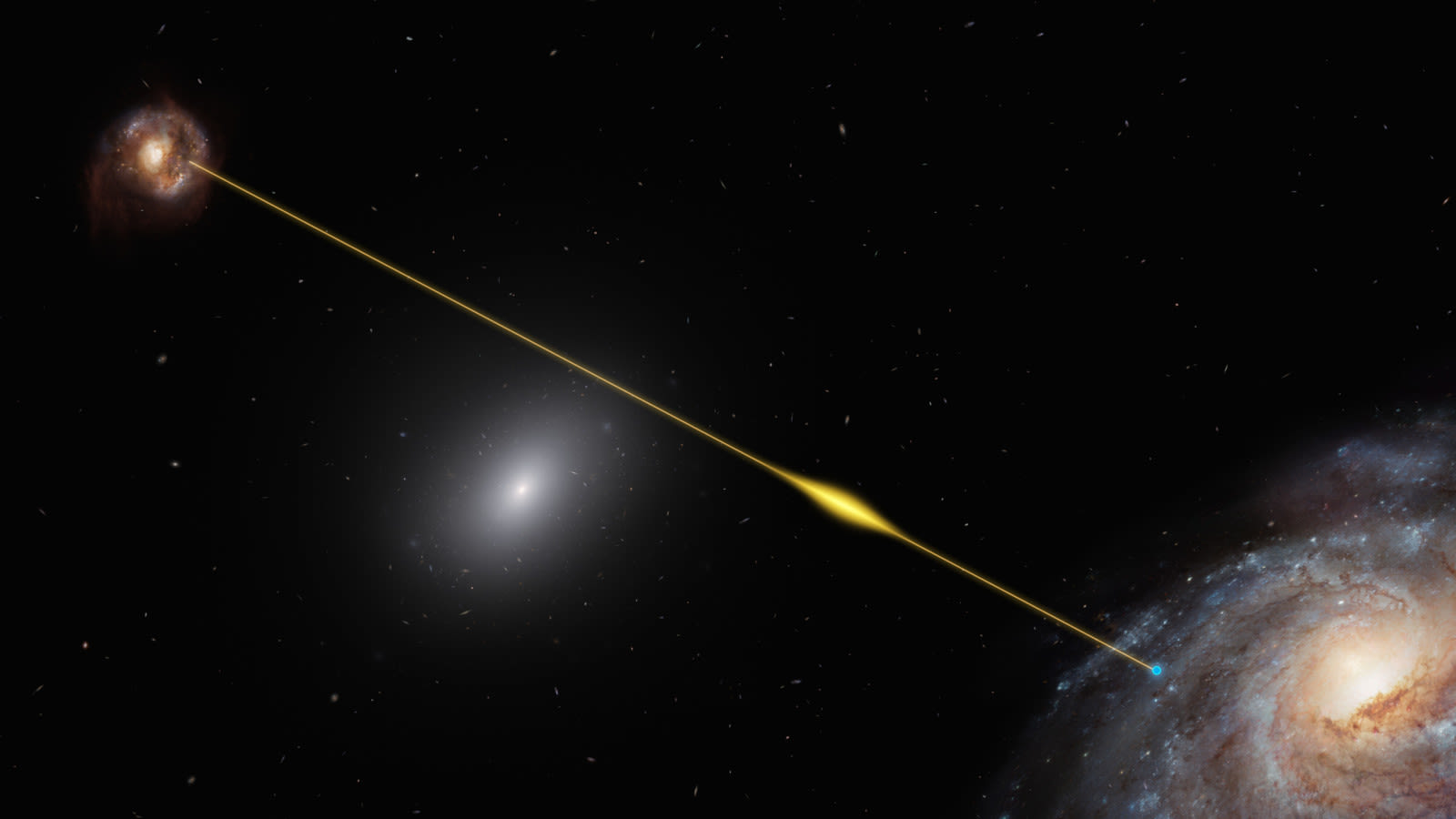
This artist’s impression shows a fast radio burst travelling between its source in a distant galaxy (top left) towards Earth in the Milky Way (bottom right), passing through the halo of a massive galaxy along the way. Credit: ESO/M. Kornmesser
It’s been over 15 years since the first FRB was detected from space. In that time, hundreds more have been found, but still, astronomers are no closer to figuring out exactly what causes them.
Even more puzzling are the few FRBs found that periodically repeat. Until now, of the hundreds of FRBs detected, only 25 belonged to a particular class known as repeating FRBs.
Finding what was missed
In new research, a Canadian-led team of astronomers turned up another 25 repeating FRBs, doubling the number already discovered.
The researchers found them by performing the very first delve through all of the data gathered between September 2019 and May 2021 by the Canadian Hydrogen Intensity Mapping Experiment. CHIME is a unique, highly-sensitive radio telescope at the Dominion Radio Astrophysical Observatory near Penticton, British Columbia, located on the traditional, ancestral, and unceded territory of the Syilx/Okanagan people.