

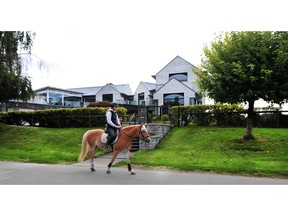
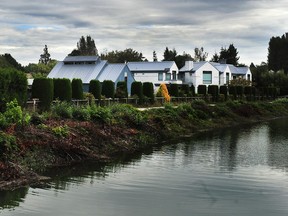
When the sale of a waterfront Southlands acreage that was partly willed to a Vancouver man eventually sold, he got $7.5 million, about half of the listed value.
Byron Stanley put the blame on his realtor’s negligence, for what he said was overpricing of $13.8 million of the four-acre property with equestrian stables and paddocks in one of the most exclusive areas of Vancouver, according to recent decision in B.C. Supreme Court.
Stanley has filed a lawsuit in B.C. Supreme Court, asking for about $1.6 million in damages from the realtor and his company Angell Hasman and Associates.
The suit said that by the time the property was sold, “Mr. Stanley was in financial distress, resulting in his selling (the property) at a discount,” and as a result was seeking $1,150,000, the difference between the fair market value and what he sold for, according to the lawsuit.
Stanley was also seeking damages to compensate him for the $45,000 a month in interest charges he paid on his loan for the estimated 10 extra months the property took to sell because of delays he said were caused by the realtor.
Many years and much litigation later, first in Supreme Court, where he lost his lawsuit against realtor Grech, and in the B.C. Court of Appeal, where his appeal was dismissed and the Supreme Court decision upheld, Stanley was left with a fraction of the $12 million he had hoped to make on the sale, according to court documents.
Skolrood noted the Supreme Court judge found that Grech had breached his duty by failing to get legal advice or to recommend Stanley do so, but he held the “breach did not cause Mr. Stanley’s damages.”
The Supreme Court judge said there was no evidence to show that Stanley lost money because of that breach. And the earlier judgment found Stanley had collaborated with Grech on the asking price.
Skolrood dismissed the appeal on the grounds that Stanley failed to identify a legal error in the lower court decision and that he said he lost money from the high listing price but didn’t appeal the judge’s finding that Grech wasn’t negligent in recommending the list price.
And Skolrood wrote that if Stanley had received legal advice about development limitations on the land and assumed as a result wouldn’t have lost the money is “mere speculation” presented without evidence.
Stanley had grown up in Southlands and his mother had been a friend of Reid’s and her husband, who predeceased her. For 35 years Stanley was like a son to her and called her his aunt, according to the Supreme Court judgment.
Stanley had lived at the property during her last years, caring for her while she lived with dementia and caretaking the property.
After Reid died in 2016, Stanley couldn’t afford to buy the property even at half its $9 million value, so he borrowed $4.5 million plus $1 million for other expenses, including interest payments on the loan that he obtained from a private lender because he didn’t qualify for a conventional bank loan.
He hired Grech and the property was listed the day Stanley’s purchase of the home completed on Feb. 27, 2017, and the house was listed at $13.8 million.
The property was part of a two-lot strata after Reid created one to accommodate the sale of a second house, which meant any development on the property needed unanimous consent from all strata owners. The existing first house was a modest 2,000 square feet and a house up to 7,000 square feet was permitted but it would require using the limited common property.
Article content
Such strata restrictions make sales more difficult and the owners and others flagged this to Grech, who told Stanley during the sale period, according to the judgment.
Grech, who primarily worked on the North Shore, wasn’t familiar with strata restrictions and Stanley assured him several times his property could be developed without consent of the other strata owners, Skolrood wrote.
The asking price was dropped as offers were made and countered, and then dropped by the buyers, and eventually it was the owner of the other strata unit who bought the property on April 21, 2018. As owners of both strata lots, they could build the 7,000 square foot house that now exists on the property.