



The Art Gallery of Hamilton has more than 10,500 works but only space to display a fraction of them.
Depending on programming, visitors might see between two and four per cent, says Shelley Falconer, president and CEO.
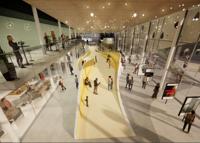
But the AGH has a plan to change that through a 48,000-square-foot expansion that includes a four-storey extension at the south of the building with a new entrance on Main Street across from city hall.
The estimated $90-million project also calls for new gallery space for its permanent collection and a new exhibition area to chronicle local history and innovation.
The plan also calls for more storage capacity, a new theatre, as well as additional education and event spaces, including a revamped outdoor plaza featuring a splash pad and skating rink.
“It would be an open and welcoming public art museum for the people of Hamilton,” Falconer said. “And that whole area around the building also would be activated.”
To pay for expansion, the AGH is angling for federal and provincial funding, and plans to launch a national fundraising campaign to realize the ambitious initiative.
And a “signal from the city” would help encourage contributions from senior levels of government and inspire donors, board member Eleanor McMahon told council in a recent presentation.



Ottawa has funded a feasibility study of expansion concept, which bodes well for an upcoming application for capital dollars via the Canada Cultural Spaces Fund, McMahon noted.
The gallery — which has operated on King Street West beside the convention centre since 1977 through a long-term lease agreement with the city — was last renovated in 2005.
It’s collection spans 700 years of history and includes works by the Group of Seven, Tom Thomson, Norval Morrisseau, Emily Carr and Alex Colville.
The city — which founded the non-profit entity in 1914 and is co-owner of the collection — has a vested interest in the gallery, board member Tom Wilson told council.
“For me, that’s a flag that should be waved by all of us regularly, so it’s ours,” the Hamilton musician and artist said. “What are we going to do about it? What are we going to do with it?”
The AGH wants to work with the city “as a partner” on its future vision, Falconer added. “That’s your land. It’s your collection, so it’s something that we need to do with the city.”
‘New relationship’
The gallery receives a $1-million annual grant from the city, but no regular based funding from the federal and provincial governments.
That’s 16 per cent of its revenue, which is low compared to other galleries of its size and stature, Falconer said. About 60 per cent is drawn from donations and fundraising efforts, while earned proceeds make up the balance.
“We can’t afford to take care of this building,” Falconer told The Spectator, noting the city could help with “in-kind” services, such as covering insurance and maintenance.
Council has directed staff to review the city’s partnership with the AGH and its funding model, which was established in 2007.
It’s time for the city forge a “new relationship” with the art gallery, which is a “critical part” of Hamilton’s downtown renewal, said Coun. John-Paul Danko, who sits on the board.
“The part of the collection that we know is really the tip of the iceberg, and there’s no much more there that it really needs to be on display and celebrated by the city.”

