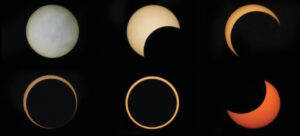

The ring of fire: Different phases of the eclipse as seen from Albuquerque, New Mexico. Annularity or “the ring of fire” will last four minutes and forty-eight seconds. PHOTO BY DAVE GIBSON
It has been eleven years since I witnessed my only annular solar eclipse while in Albuquerque, New Mexico. A breathtaking event sometimes referred to as “the ring of fire,” an annular eclipse occurs when the Earth, moon, and sun are in perfect alignment. Unlike a total solar eclipse where the moon is at its closest distance from Earth (perigee), during an annular eclipse the moon is near or at its farthest away (apogee), resulting in a bright ring of sunlight visible from Earth encircling the darkened moon.
On Saturday, October 14, the rare celestial event will transpire across a large swath of the western U.S. from Oregon through Texas. At peak viewing, over 90% of the sun will be obscured by the moon. To experience the ring of fire, you must position yourself within its 116-mile-wide path. Although passing through the extreme southwest corner of Colorado, once again Albuquerque, for most of us, is a convenient location from which to view the heavenly happening. The weather forecast at the moment is calling for clear skies with scattered clouds.
In Albuquerque, the annular solar eclipse starts at 9:13 a.m. MST and reaches annularity at 10:36 a.m. before the moon begins its exit into the brightening sky. Beginning at 8:30 a.m., the University of New Mexico is hosting an Enchanted Eclipse 2023 celebration at Johnson Field. Solar viewing glasses and maps will be available at no charge and telescopes set up throughout the field for safe solar viewing. If you plan on photographing the eclipse, you’ll need a solar filter for your camera. The show will conclude at 12:09 p.m.
For more information, go to www.eclipse.unm.edu.