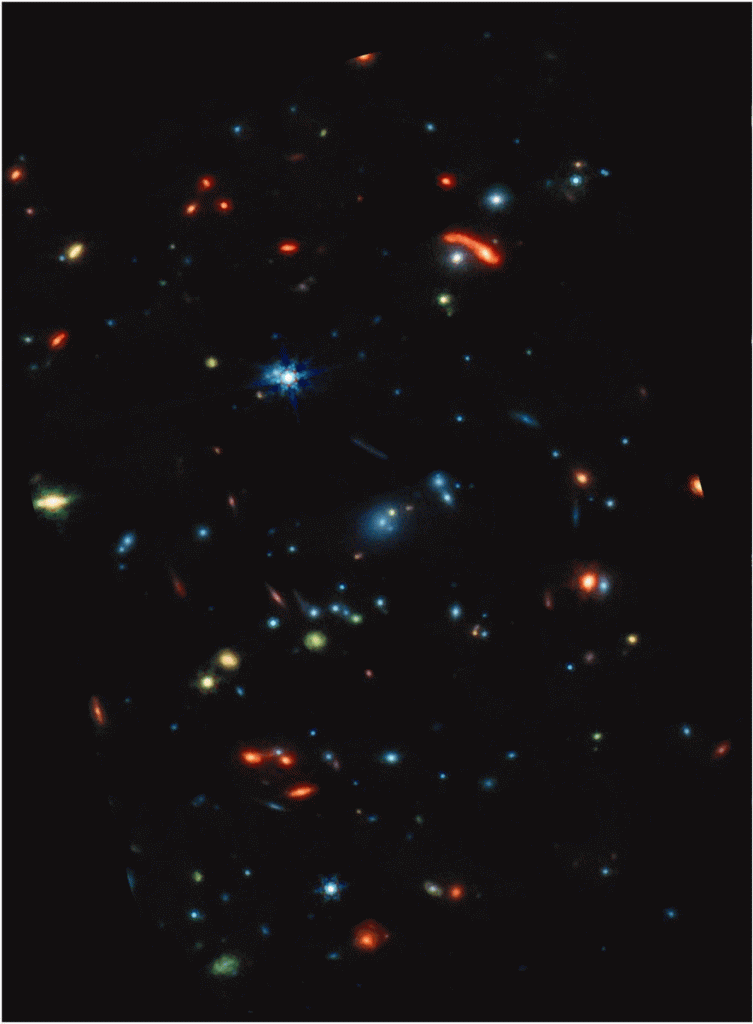


NASA on its social media shared another marvel of space, the ‘Hidden galaxy’, also known as the spiral galaxy.
The galaxy, which is located nearly 11 million light-years away from Earth, was captured using the Hubble telescope. The European Space Agency’s Euclid mission had captured the stunning image of the galaxy.
“The spiral galaxy above also known as the “Hidden Galaxy,” is the first of five images released from the Euclid mission,” wrote NASA, in the caption on the social media platform Instagram.
The space agency further added that the galaxy is located around 11 million light-years away from Earth and it is located behind a crowd of dust in the Milky Way.
“Located about 11 million light-years from Earth, it lies behind a crowd of dust in the Milky Way. Euclid is able to peek through the dust to study it by using a near-infrared instrument. “Euclid’s first images mark the beginning of a new era of studying dark matter and dark energy,” said Mike Seiffert, Euclid project scientist at @NASAJPL. NASA teams will join Euclid scientists to study the dark energy, dark matter and galaxy evolution found in space,” the caption read.
“The @EuropeanSpaceAgency’s Euclid mission launched on July 1, 2023, with NASA contributions. The space telescope is performing as expected after travelling nearly 1 million miles to its vantage point,” it added.Spiral galaxy shares similarity with Milky Way
Typically, a spiral galaxy has a rotating disc with spiral ‘arms’ which curve out from a dense central region. The Milky Way is also considered as a spiral galaxy.
Describing the galaxy’s image in the caption, NASA wrote, “A big spiral galaxy is visible face-on in white/pink colours at the centre of this square astronomical image. The galaxy covers almost the entire image and appears whiter at its center where more stars are located. Its spiral arms stretch out across the image and appear fainter at the edges. The entire image is speckled with stars ranging in colour from blue to white to yellow and red, across a black background of space. Blue stars are younger and red stars are older. A few of the stars are a bit larger than the rest, with six diffraction spikes.”
Just after 5 hours of getting posted, the image garnered more than 2 lakh likes on Instagram. The image shared by NASA appeared to have left the space-lovers absolutely mesmerised.
A user wrote, “That would make an out-of-this-world holiday ornament! We’re sure people would make space on their tree for one.”
Another user said, “This telescope will produce great science!” “Wow, this is what everyone needed to see before going to bed! Such dreams to everyone,” wrote the third user.
(With inputs from agencies)