

“We are a cement company, so we are really not specialized in cultural-heritage management,” says Johanna Daunan, head of sustainability at SIG in Jakarta. But she says that the company is committed to doing what it can to protect the sites and it has already taken measures to reduce the amount of dust coming from its operations. One problem, says Daunan, is that there are few government regulations to guide the firm on what levels of dust, pollution and vibrations might be safe for the rock art.
Fragile paintings
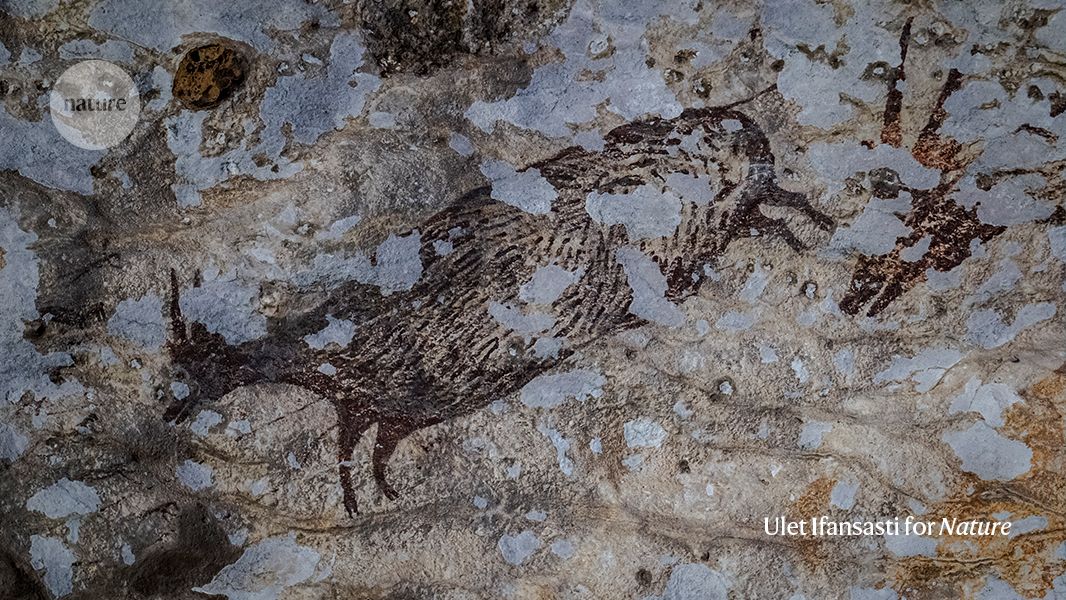
Lebe and others who work in the caves are convinced that dust from Semen Tonasa’s mines — and others in the region — is a big problem. “Absolutely the dust comes into the caves,” Lebe says, “especially the caves situated near the mining and industries.”
Although he is concerned about the impacts of Semen Tonasa’s activities, they are only one of several mining operations in the region that he says could be affecting the cave art. A spokesperson for one company, Bosowa Semen in Maros, told Nature that it is not aware of heritage sites located in its mining concession and that it will let Lebe know if its employees find any caves; Lebe has not been granted permission to explore that area.
Even so, diagnosing the sources of deterioration for rock art is a challenge all around the world. Every site is unique, and causes can range from biological and physical to behavioural ones. In India, visitors scrawl over the top of prehistoric paintings, or chisel them off as souvenirs. In Tanzania, tour guides throw water onto images to brighten the contrast, not realizing that it causes the pigments to fade and disappear. Even the mere presence of people can alter a cave’s microclimate, bumping up the temperature, humidity and carbon dioxide levels with each exhaled breath. In the Lascaux cave, this caused the growth of algae, fungi, bacteria and salt crystals, so access is now limited.
Pollution from traffic and agriculture can also cause untold damage. Dry pollution particles can, when combined with water or moisture in the air, turn to nitric or sulfuric acid, which dissolves the rock face and any artwork on it, says Johannes Loubser, a rock-art specialist based in New York City.