

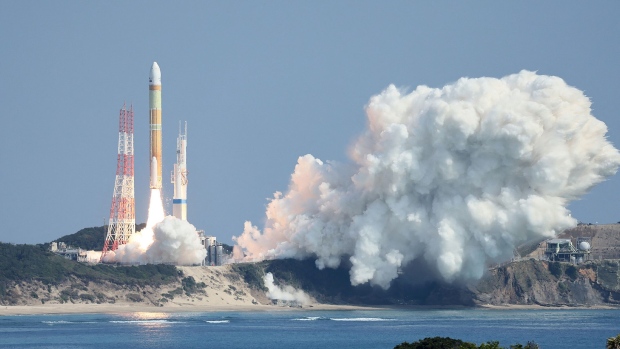

(Bloomberg) — Japan plans to launch its flagship H3 rocket in February following two failed attempts to inaugurate the craft during what was a woeful 2023 marred by costly missteps and major setbacks.
The H3 rocket should now take off between 9:20 a.m. and 1:00 p.m. local time on Feb. 15 from the Tanegashima Space Center in southern Japan, although the exact launch window is subject to change due to weather conditions and won’t be finalized until two days prior, the Japan Aerospace Exploration Agency (JAXA) said Thursday.
The 63-meter-tall heavy payload rocket, built by Mitsubishi Heavy Industries Ltd., represents Japan’s latest attempt to capitalize on growing demand for launch vehicles in the global space industry.
Read more: SpaceX Cements Dominance of Rocket-Launch Market as Rivals Flail
JAXA wants it to compete with the Falcon 9, the reusable rocket from Elon Musk’s Space Exploration Technologies Corp., or SpaceX as it is more commonly known. While the H3 has some parts that can be recycled, the Japanese rocket is single-use only.
The H3 rocket was supposed to make its inaugural launch in February this year but a malfunction between the main engine and side booster forced operators to keep it grounded.
A second attempt in March ended dramatically after the rocket’s second-stage booster failed to ignite, giving JAXA no choice but to shut down the engine and send it — and the satellite it was carrying — plummeting into the Philippine Sea.
The H3 is meant to replace the H2-A, which was first introduced in 2001 as the country’s flagship rocket.
JAXA said in October that it aims to eventually launch six H3 rockets annually as nations race to claim a slice of the growing aerospace market.
–With assistance from Bruce Einhorn.
©2023 Bloomberg L.P.

Follow Canada News Media
Get the day's top Canadian stories and our two daily 60-second news videos wherever you scroll.