


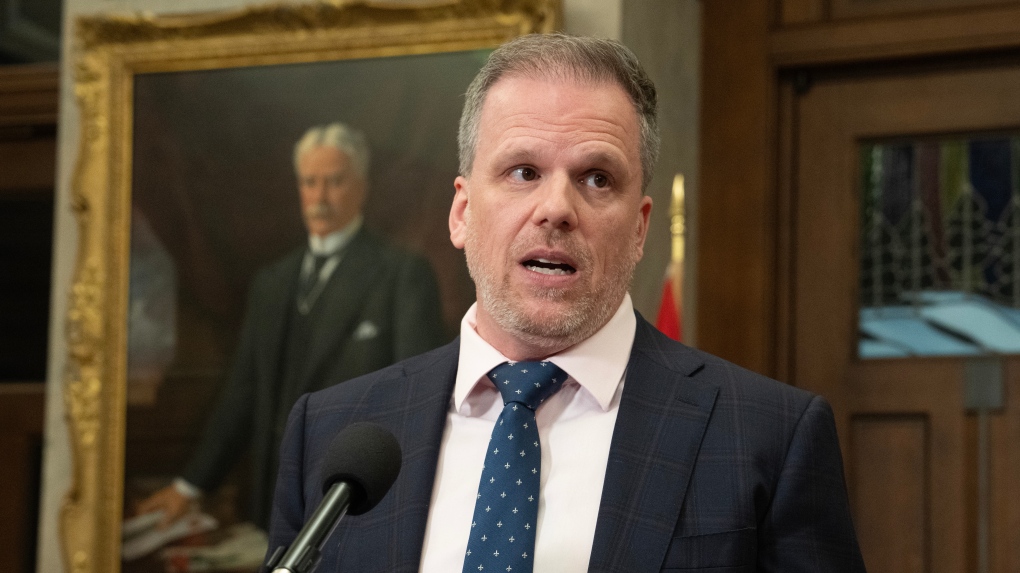
Health Minister Mark Holland has tabled a much-anticipated piece of legislation laying out the Liberals’ plans to implement a national pharmacare framework, satisfying a core commitment to the NDP.
Presented in the House of Commons on Thursday morning—one day ahead of the March 1 deadline agreed to by both parties—the bill is expected to outline the core principles of a national drug coverage plan, but not directly implement one.
While the details of the legislation have yet to be revealed—Holland has a press conference at 11:30 a.m. —the NDP has confirmed that the legislation will come alongside a commitment to launch diabetes medication and birth control coverage for every Canadian with a health card, through a single-payer system.
“Everyone in our country will get free diabetes medication. To women who have seen, south of the border, direct attacks on women’s rights… We can say very clearly now that in our country, everyone will have access to free birth control because of New Democrats,” NDP Leader Jagmeet Singh said Thursday. “This is historic. This is the dream of our party since the conception of our party.”
The bill, C-64, comes as recent survey data indicated some Canadians are resorting to cost-cutting means to save on critical prescriptions. Nearly one in four Canadians have reported splitting pills, skipping doses or deciding not to renew or fill their prescriptions due to high costs, according to a recent poll.
Reaching the deal by the already-extended March 1 deadline came down to the wire, with Singh threatening for weeks to pull out of the deal if the Liberals didn’t come through.
Setting up a framework for a national drug plan was one of the core planks of the two-party agreement meant to provide the minority Liberal government parliamentary stability until June 2025, in exchange for progress on progressive policies.
After saying he put Prime Minister Justin Trudeau “on notice,” late last week, Singh broke the news that the two sides had come to an agreement on “historic” draft legislation that specifically refers to single-payer delivery—a key demand of the New Democrats— as well as securing initial commitments to cover diabetes medication and contraceptives.
A key sticking point through the talks has been the Liberals’ fiscal prudence preoccupation, with Holland previously indicating the government “can’t afford this to be a massively expensive program.” The Parliamentary Budget Officer has estimated a full universal national pharmacare program could approximately $11 billion a year.
Over the weekend, Finance Minister Chrystia Freeland indicated the new drug coverage approach won’t impede on her plans to keep the federal deficit below one per cent of gross domestic product, according to The Canadian Press.
At a town hall during last month’s Edmonton caucus retreat, Singh and his MPs heard pleas to pin down the—as Singh characterized them—at-times “slippery” Liberals on pharmacare.
NDP MP and health critic Don Davies told reporters at the January retreat that there has been some back-and-forth on some “creative” and “bold” proposals to see an agreeable version of the legislation materialize, after the initial draft was rejected by Singh as offering “insufficient” coverage for Canadians.
“Today, we lay the foundations of public pharmacare in Canada,” Davies told reporters on Parliament Hill Thursday. “It’s the result of decades of hard work by New Democrats and progressive Canadians, and allied organizations for years, who believe that every Canadian should get access to the prescription medication they need to stay healthy with their health card, not their credit card.”
While the agreement originally required the federal government to pass a “Canada Pharmacare Act” by the end of 2023, the Liberals and New Democrats agreed to an extension, after being unable to even table a bill by that deadline.
The bill comes just as both Quebec and Alberta have said they want to opt out of the new federal offering, which could have knock-on effects for the federal government’s bulk purchasing power. Others, such as New Brunswick and Nova Scotia, say they want to hear the details of the plan before saying whether they’re in favour.
With files from CTV News’ Spencer Van Dyk
This is a developing story, more coming…

Follow Canada News Media
Get the day's top Canadian stories and our two daily 60-second news videos wherever you scroll.
X Threads Facebook Instagram LinkedIn TikTok YouTube Pinterest Reddit Substack Flipboard Newsletter RSS