

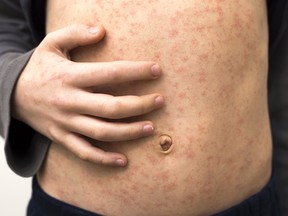
Many children with measles develop inanition, the medical term for a state of exhaustion from lack of food and water.
Children don’t want to eat or drink, said Dr. Brian Ward. “They’re moribund. They just lie there. You can put a needle into their arm to insert an IV and they don’t move.”
Measles cases are rising because vaccination rates are falling, and vaccination rates are down for different reasons, including growing anti-vaccine sentiment and the lingering legacy of a fraudulent, discredited study that falsely implicated the combined measles, mumps and rubella (MMR) vaccines with autism.
Outbreaks of vaccine-preventable diseases that public health had hoped to eradicate point to a larger crisis in distrust in science, Deonandan and others said, a trust gap that widened during COVID-19. Public confidence in scientists is high but has fallen somewhat in recent years: The proportion of Canadians that say they have “a lot” or “some confidence” in scientists declined by nine percentage points between 2021 and 2023, down from 84 to 75 per cent, according to a Confidence in Leaders report by Environics Institute and partners.
“We don’t want to go back to the bad pre-vaccine days when measles killed hundreds of mostly kids every year,” Deonandan said on X, formerly known as Twitter.
But “slick, well-produced” disinformation videos posted online can reach millions of viewers within an hour, he said in an interview.
“We have this well-funded, well organized disinformation cadre in society that pushes any anti-science message just to create distrust and chaos,” Deonandan said.
“We have the RFK (Robert F. Kennedy) juniors who are contributing to this narrative that measles isn’t even caused by a virus but by toxins…. We have people claiming there is measles in the COVID vaccine.
“These are fringe (views) but they are common enough that they’re in my inbox every day,” he said. “What doesn’t go away is this narrative that MMR vaccine causes autism.”
Boosting public confidence in science doesn’t mean assuming society “would be better off with higher levels of uncritical trust in the scientific community,” write the authors of a new report in the journal PNAS.
“Instead, researchers, scientific organizations and the scientific community writ large need to redouble their commitment to conduct, communicate, critique, and — when error is found, or misconduct detected — correct the published record in ways that both merit and earn public confidence.”
The bogus scare and “elaborate fraud” led to a major medical scandal and steep drops in vaccination rates in Canada, the United States, Britain and other parts of Europe.
“There are still lots of people who still fervently believe that Andrew Wakefield is a martyr and measles vaccines cause autism,” Ward said.
Ward has seen lots of cases of measles over his career — in Peru, in Baltimore, where 30 per cent of adults in a tri-state breakout in the late 1980s ended up in hospital, and in Quebec, where an outbreak of more than 10,000 cases in 1989 led to five deaths and five people left with permanent brain damage.
About one in 1,000 people with measles will develop post infectious encephalomyelitis, an auto-immune attack against the brain. “I think that’s far too high a risk to take when the (MMR) vaccine is really safe and really effective,” Ward said.
“Small measles outbreaks (in Canada) would not be surprising given that many routine vaccinations were missed during the pandemic,” David Earn, a mathematical epidemiologist at McMaster University said in an email.
However, bigger outbreaks involving sustained exponential growth of cases “could occur only if a sufficiently large proportion of the population is susceptible.” Measles has a basic reproduction number of 12 to 18, meaning each infected person can go on to infect 12 to 18 others in a totally susceptible population, dwarfing the worst known COVID variant to date.
Earn didn’t have data needed to estimate the probability Canada might see exponential growth in measles cases. “However, we don’t need exponential growth in order to be concerned,” he said.
Deonandan agreed that it’s a problem that’s “eminently solvable. Get everybody up to date on their vaccines,” he said. In Ontario, immunization coverage for measles among seven-year-olds dropped to 52.5 per cent in the 2021-22 school year, down from 85 per cent in 2019-2020.
Spring break travel is one concern, but “we’re already seeing community transmission,” Deonandan said. Ontario and Quebec have reported cases in people with an unknown source of exposure, meaning no history of travel and no link to a confirmed case. “So, clearly they got it somewhere — here,” Deonandan said.
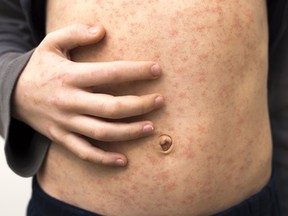
Signs of measles include fever, a characteristic red, blotchy rash starting on the face and spreading head to toe, cough, runny nose and conjunctivitis, or pink eye.
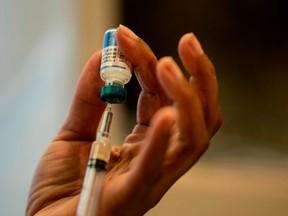
Two doses of the MMR vaccine are routinely given in Ontario and many other provinces starting with the first dose at 12 months and the second dose at four to six years of age. Quebec administers the second dose at 18 months.