


Exchange-traded fund providers have flooded the market with all sorts of novel assets and strategies: single-stock ETFs, leveraged and inverse ETFs, and even spot bitcoin ETFs can be accessed through your brokerage account with the click of a mouse.
You don’t need any of it. Basic stocks and bonds are still the workhorses of real long-term investments, and access to them through tax-efficient ETFs has never been easier or cheaper.
Combining them in the right proportions can be another sticking point. Complex mathematical models that solve for an “optimal” portfolio look like one remedy. But they can create a false sense of security because the future is so difficult to predict with any degree of accuracy.
These complex tools still provide some insight. They demonstrate some simple and timeless principles that every investor should understand. Portfolio construction ultimately rests on a few basic ideas that have withstood the test of time. Investors need to incur enough risk to achieve a rate of return that will allow them to meet their goals. And they have two asset classes to help dial in the right amount of risk and return: high-risk stocks and low-risk bonds.
Smart People
Portfolio construction is ultimately about combining different assets to achieve a desired rate of return, level of risk, or both. In its ideal form, it tries to minimize the amount of risk necessary to achieve a desired rate of return or maximize the amount of return for a given level of risk.
Diversification plays a big role in achieving that objective. Diversifying a portfolio means holding multiple assets that perform in unrelated ways so that one won’t wipe out the entire portfolio when it goes through a rough patch. The trick lies in figuring out how much of each asset is necessary to realize the greatest benefit.
Harry Markowitz, the late Nobel Prize-winning economist, is credited with formalizing the mathematics behind portfolio construction. His model, still used by many financial professionals, calculates the precise weighting of stocks and bonds necessary to achieve an ideal portfolio—one that maximizes the rate of return for a given level of risk.
The math behind Markowitz’s framework is complicated—too complicated for most to comprehend. But it’s built on some simple concepts that can help any investor make better long-term investment decisions.
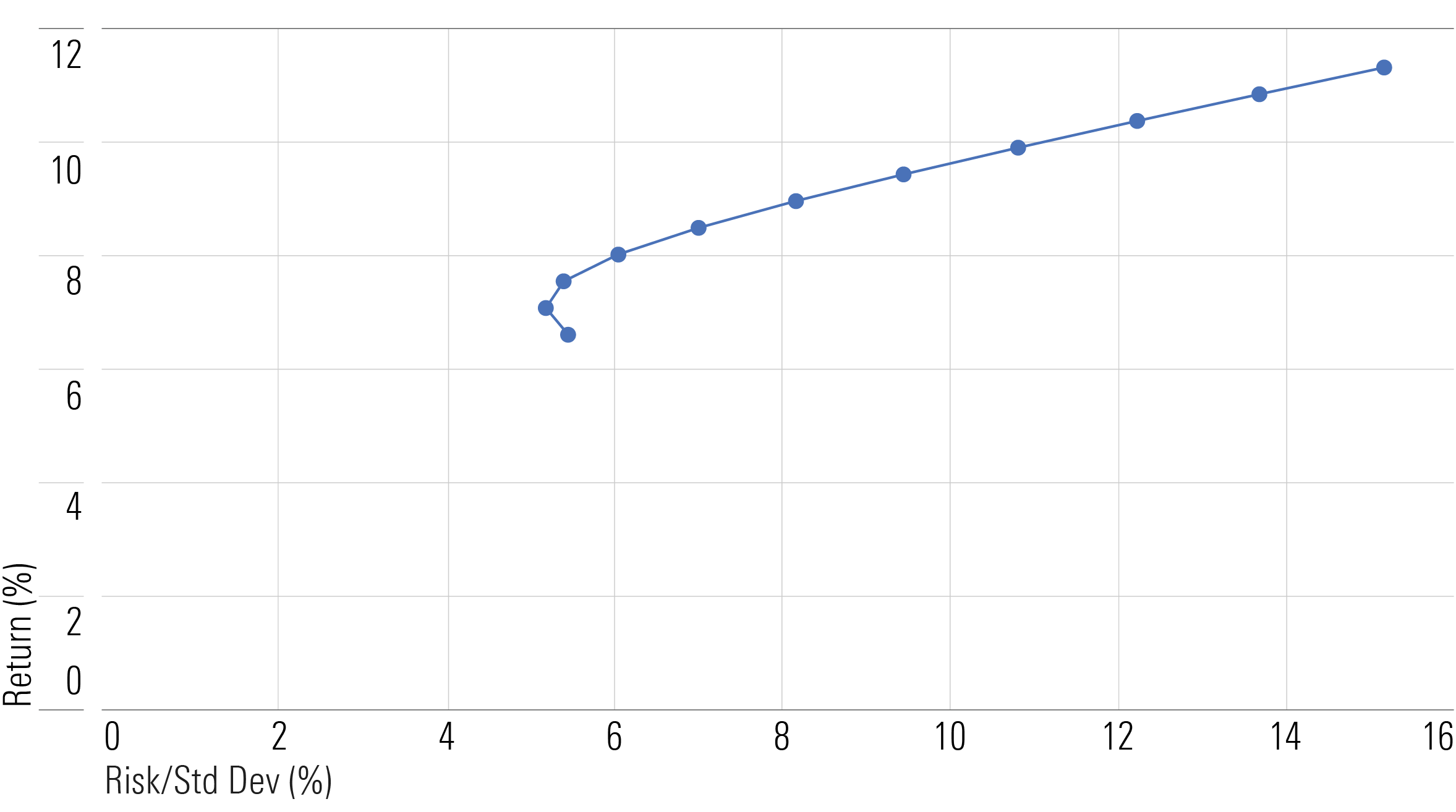
Exhibit 1 illustrates the output of Markowitz’s model, a chart commonly referred to as an “efficient frontier.” The plot shows various mixes of US stocks and bonds that produced the highest level of return (the vertical axis) for a given amount of risk (the horizontal axis). The point at the left end of the chart represents a low-risk portfolio of 100% investment-grade US bonds (proxied by the Bloomberg US Aggregate Bond Index), while the high-risk portfolio at the right end held only US stocks (proxied by the S&P 500). The points in between represent various mixes of those two assets.
There’s an easy conclusion to draw without reading too much into the numbers. Higher rates of return require taking on more risk. That means owning more stocks and fewer bonds. And there’s some nuance at the extreme ends of the chart. The least risky portfolio wasn’t the one fully allocated to bonds. It had a small investment in stocks, so the most risk-averse investor can further cut back on risk by owning some riskier equities. At the other end of the chart, the most aggressive investor can make a meaningful reduction in risk with only a modest hit to their long-term total return.