



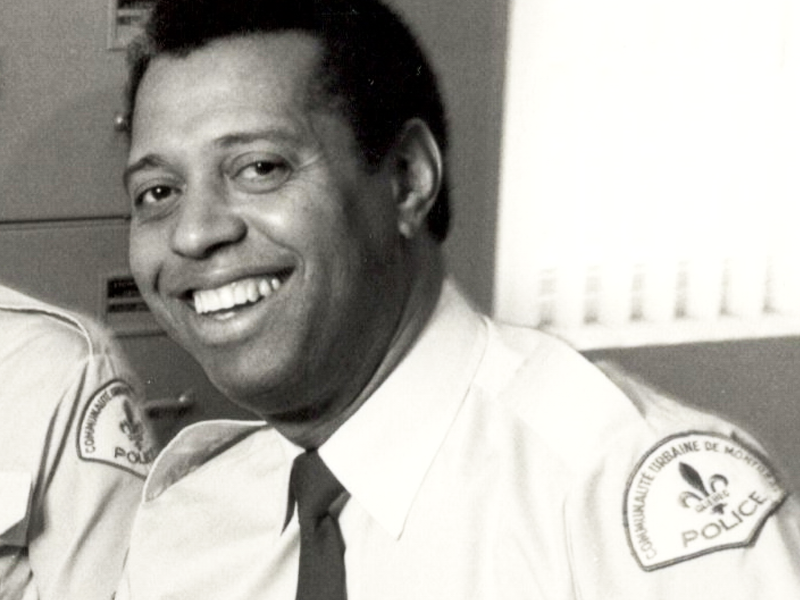
As we celebrate Black History Month 2025, it’s important to reflect on the individuals who have paved the way for change and progress within Black communities across Canada. This year, we honour the life and legacy of Édouard “Eddie” Anglade, the first Black police officer in Montreal, whose perseverance, leadership, and trailblazing career have left an indelible mark on law enforcement and the city of Montreal.
Édouard Anglade’s journey to becoming the first Black officer in the Service de police de la Ville de Montréal (SPVM) began in 1974 when he broke through racial barriers to join a force that, at the time, was predominantly white. As a Haitian immigrant, Anglade arrived in Canada with dreams of making a difference, not only for himself but for the wider Black community. Little did he know that his entry into the police force would lay the foundation for the greater inclusion of Black officers and minorities in Montreal’s law enforcement.
In the early days of his career, Anglade was not just the first but the only Black officer in the entire city. The challenges he faced went beyond the rigours of policing. He had to confront racial biases, stereotypes, and the loneliness of being one of the few Black individuals in a predominantly white institution. Despite these challenges, Anglade demonstrated remarkable professionalism, compassion, and an unwavering commitment to justice, earning the respect of both his colleagues and the community.
Throughout his 30-year career, Édouard Anglade rose through the ranks to become the highest-ranking Black officer in Montreal, overseeing the operations of a police force that grew to include more than 130 Black officers. His influence and leadership helped foster a more diverse and inclusive environment within the SPVM. Anglade’s efforts weren’t just about protecting the streets; they were also about paving the way for future generations of Black officers.
Anglade’s story is one of resilience and success in the face of adversity. His ability to navigate the complex world of policing as a racial minority was a testament to his strength of character. In interviews with those who knew him, Anglade is often described as someone who never lost sight of his roots, even as he climbed the ranks within the police force.
“When I first started, Eddie was already well known,” says Pierre Richard, a current Black officer with the SPVM. “He was an inspiration to me and many others. He showed us that it’s possible to succeed, even in an environment that historically wasn’t built for people like us.”
One of the remarkable aspects of Anglade’s career was his ability to use his position of authority to advocate for change from within the police force. At a time when racial profiling and discrimination against Black communities were widespread in Montreal, Anglade worked tirelessly to bridge the gap between law enforcement and the communities they served. His approach to policing was centred on building trust and fostering understanding.
Anglade’s autobiography, Nom de code: Mao, provides a vivid account of his life as a Black officer in Montreal. In it, he reflects on the racism he encountered both within the police force and in the broader society. He recounts incidents of racial profiling that he witnessed firsthand and shares stories of how he used his position to address these issues from within.
“I knew that my presence was significant, not just for me but for all the young Black people in the city who didn’t believe they had a place in law enforcement,” Anglade wrote in his book. “It was never easy, but I understood that I had a responsibility to keep pushing for change, to show that we belong here, too.”
Anglade’s perseverance in the face of systemic racism helped change the course of policing in Montreal. His legacy is not only one of personal accomplishment but also of a lasting impact on the police force’s relationship with the city’s diverse populations. Over the years, Montreal has seen a gradual increase in the representation of Black and minority officers, a trend that began with Anglade’s pioneering efforts.
For many, Anglade’s story serves as a reminder of the importance of representation in positions of power and authority. His ability to lead, influence, and mentor others has had a ripple effect on Montreal’s Black community and beyond.
“Seeing Eddie in uniform, leading a team, and standing tall in the face of racism—it meant everything to us,” says Yvonne Lamour, a community leader in Montreal’s Black community. “He wasn’t just a police officer; he was a symbol of what we could achieve.”
As we honour Édouard Anglade during Black History Month 2025, we recognize the vital role that individuals like him to play in the ongoing fight for racial equity and justice. His journey from a Haitian immigrant to a high-ranking officer in Montreal’s police force is a powerful example of what can be achieved when barriers are broken, and opportunities are seized.
Black History Month serves as an opportunity not only to celebrate the achievements of Black Canadians but also to reflect on the systemic challenges that remain. Anglade’s story highlights both the progress that has been made and the work that still needs to be done to ensure that law enforcement and other institutions are fully inclusive and representative of the communities they serve.
While Anglade’s legacy is a source of pride, it also serves as a reminder that the fight for equality is far from over. Black Canadians continue to face challenges in many areas, including law enforcement, education, employment, and access to resources. The progress that Anglade helped bring about within the SPVM is part of a larger movement toward dismantling systemic racism in Canada, but there is still much work to be done.
As we look to the future, it’s important to continue advocating for diversity, equity, and inclusion in all sectors of society. Anglade’s story reminds us that representation matters and that the contributions of Black Canadians are essential to building a more just and equitable country.
Édouard “Eddie” Anglade’s legacy as Montreal’s first Black police officer is one of courage, resilience, and determination. As we celebrate Black History Month 2025, we honour his contributions to law enforcement and his role in breaking down racial barriers. Anglade’s story is a testament to the power of perseverance and the importance of representation in creating systemic change.
His autobiography, Nom de code: Mao, continues to inspire future generations of Black officers and community leaders, reminding us all of the impact that one individual can have in the fight for justice and equality. As we reflect on his life and career, we are reminded of the work that remains to be done to ensure that all Canadians, regardless of race or background, have the opportunity to succeed and thrive.