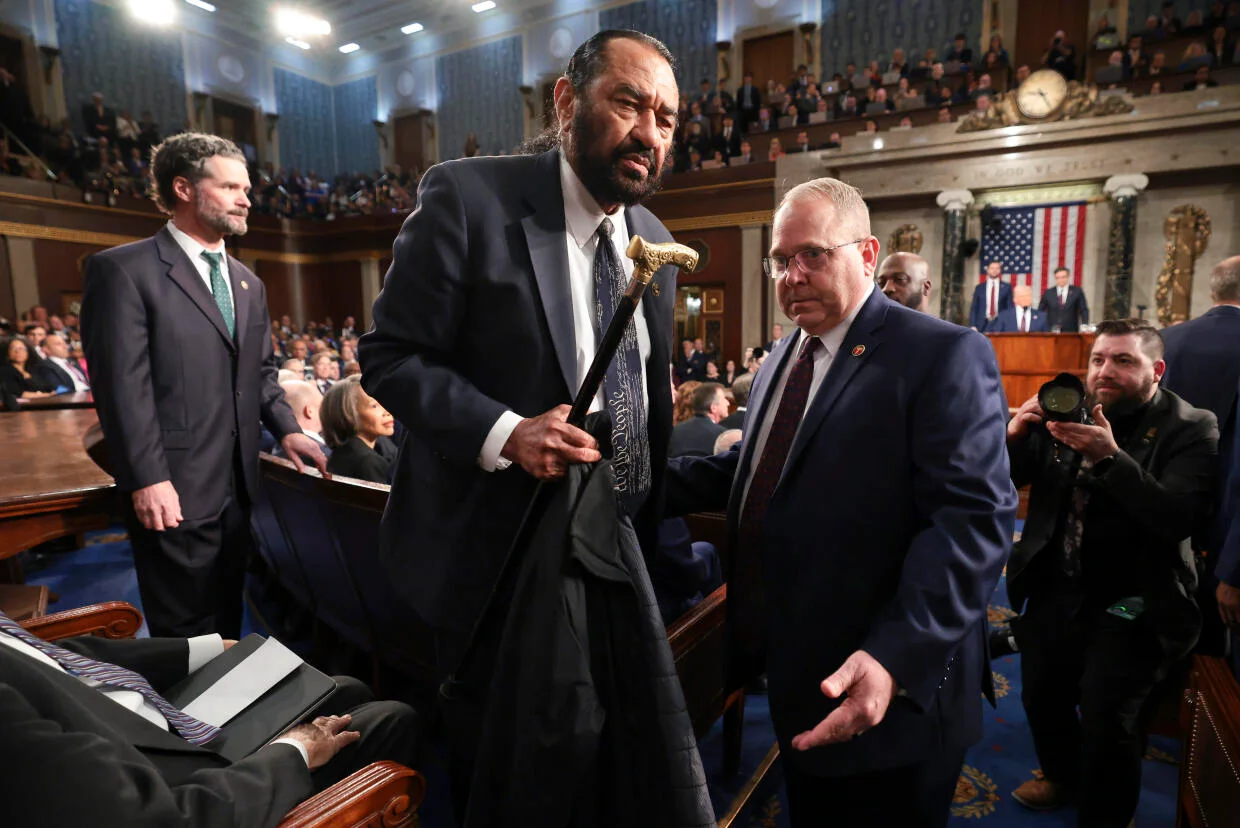
In a dramatic turn of events, Representative Al Green (D-TX) was removed from the U.S. House chamber for repeatedly disrupting a speech delivered by President Donald Trump. The incident, which took place as Trump addressed Congress, has set off a firestorm of political debate in the United States. Yet the reverberations of this confrontation have also been felt north of the border, where Black Canadians are closely following the story, seeing parallels in their own struggles for representation and equity.
On Tuesday night, as Trump began his speech to Congress, Rep. Al Green stood up and loudly interjected, accusing Trump of using divisive language and ignoring critical social issues, including the fate of programs like Medicaid.
Eyewitnesses report that Green repeated claims that Trump had “no mandate” to slash social programs. House sergeant-at-arms then escorted Green out of the chamber for his “numerous interruptions.”
Rep. Daniel Newhouse (R-WA) wasted no time. The following day, he introduced a formal resolution to censure Green, citing the “beyond the pale” nature of his repeated disruptions and emphasizing the House’s longstanding decorum rules:
“We have to uphold the expectations of decorum here, or else, what are we? We have nothing other than just a club that everybody comes and yells at each other,” said Newhouse, adding, “This was beyond the pale. It went on and on, disrupting the entire evening.”
By Wednesday, House Democrats had failed to block the resolution from advancing, setting the stage for a high-stakes vote on whether to formally condemn Al Green’s actions.
Why This Matters to Black Canadians
While the immediate political drama is unfolding in Washington, D.C., the story has taken on a broader significance for Black Canadians, who have long confronted systemic racism in their own political and social institutions.
“Black Canadians are watching because we, too, know what it’s like to be told to ‘stay in our place’ when we speak truth to power,” says Karen Flynn, a Black Canadian studies professor. “Al Green’s disruption reminds us that sometimes you must be willing to break the rules of decorum to call out injustices no one wants to address.”
A Shared Legacy of Protest
Historically, Black Canadians have been forced to use disruptive tactics to draw attention to inequality—whether it’s the story of Africville in Nova Scotia, where Black residents resisted forced displacement, or demonstrations in Toronto against police carding policies.
“Al Green’s act of standing up and shouting is reminiscent of moments in our own history where the protest had to be loud to be heard,” notes El Jones, a Halifax-based poet and community activist. “We see parallels in how he was removed from the chamber—just as Black communities here have often been removed from decision-making spaces.”
Political Reactions and Internal GOP Tensions
The fallout within the Republican Party has also caught the attention of Canadian observers. Rep. Newhouse, often described as a GOP centrist who once voted to impeach Trump, introduced the censure resolution—a move that angered more conservative factions who had been drafting their own disciplinary measures against Green.
Some conservatives privately accused Newhouse of using the resolution to “shore up his right flank” and discourage primary challengers. Yet he denied these claims:
“This is about the House of Representatives, Congress, and respecting the rules of decorum that we have,” Newhouse told reporters. “It could be any president, any member. This is bigger than any particular relationship.”
Black Canadian commentators point out that these internal GOP struggles mirror tensions in Canadian politics, where centrist and far-right elements often clash over issues like immigration and social policy.
“Newhouse’s motivations may be strategic, but it underscores how moderate voices within conservative circles can sometimes lean rightward to keep their seats,” says Andray Domise, a Toronto-based political commentator. “We see similar dynamics in Canada’s Conservative Party, where members try to balance mainstream appeal with a vocal right-wing base.”
The Censure Vote and Its Implications
Set to come up for a vote on Thursday, the censure resolution places House Democrats in a difficult position. While many disagree with Green’s tactics, they also recognize the moral impetus behind his protest—particularly those worried about Medicaid cuts.
“What I did was from my heart,” Green told reporters, expressing no resentment towards those bringing the resolution. “People are suffering, and I was talking about Medicaid.”
For Black Canadians observing this from afar, it raises questions about how political protest is policed and whether decorum rules can stifle urgent conversations about race and social services.
“In Canada, we have our own parliamentary rules,” says Jagmeet Singh, leader of the New Democratic Party. “We don’t often see disruptions on the floor, but we do see tension between following procedure and addressing systemic inequalities. Green’s case is a reminder that sometimes the status quo needs to be shaken up.”
Black Canadian Perspectives: ‘Two Different Systems, One Shared Struggle’
Despite the distinct political systems between Canada and the U.S., many Black Canadians note that the issues fueling Green’s disruption—health care, social welfare, racial inequities—have parallels in their own communities.
“Our system may differ, but the prejudice and disregard for marginalized voices is the same,” says Desmond Cole. “When Rep. Green stands up and disrupts a speech, we see a reflection of the frustration we feel when government officials fail to address anti-Black racism or fail to protect our healthcare.”
Impact on Grassroots Advocacy
Several Black-led advocacy groups in Canadian cities say they plan to organize online forums and in-person discussions to explore the themes raised by Al Green’s protest—chief among them, how to effectively challenge policies that disproportionately harm racialized people.
“We’re looking at holding a webinar on direct action in political spaces,” shares Sandy Hudson, co-founder of Black Lives Matter—Toronto. “Green’s example could spark conversations about how disruption can be both a moral and political tool.”
Criticisms of Green’s Approach
Not everyone in Canada’s Black community supports Green’s methods. Some argue that loud interruptions and direct confrontations might escalate partisanship and overshadow the issues being raised.
“I understand the passion, but I question the effectiveness,” says Dionne Brand, a celebrated Canadian poet and essayist. “Sometimes, the story becomes about the disruption itself, not about Medicaid or racial inequality. We need to be strategic.”
Additionally, some fear that the dispute in Washington will overshadow pressing Canadian issues. “Yes, we stand in solidarity with Green, but we also can’t let U.S. drama distract from our own battles, like police accountability or the crisis in Indigenous healthcare,” says Fo Niemi, Executive Director of the Centre for Research-Action on Race Relations (CRARR) in Montreal.
Potential Long-Term Effects on U.S.-Canada Relations
The incident has not caused any diplomatic rift, but it does add to the ongoing fascination Canadians have with U.S. politics. Many wonder whether a high-profile censure of Al Green might embolden similar stances—or crackdowns—on disruptive tactics in Canada’s own House of Commons.
“We might see a renewed debate on what constitutes acceptable protest in parliamentary settings,” observes Nelson Wiseman, Professor Emeritus of political science at the University of Toronto. “If the U.S. sets a precedent in heavily penalizing an outspoken lawmaker, Canadian MPs who are more inclined to protest might think twice.”
Conclusion: A Single Disruption, A Wider Ripple
What began as a tense moment in the U.S. House—one man standing up to challenge a speech by a polarizing former president—has grown into a larger conversation about decorum, moral obligation, and systemic injustices. Black Canadians, watching from afar, see their own challenges reflected in this dramatic event.
“Al Green’s disruption speaks to a universal truth: sometimes the established order needs to be confronted head-on,” says El Jones, Halifax-based poet and community educator. “For Black folks on both sides of the border, this incident underscores that the fight for equity often requires us to break the mold—whatever the personal or political cost.”
Whether or not Al Green ultimately faces censure, his actions have sparked a debate that transcends national boundaries, reminding Canadians and Americans alike that democracy isn’t always polite, and real change seldom happens without stepping outside the constraints of decorum.
Follow Canada News Media
Get the day's top Canadian stories and our two daily 60-second news videos wherever you scroll.