


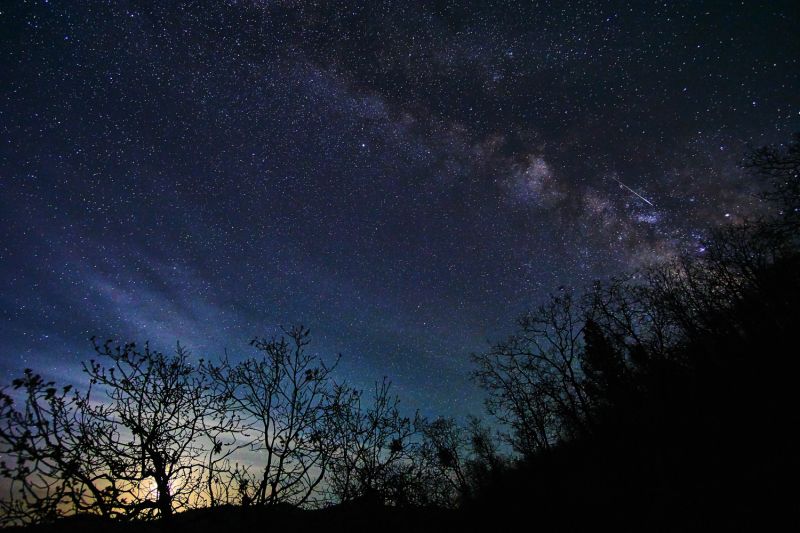

Between 10 and 15 meteors an hour will streak across the sky, with the best time to watch coming between midnight and dawn.
<p class="canvas-atom canvas-text Mb(1.0em) Mb(0)–sm Mt(0.8em)–sm" type="text" content="The Met Office forecasts a clear night for most of the UK, so the Lyrids should be clearly visible from people’s gardens, even with the naked eye. ” data-reactid=”25″>The Met Office forecasts a clear night for most of the UK, so the Lyrids should be clearly visible from people’s gardens, even with the naked eye.
<p class="canvas-atom canvas-text Mb(1.0em) Mb(0)–sm Mt(0.8em)–sm" type="text" content="Read more: Lyrid meteor shower captured in time-lapse” data-reactid=”26″>Read more: Lyrid meteor shower captured in time-lapse
The Met Office says, ‘Known for their fast, bright meteors, the Lyrids are one of the oldest known meteor showers.’
‘The Lyrid meteor shower is named as such because it appears to radiate from the constellation Lyra, though it is better to view the Lyrids away from this constellation so they appear longer and more impressive.’
The annual display is caused by the Earth passing through a cloud of debris from a comet called C/186 Thatcher.


Chinese astronomers wrote about the Lyrids in 687BC, writing ‘at midnight, stars fell like rain’.
There’s no need to take binoculars or a telescope with you, just find a suitably dark area and hope there’s not too much cloud.
<p class="canvas-atom canvas-text Mb(1.0em) Mb(0)–sm Mt(0.8em)–sm" type="text" content="Read more: Scientists warn dangerous space rocks could be hiding in meteor shower” data-reactid=”43″>Read more: Scientists warn dangerous space rocks could be hiding in meteor shower
You don’t need to go anywhere special to see it from the UK – just go outside and give your eyes half an hour to get used to the dark.
To see it look for the Big Dipper or The Plough (they’re the same thing, but actually they’re back end of the Great Bear constellation).
<p class="canvas-atom canvas-text Mb(1.0em) Mb(0)–sm Mt(0.8em)–sm" type="text" content="Read more: Huge meteor explodes in the sky above Derby” data-reactid=”46″>Read more: Huge meteor explodes in the sky above Derby
Astronomy site Earthsky says, “The Lyrids are known for uncommon surges that can sometimes bring the rate up to 100 per hour.
“Those rare outbursts are not easy to predict, but they’re one of the reasons the tantalising Lyrids are worth checking out.”
In the book ‘Observe Meteors’, authors David Levy and Stephen Edberg write, “… of the annual meteor showers, this is the first one that really commands attention, one for which you can organise a shower observing party with significant chance of success.”