


Next week’s SpaceX launch received a key go-ahead as astronauts get ready to take off from U.S. soil for the first time since NASA retired the space shuttle in 2011.
On Friday, NASA concluded a flight readiness review and cleared SpaceX, after some last-minute turmoil hit the space agency’s upper ranks.
“There are no significant open issues, I am happy to report,” said Steve Jurczyk, associate NASA administrator, who chaired the flight review.
A static fire of the SpaceX Falcon 9 rocket went smoothly Friday afternoon, as did a dress rehearsal with the astronauts on Saturday. A final launch readiness review is set for Monday.
The SpaceX launch will take place Wednesday on May 27 at 4:33 p.m. ET from NASA’s Kennedy Space Center in Florida. But the Space Force’s 45th Weather Squadron said there is only a 40% chance of good conditions for the launch window.
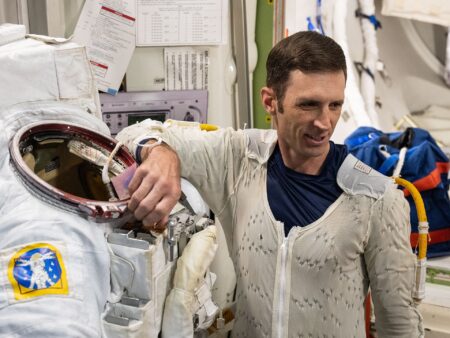
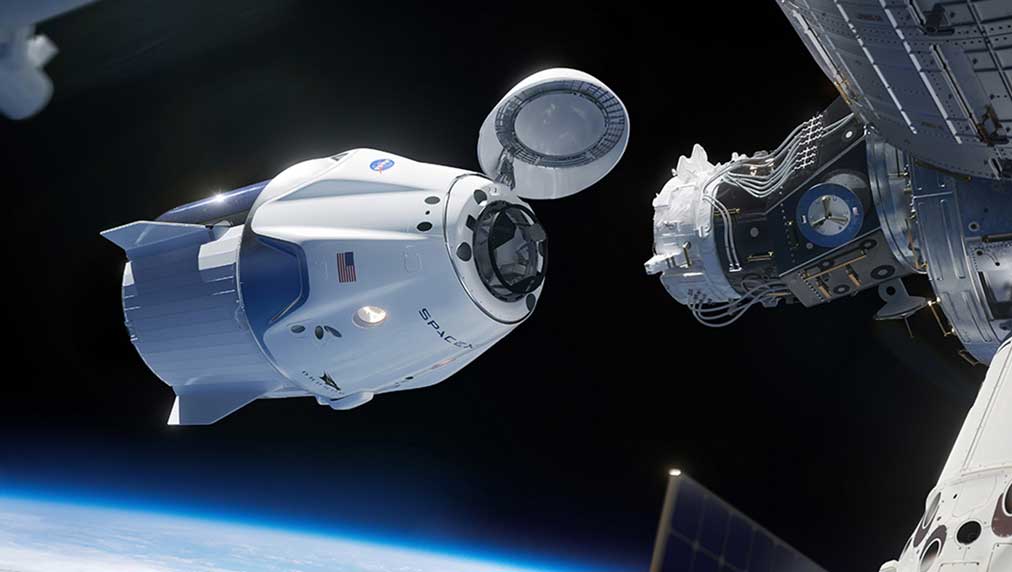
The Crew Dragon capsule will carry astronauts Bob Behnken and Doug Hurley to the space station, docking 19 hours after launch.
But even before the abrupt resignation of NASA’s human spaceflight chief Monday, the stakes were already high for the SpaceX launch.
A successful mission would validate NASA’s goal of relying on private-sector companies like SpaceX and perhaps Boeing (BA) to provide transport to and from the International Space Station, freeing it to focus on deep-space exploration.
It also would open the door for SpaceX to leap ahead in the growing space tourism sector, which includes Virgin Galactic (SPCE) and Amazon (AMZN) founder Jeff Bezos’ Blue Origin. While SpaceX has been putting satellites into orbit and delivering supplies to the space station, it has never taken humans into space.

Elon Musk, CEO of SpaceX and Tesla (TSLA), has added his own flair to the SpaceX launch. Behnken and Hurley will ride a Tesla Model X to the Falcon 9 rocket that will take them to the space station.
While in space, the astronauts’ main objectives will be to check the capsule’s systems. But beyond that, things are less certain. NASA has said the mission could run anywhere from one month to the end of September, and a decision will come when the astronauts are on orbit. The Crew Dragon is capable of staying on orbit for 210 days.
Crewed SpaceX Launch A Long Time Coming
In 2014, NASA awarded Boeing a $4.2 billion contract and SpaceX a $2.6 billion contract to develop space taxis for missions to the space station and end its reliance on Russia’s Soyuz capsules.
After nine years, that day may finally come. If next week’s SpaceX launch goes as planned, the first operational Commercial Crew mission will come later this year, taking U.S. astronauts Michael Hopkins, Victor Glover and Shannon Walker as well as Japan’s Soichi Noguchi to the space station for a six-month mission.

Still, NASA is hedging its bets. Earlier this month, it reportedly paid over $90 million for an extra seat on a Soyuz capsule in mid-October in case there is still a delay with the SpaceX launch.
But NASA isn’t SpaceX’s only Crew Dragon customer as Axiom Space, which builds habitats and modules for the space station, signed a deal with SpaceX to fly three paying customers to the space station in late 2021.
SpaceX is also working with Space Adventures to fly four space tourists around the Earth’s orbit. No time frame has been given for the tourist flight.
NASA Stuns Just Before SpaceX Launch
But just over a week from the SpaceX launch, NASA shocked the space community when it announced Tuesday that Doug Loverro, associate administrator for human exploration and operations, had resigned effective Monday.

His tenure was just six months. Loverro took over when predecessor Bill Gerstenmaier left, reportedly over slowness on the Trump administration’s ambitious goal to return to the moon by 2024.
In a resignation letter, Loverro indicated his departure wasn’t related to the Commercial Crew program but to the Artemis moon program.
Weeks earlier, NASA awarded contracts to SpaceX, Leidos‘ (LDOS) Dynetics unit and a Blue Origin-led team, which also includes Lockheed Martin (LMT) and Northrop Grumman (NOC), to develop lunar landers for Artemis.
On Friday, associate NASA administrator Jurczyk was asked if Loverro’s sudden departure meant more work to prepare as he had to take over the role of leading the flight readiness review.
“Actually, I’ve been conducting agency level reviews of the Commercial Crew Program for the last two years, as the associate administrator,” he said. “So those reviews prepared me really well to step in and share the flight Readiness Review.”
Crew Dragon, Starliner Delays
The SpaceX launch marks the company’s second test flight for NASA’s Commercial Crew program, following an uncrewed demonstration to the space station last year.
But delays have plagued the program for both Boeing and SpaceX as NASA implemented strict protocols for testing and other requirements for human-rated capsules.

Officials were worried earlier about SpaceX’s plans to fuel rockets while astronauts are on board, especially after a Falcon 9 exploded on the launchpad in 2016 while being fueled for a test fire. Last year, an empty Crew Dragon exploded while its thrusters were tested. SpaceX has also run into snags developing the parachutes for the capsule. NASA also questioned the safety culture at the company after Musk smoked marijuana on a popular podcast.
On Friday, NASA’s Commercial Crew manager, Kathy Lueders, was asked about last year’s capsule explosion and her thoughts on the upcoming SpaceX launch. “Don’t ever underestimate the value of a failure,” she replied.
Boeing has faced its own mishaps, and the aerospace giant has yet to successfully complete an uncrewed test of its Starliner capsule. In December, the Starliner set off on its uncrewed test, but it failed to reach the space station as planned because a software error prevented it from getting into the proper orbit.
An internal timer on the capsule was off by 11 hours. That caused the Boeing Starliner to believe that it was further into the mission than it actually was. Another software issue was found with the thrusters that could have lead to a catastrophic spacecraft failure.
As Boeing works through the coding issues, it plans to redo the uncrewed test and took a $410 million pretax charge in the fourth quarter for related costs.
Follow Gillian Rich on Twitter @IBD_GRich for space news and more.
Source: – Investor’s Business Daily
Edited By Harry Miller
Follow Canada News Media
Get the day's top Canadian stories and our two daily 60-second news videos wherever you scroll.
X Threads Facebook Instagram LinkedIn TikTok YouTube Pinterest Reddit Substack Flipboard Newsletter RSS