





Donnie Snook will have a Parole Board of Canada hearing in July, but journalists won’t be allowed to attend and report on the hearing.
Snook’s sentence doesn’t expire until November 2030, but the former Saint John city councillor — who sexually abused boys in both New Brunswick and Newfoundland and Labrador — became eligible for day parole in December 2018 and full parole in June 2019, according to the board.
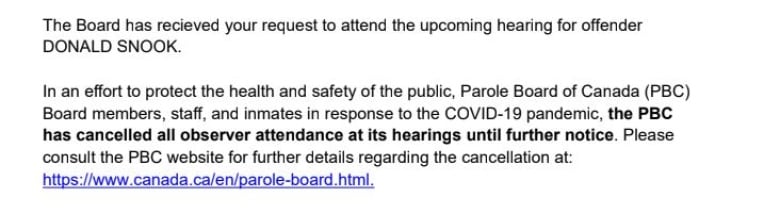
CBC News applied to observe any hearings scheduled for Snook and was notified of the July hearing by letter.
But the board sent a second letter last week that says observers aren’t allowed to attend the hearings, which are being held remotely by videoconference or teleconference.
“In an effort to protect the health and safety of the public, Parole Board of Canada (PBC) Board members, staff, and inmates in response to the COVID-19 pandemic, the PBC has cancelled all observer attendance at its hearings until further notice,” says the letter, signed by regional communications officer Heather Byron.
No one from the parole board was made available for an interview about why observers aren’t allowed to attend hearings.
Victims can participate by phone
The board has made “technological and procedural enhancements” so victims can participate in hearings by phone. They can listen to the hearing and present statements for the board, Parole Board of Canada spokesperson Lisa Saether wrote in an emailed statement to CBC News.
But those accommodations are limited to victims, their support persons and offender assistants.
“PBC conditional release hearings include the exchange of personal and other information that is of a sensitive and confidential nature,” Saether wrote.
“Although observers may be permitted to attend PBC hearings, the information shared during a hearing is not considered to be in the public domain, and the PBC therefore has a duty to ensure this information is protected under the Privacy Act.”

She said the technology used to hold hearings remotely must be “secure and meet Government of Canada requirements.”
The idea that the information isn’t public is “outrageous,” according to Iain MacKinnon, the president of the Canadian Media Lawyers Association.
He said it’s almost unheard of to have a publication ban on any part of the hearing, as far as he knows.
“The fact that they take the view that this is not public, what happens at a hearing, is really problematic,” said MacKinnon, who is based in Toronto.
Secrecy erodes public confidence, media lawyer says
Refusing to provide even basic details, such as the date of a hearing, undermines the open court principle that the Supreme Court has repeatedly said is crucial to a functioning democracy, MacKinnon said.
“My concern is that it erodes the public confidence and the overall transparency of the system,” he said.

Earlier this spring, MacKinnon wrote to the board to question why journalists aren’t allowed to observe hearings, after several reporters were denied permission to attend a high-profile hearing in Ontario. He said the parole board wrote back to say it was temporary.
But several months have gone by without journalists being able to attend the hearings.
In her response to CBC News, Saether also described the ban on observers as “a temporary measure,” but her statement didn’t specify how long ir could last.
“The PBC is currently encountering a variety of technical issues in conducting its hearings remotely, which have led to, among other things, delays and interruptions in its hearings,” Saether said.
“The PBC has therefore determined that it does not have the capacity to facilitate the attendance of additional observers at its hearings at this time, which would further compound these issues.”
‘A lack of transparency’
In the meantime, journalists have to wait for a written decision to be issued in order to report on the hearing.
But without access to the hearing, the public will have little understanding of how the decision was made, MacKinnon said.
“There’ll be a lack of faith in the justice system generally on top of a lack of transparency,” he said.
“But it undermines the public’s confidence in the operation of the justice system.”
Snook admitted to abusing 17 young male victims over a 12-year period in Saint John, where he ran a popular lunch program for underprivileged children.
He also admitted to three child exploitation charges involving a boy under the age of 14 in his home province of Newfoundland and Labrador.
Snook has previously been granted permission to take several escorted temporary absences from prison. They included a trip to St. John’s in 2019 for his father’s funeral and outings in the Abbotsford, B.C. area, the region where Snook is believed to be serving his sentence, for “personal development” reasons.

